

Bacterial vaginosis, commonly called BV, is a condition caused by an imbalance in the bacteria that normally live in the vagina. Protective bacteria decrease while certain other bacteria grow too much. BV is not a yeast infection, and it is not usually considered a traditional sexually transmitted infection.
BV may cause thin vaginal discharge and a strong fish-like odor, but many people have no symptoms. Antibiotics can treat BV, although it may return after treatment.
About Bacterial Vaginosis – Centers for Disease Control and Prevention
https://www.cdc.gov/bacterial-vaginosis/about/
Provides information about BV symptoms, risk factors, treatment, and prevention.
Bacterial Vaginosis – Office on Women’s Health
https://womenshealth.gov/a-z-topics/bacterial-vaginosis
Provides patient-friendly information about BV, testing, treatment, pregnancy, and recurrence.
BV is the most common vaginal condition among people of reproductive age. It can occur at any age and may affect people who have never had vaginal sex, although it is more common among those who are sexually active.
Many people with BV do not notice symptoms. Because BV can occur without discharge, odor, or irritation, some cases are discovered during a pelvic examination or vaginal testing.
Bacterial Vaginosis Test – NIH MedlinePlus
https://medlineplus.gov/lab-tests/bacterial-vaginosis-test/
Explains who may need BV testing, how samples are collected, and what test results mean.
Many people with BV have no symptoms.
When symptoms occur, they may include:
Severe itching, marked swelling, thick cottage-cheese-like discharge, sores, or green-yellow discharge may suggest a yeast infection, trichomoniasis, an STI, an allergic reaction, or another condition. Symptoms alone cannot always confirm BV.
A healthcare provider may diagnose BV based on your symptoms, examination, vaginal pH, and testing of vaginal discharge.
Your provider may ask about:
Because BV symptoms can resemble yeast infection, trichomoniasis, chlamydia, gonorrhea, cervicitis, or irritation, medical testing is often helpful before treatment.
Bacterial Vaginosis Test – NIH MedlinePlus
https://medlineplus.gov/lab-tests/bacterial-vaginosis-test/
Describes how BV is diagnosed using a vaginal sample and other testing methods.
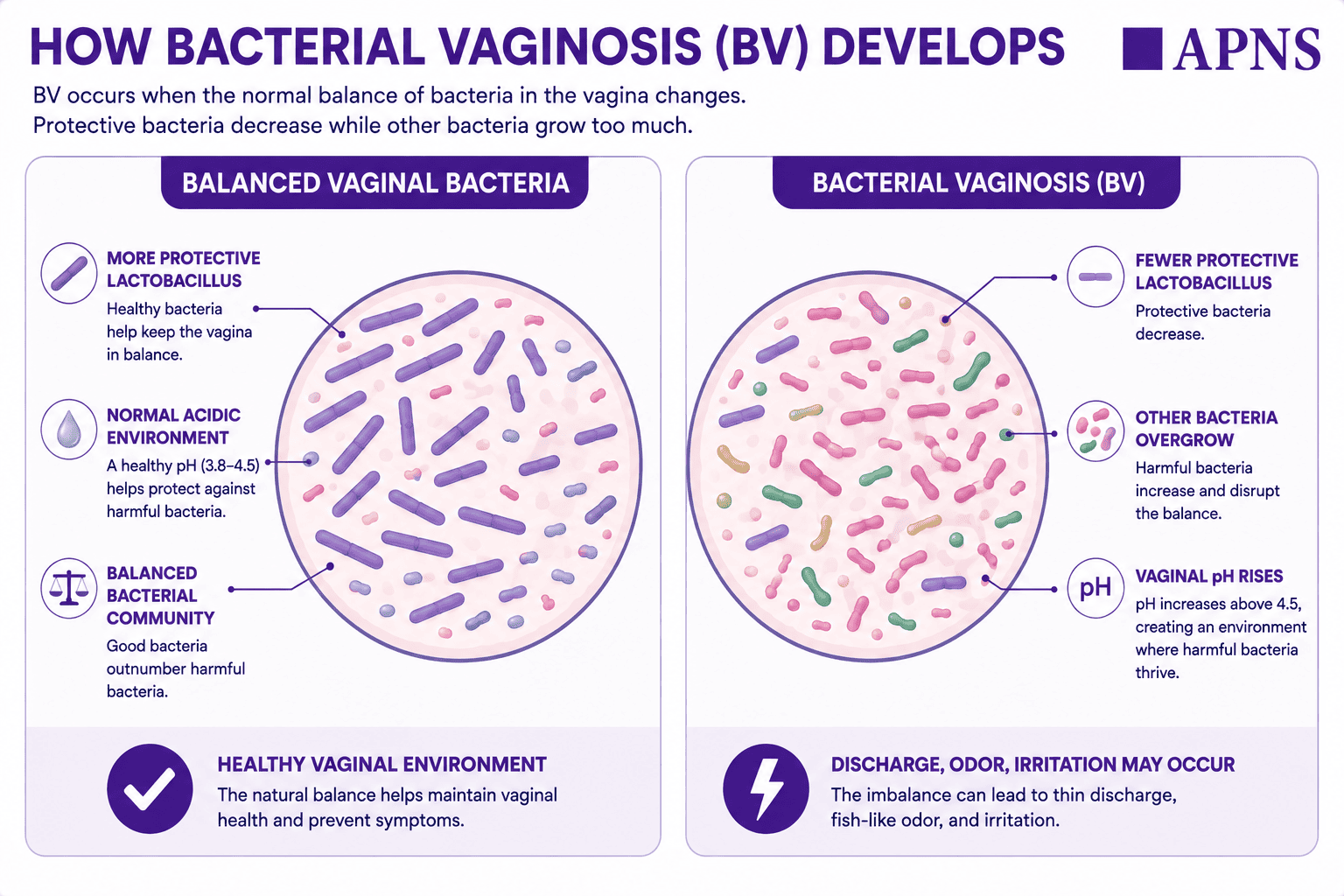
BV develops when the normal balance of vaginal bacteria changes. Protective bacteria called Lactobacillus become less common, allowing other bacteria to grow excessively.
The exact reason this imbalance develops is not always known. Factors associated with BV include:
BV can occur without sexual activity. It does not mean that someone is unclean or has been unfaithful.
Vaginitis – American College of Obstetricians and Gynecologists
https://www.acog.org/womens-health/faqs/vaginitis
Explains bacterial vaginosis and other common causes of vaginal discharge, odor, itching, and irritation.
Several factors may disturb the vaginal environment, worsen irritation, or contribute to BV returning.
These may include:
Douching removes protective bacteria and can make vaginal symptoms worse. It may also make it harder for a healthcare provider to identify the cause of abnormal discharge.
Douching – Office on Women’s Health
https://womenshealth.gov/a-z-topics/douching
Explains why douching is not recommended and how it can affect vaginal health.
BV cannot always be prevented, but certain practices may reduce the chance of developing or recurring symptoms.
Helpful prevention measures include:
About Bacterial Vaginosis – CDC
https://www.cdc.gov/bacterial-vaginosis/about/
Provides prevention guidance and explains factors associated with BV.
The following video content is provided to help you better understand this condition. These resources are intended for educational purposes and should not replace personalized medical advice from your healthcare provider.
Common laboratory tests may include:
BV is commonly diagnosed using clinical findings known as the Amsel criteria or a laboratory scoring method such as the Nugent score.
BV generally does not require imaging or invasive procedures.
Possible evaluations include:
A pelvic examination may not always be required if an accurate self-collected vaginal swab is available, depending on the symptoms, clinic, and type of testing used.
Healthcare providers usually recommend antibiotic treatment for people with BV symptoms. Treatment may relieve discharge and odor and may reduce the risk of acquiring certain sexually transmitted infections.
Treatment options may include:
Take the medication for the full prescribed period, even if symptoms improve early. BV frequently returns, and another treatment course may be needed.
Bacterial Vaginosis Treatment Guidelines – CDC
https://www.cdc.gov/std/treatment-guidelines/bv.htm
Provides detailed information about recommended antibiotic treatments and recurrent BV.
Healthy vaginal-care habits may reduce irritation and help support treatment.
Helpful changes include:
The vagina cleans itself naturally. Clear or white discharge without a strong odor may be normal and does not require internal cleansing.
Vulvovaginal Health – American College of Obstetricians and Gynecologists
https://www.acog.org/womens-health/faqs/vulvovaginal-health
Provides guidance about normal discharge, vulvar care, hygiene, irritation, and vaginal health.
Common prescription medications for BV include:
Some clindamycin vaginal products are oil-based and may weaken latex condoms or diaphragms for several days after use. Review the medication instructions and ask your pharmacist about alternative protection.
Metronidazole and clindamycin do not treat yeast infections. Antibiotic treatment can occasionally contribute to yeast symptoms, so contact your provider if thick discharge or significant itching develops after treatment.
Metronidazole Vaginal – NIH MedlinePlus
https://medlineplus.gov/druginfo/meds/a617051.html
Provides instructions, precautions, and side-effect information for vaginal metronidazole.
Clindamycin Vaginal – NIH MedlinePlus
https://medlineplus.gov/druginfo/meds/a609006.html
Provides information about vaginal clindamycin, proper use, and treatment precautions.
BV usually does not require surgery or an invasive procedure.
Office-based care may include:
People with frequent recurrences may need repeat testing to confirm that symptoms are truly caused by BV rather than yeast, trichomoniasis, dermatitis, or another condition.
Most people improve after completing antibiotic treatment. Odor and discharge may begin to improve within several days, but the full course of medication should still be completed.
BV commonly returns after treatment. Recurrence does not necessarily mean that the medication was taken incorrectly or that a partner was unfaithful. The vaginal bacterial balance may simply become disrupted again.
Repeated BV may require:
ACOG updated its guidance in October 2025 to recommend considering concurrent sexual-partner treatment for some patients with recurrent symptomatic BV. The decision depends on the patient’s circumstances and should be discussed with a healthcare professional.
Helpful home-care steps include:
Do not insert vinegar, hydrogen peroxide, yogurt, garlic, herbs, essential oils, or other household treatments into the vagina. These products may cause burns, irritation, or further disruption of the vaginal environment.
Probiotics are sometimes promoted for BV, but they should not replace prescribed antibiotic treatment. Ask your healthcare provider before using vaginal or oral probiotic products.
Bacterial Vaginosis Aftercare – NIH MedlinePlus
https://medlineplus.gov/ency/patientinstructions/000687.htm
Provides home-care guidance, medication instructions, and signs that require medical follow-up.
BV is not usually classified as a traditional STI. It results from an imbalance of vaginal bacteria, and it can occur without sexual activity. However, sexual activity and partner-related bacterial exchange can affect the risk of developing or recurring BV.
BV-associated bacteria may be shared between sexual partners. BV can occur between female partners, and newer evidence suggests that partner treatment may help some patients with recurrent BV. Discuss this with your provider.
Routine partner treatment has historically not been recommended for every BV episode. Updated ACOG guidance recommends considering concurrent partner treatment in certain cases of recurrent symptomatic BV. Your healthcare provider can determine whether this applies to you.
BV often causes thin gray or white discharge and a fish-like odor. Yeast infections more commonly cause intense itching and thick, white discharge without a h4 odor. Testing may be needed because symptoms can overlap.
BV may sometimes improve without treatment, particularly when there are no symptoms. However, symptomatic BV should be evaluated because treatment can relieve symptoms and may reduce certain health risks.
Yes. Recurrence is common and does not necessarily mean that treatment failed.
BV during pregnancy has been associated with complications such as premature delivery and low birth weight. Pregnant patients with symptoms should contact their prenatal healthcare provider for evaluation and treatment.
No. Antifungal medication does not treat BV. BV requires an antibiotic when treatment is indicated.
No. BV is caused by a change in vaginal bacteria, not poor cleanliness. Excessive washing and douching may make the imbalance worse.
Antibiotics can change the body’s normal bacteria. Some antibiotics treat BV, while others may affect the vaginal environment differently. Contact your provider if new vaginal symptoms develop.

Consider asking:
BV is usually treated by a primary care or reproductive-health provider.
You may be referred to:
Vaginitis – American College of Obstetricians and Gynecologists
https://www.acog.org/womens-health/faqs/vaginitis
Provides information about bacterial vaginosis, yeast infections, trichomoniasis, diagnosis, and treatment.
Yes. BV is usually treatable with antibiotics.
However, treatment does not permanently prevent the vaginal bacterial imbalance from returning. Some people experience only one episode, while others have frequent recurrences.
Recurrent BV can often be managed with:
About Bacterial Vaginosis – CDC
https://www.cdc.gov/bacterial-vaginosis/about/
Explains that BV is treatable but may return even after successful treatment.
BV itself rarely causes a medical emergency.
Call 911 or seek emergency medical care immediately for:
Seek prompt medical evaluation for:
Pelvic pain, fever, bleeding, or vomiting may indicate pelvic inflammatory disease, cervicitis, pregnancy complications, or another condition requiring urgent evaluation.
CALL 911
APNS does not provide emergency medical services. If you believe you are experiencing a medical emergency, including (but not limited to) chest pain, difficulty breathing, stroke symptoms, severe allergic reactions, anaphylaxis, uncontrolled bleeding, seizures, loss of consciousness, or any other potentially life-threatening condition, you are instructed to call 911 immediately or go immediately to the nearest emergency department.
About Bacterial Vaginosis – Centers for Disease Control and Prevention
https://www.cdc.gov/bacterial-vaginosis/about/
Patient information about symptoms, risk factors, treatment, recurrence, and prevention.
Bacterial Vaginosis Treatment Guidelines – CDC
https://www.cdc.gov/std/treatment-guidelines/bv.htm
Detailed clinical information about diagnosis and recommended antibiotic treatments.
Bacterial Vaginosis – Office on Women’s Health
https://womenshealth.gov/a-z-topics/bacterial-vaginosis
Patient-friendly information about symptoms, complications, pregnancy, and treatment.
Bacterial Vaginosis Test – NIH MedlinePlus
https://medlineplus.gov/lab-tests/bacterial-vaginosis-test/
Explains how vaginal samples are tested for bacterial vaginosis.
Bacterial Vaginosis Aftercare – NIH MedlinePlus
https://medlineplus.gov/ency/patientinstructions/000687.htm
Provides medication and home-care guidance after diagnosis.
Vaginitis – American College of Obstetricians and Gynecologists
https://www.acog.org/womens-health/faqs/vaginitis
Explains BV and other common causes of vaginal discharge and irritation.
This guide is intended for educational purposes only and should not replace medical advice, diagnosis, testing, or treatment from your healthcare provider. Vaginal discharge, odor, itching, burning, or irritation may be caused by bacterial vaginosis, a yeast infection, trichomoniasis, another sexually transmitted infection, cervicitis, an allergic reaction, or another condition requiring different treatment. Do not use leftover antibiotics, another person’s medication, vaginal douches, or over-the-counter yeast treatment without confirming the cause of your symptoms. Contact a healthcare provider if symptoms occur during pregnancy, repeatedly return, worsen during treatment, or do not improve after treatment. Seek prompt medical care for fever, pelvic or abdominal pain, vomiting, abnormal bleeding, sores, or possible STI exposure. Call 911 immediately for difficulty breathing, facial or throat swelling, fainting, loss of consciousness, or another medical emergency.
At APNS, our providers take the time to understand your condition and your goals. We offer comprehensive telehealth visits at a fixed rate — no membership fees, no insurance required, and no unexpected charges. Whether you’re newly diagnosed or looking for a provider who actually listens, we’re here to help.