
Understanding Your Birth Control Options
There are many types of birth control, and each works a little differently. Some methods are taken daily, while others are changed weekly, monthly, every few months, or placed for longer-term pregnancy prevention. Some options use both estrogen and progestin, while others use progestin alone or do not contain hormones.
This page provides an overview of common birth control options, how they work, and what patients may want to consider when comparing methods. More detailed information is available on each individual birth control page.

Birth Control Overview
Birth control, also known as contraception, refers to a variety of methods used to prevent pregnancy. These methods work in different ways, including preventing ovulation, thickening cervical mucus to block sperm, thinning the uterine lining, or preventing sperm from fertilizing an egg. Available options include daily pills, progestin-only mini-pills, weekly patches, monthly vaginal rings, injections given every three months, intrauterine devices (IUDs) that can last for years, and emergency contraception used after unprotected intercourse.
No single method is best for everyone. The ideal contraceptive choice depends on a patient’s medical history, lifestyle, reproductive goals, tolerance for hormones, and personal preferences. Some patients prioritize convenience and long-term effectiveness, while others prefer methods that are hormone-free, easily reversible, or help manage menstrual symptoms such as heavy bleeding, cramping, acne, or premenstrual symptoms.
When used correctly, modern contraceptive methods are highly effective and safe for most individuals. Understanding the benefits, limitations, and proper use of each option can help patients make informed decisions and choose a method that best fits their needs and goals.
Types of Birth Control
Each birth control method has its own benefits, instructions, side effects, and safety considerations. Use the sections below to compare options and learn more about the methods that may be appropriate to discuss with your provider.
Combined Birth Control Pills
Combined birth control pills contain estrogen and progestin. They help prevent pregnancy and may also support more regular periods, lighter cramps, and improvement in some hormone-related symptoms.
Progestin-Only Pills
Progestin-only pills, sometimes called mini-pills, do not contain estrogen. They may be considered for patients who cannot or prefer not to use estrogen-containing birth control.
Birth Control Patches
The birth control patch is a combined hormonal method worn on the skin and changed on a weekly schedule. It may be a good option for patients who prefer not to take a pill every day.
Vaginal Rings
The vaginal ring is a flexible combined hormonal method placed in the vagina and changed on a schedule. It provides pregnancy prevention without requiring a daily pill.
Birth Control Injections
The birth control injection is a progestin-only method given every few months. It may be helpful for patients who want a longer-lasting option that does not require daily, weekly, or monthly use.
IUDs
Intrauterine devices, or IUDs, are placed inside the uterus by a healthcare provider. Depending on the type, they may provide long-term pregnancy prevention with or without hormones.
Emergency Contraception
Emergency contraception may help reduce the chance of pregnancy after unprotected sex, a missed or late birth control dose, condom failure, or another concern about possible pregnancy. The best option depends on how much time has passed, your medical history, current medications, and what is available to you.
For a complete list of currently available birth control products as of 2026, visit our Birth Control Medication List page.
Birth Control Comparison Chart
This chart compares common birth control methods, including how each method is used, typical pregnancy risk, possible period changes, potential side effects, and other considerations. It can be a helpful starting point when reviewing options with your healthcare provider.
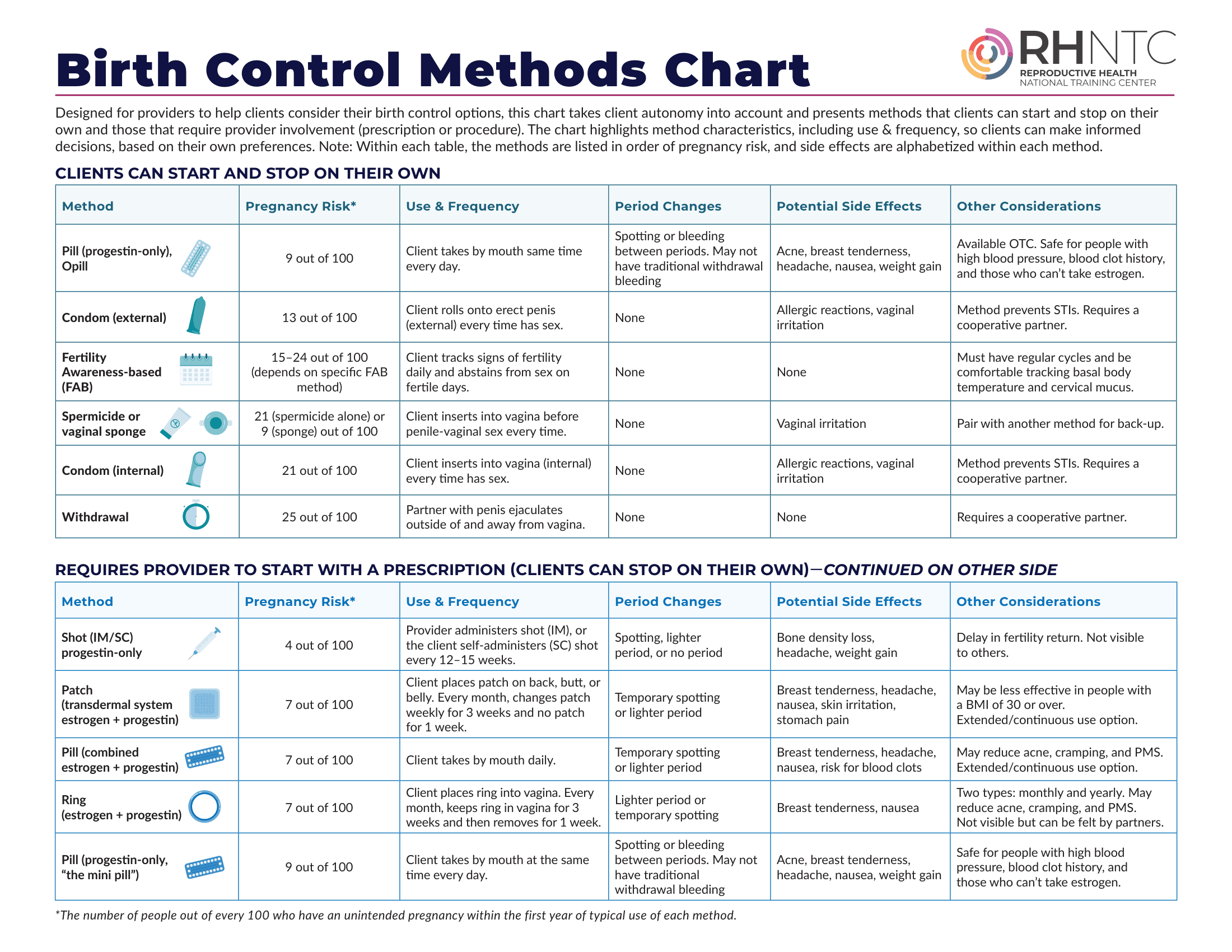
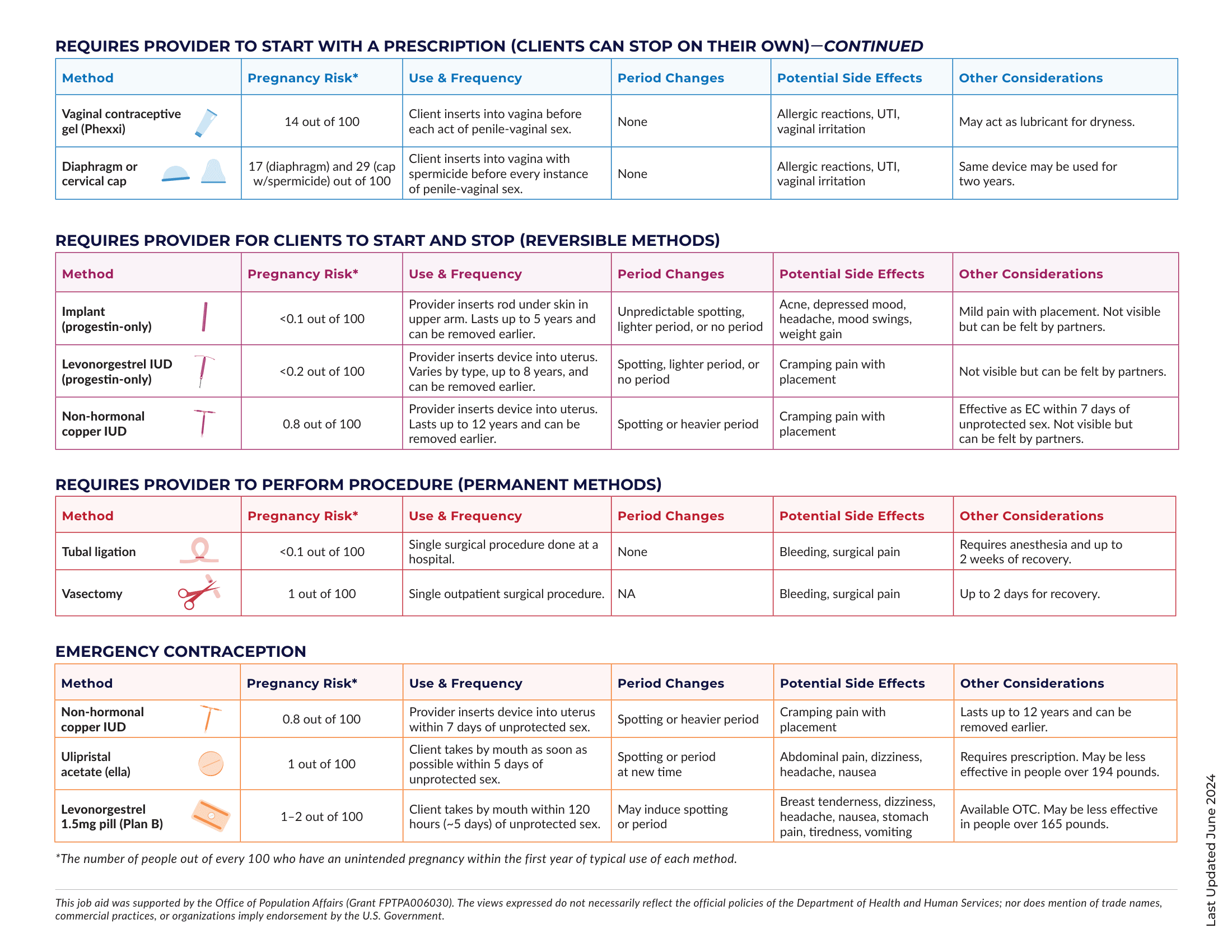
Click to enlarge or download PDF
Source: Reproductive Health National Training Center (RHNTC), Birth Control Methods Chart. Last updated June 2024.
How the Menstrual Cycle and Birth Control Work
Quick Review of the Menstrual Cycle
The menstrual cycle is controlled by hormones that help prepare the body for a possible pregnancy each month. These hormones signal the ovaries to mature and release an egg, while also causing the lining of the uterus to thicken.
Around the middle of the cycle, ovulation may occur, meaning an egg is released from the ovary. After ovulation, hormone levels shift to help maintain the uterine lining. If pregnancy does not occur, estrogen and progesterone levels fall, and the uterine lining sheds. This shedding is what causes menstrual bleeding, or a period.
How Birth Control Works
Hormonal birth control works by using synthetic hormones, usually progestin alone or progestin combined with estrogen, to help prevent pregnancy.
Progestins are synthetic compounds designed to act like progesterone in the body. Different progestins may have slightly different effects, which is one reason birth control options can vary in benefits, side effects, and bleeding patterns.
Ethinyl estradiol is the most common synthetic estrogen used in combined birth control pills, patches, and rings.
Depending on the method, hormonal birth control may suppress ovulation, thicken cervical mucus so sperm have a harder time reaching an egg, and change the uterine lining. Some methods may also reduce, lighten, or temporarily stop menstrual bleeding.
Hormonal birth control does not mimic pregnancy. For people using combined pills, patches, or rings, bleeding during the hormone-free or placebo week is usually withdrawal bleeding, not a true menstrual period.
Understanding Progestins
Progestins are synthetic compounds designed to act like progesterone in the body. Different progestins may have slightly different effects, which is one reason birth control options can vary in benefits, side effects, bleeding patterns, acne, fluid retention, and other hormone-related symptoms. While all approved progestins provide effective contraception when used appropriately, some may be better suited for certain treatment goals or patient preferences.
| Progestin | Major Benefits | Often Preferred For |
|---|---|---|
| Levonorgestrel | Excellent cycle control, highly effective contraception, lighter periods, decreases menstrual cramps, may stop periods with IUDs | Heavy or painful periods, long-term contraception, emergency contraception |
| Norethindrone | Well-established safety profile, good bleeding control, compatible with breastfeeding, available as a progestin-only pill | Breastfeeding, estrogen avoidance, mini-pill users |
| Norethindrone Acetate | Reliable cycle regulation, good control of irregular bleeding, well tolerated | Irregular or painful periods, low-dose combination pills |
| Norgestimate | Low androgenic activity, helps improve acne, minimal effect on cholesterol, predictable cycles | Acne, younger women, and those concerned about androgen-related side effects |
| Desogestrel | Very low androgenic activity, improved skin, less oily skin and hair, reliable ovulation suppression | Acne-prone patients and women seeking lower androgen effects |
| Etonogestrel | Very effective long-acting contraception, convenient “set it and forget it” option, rapid return to fertility after removal | Women wanting highly effective, maintenance-free contraception |
| Drospirenone | Anti-androgenic (helps acne), reduces oily skin, may reduce bloating and water retention, may improve premenstrual symptoms (PMS/PMDD) | Acne, PMS/PMDD, bloating, and women sensitive to fluid retention |
| Dienogest | Strong anti-androgenic effects, improves acne, effective for endometriosis-related pain, good bleeding control | Endometriosis, acne, and pelvic pain |
| Segesterone Acetate | Low androgenic activity, long-lasting vaginal ring, no daily pill required | Women wanting a reusable vaginal ring with monthly use |
| Medroxyprogesterone Acetate (Depo-Provera) | Only needs dosing every 3 months, often stops periods after prolonged use, reduces menstrual pain, lowers risk of endometrial cancer, may reduce seizures in some women with epilepsy | Patients wanting infrequent dosing, heavy or painful periods, and endometriosis |
Understanding Estrogens
Estrogens are included in combined hormonal birth control methods such as combination pills, patches, and vaginal rings. They help suppress ovulation, improve cycle control, reduce breakthrough bleeding, and contribute to lighter, more predictable periods. Several different estrogens are used in modern contraceptives, each with slightly different characteristics.
| Estrogen | Major Benefits | Often Preferred For |
|---|---|---|
| Ethinyl Estradiol (EE) | Excellent cycle control, reduces breakthrough bleeding, improves acne when paired with appropriate progestins, decreases menstrual cramps, lighter periods | Most women; the standard estrogen in the majority of combination pills, patches, and rings |
| Estradiol (E2) | Chemically identical to the body’s natural estrogen, may produce fewer estrogen-related side effects in some women, more physiologic hormone levels | Women who prefer a more “natural” estrogen or experience side effects with ethinyl estradiol |
| Estradiol Valerate (E2V) | Converted to estradiol after absorption, good cycle control, effective for heavy menstrual bleeding, may have less impact on liver protein production than EE | Heavy menstrual bleeding and women seeking a more natural estrogen |
| Estetrol (E4) | Produced naturally by the fetal liver during pregnancy, selective estrogen activity, less effect on liver proteins and clotting factors in studies, good cycle control, generally well tolerated | Women who experience estrogen side effects or are looking for a newer estrogen option |
Ready to discuss birth control options?
Choosing a birth control method can feel overwhelming, but you do not have to sort through the options alone. APNS can help you review your health history, preferences, and goals so you can make an informed decision with guidance from a healthcare provider.