
Pubic lice, often called crabs, are tiny parasitic insects that feed on human blood and usually attach to coarse hair in the genital or pubic area. They can also affect hair around the anus, armpits, chest, beard, mustache, eyebrows, or eyelashes. They are different from head lice and body lice.
Pubic lice crawl; they cannot jump or fly. They usually spread through close intimate or sexual contact, although sharing recently used clothing, towels, or bedding can occasionally spread them. Anyone can get pubic lice, and having them is not a sign of poor hygiene.
About Pubic ‘Crab’ Lice – Centers for Disease Control and Prevention
https://www.cdc.gov/lice/about/pubic-lice.html
Explains symptoms, spread, diagnosis, prevention, and basic treatment of pubic lice.
Pubic Lice (Crabs) – NIH MedlinePlus
https://medlineplus.gov/pubiclice.html
Provides patient-friendly information about pubic lice, symptoms, spread, testing, and treatment.
Pubic lice occur worldwide, but exact case numbers are not known because many people treat themselves and cases are not routinely reported. They are most common in adults because sexual contact is the usual route of spread.
Animals do not carry or spread human pubic lice. A person can have pubic lice at the same time as another sexually transmitted infection (STI), so an STI evaluation is recommended.
Symptoms may begin several days or weeks after exposure. Some people have few symptoms.
Nits are stuck to hair and do not brush away easily like lint or dry skin.
Diagnosis is usually made by finding a live crab-like louse or nits attached to hair. A healthcare professional may examine the pubic region and other coarse-haired areas with a bright light or magnifying lens.
Seek an examination if you are unsure, symptoms continue after correctly used treatment, the eyes are involved, or the affected person is a child. Pubic lice on a child’s eyelashes or head hair may indicate sexual exposure or abuse and requires prompt professional assessment.
About Pubic ‘Crab’ Lice – Centers for Disease Control and Prevention
https://www.cdc.gov/lice/about/pubic-lice.html
Explains symptoms, spread, diagnosis, prevention, and basic treatment of pubic lice.
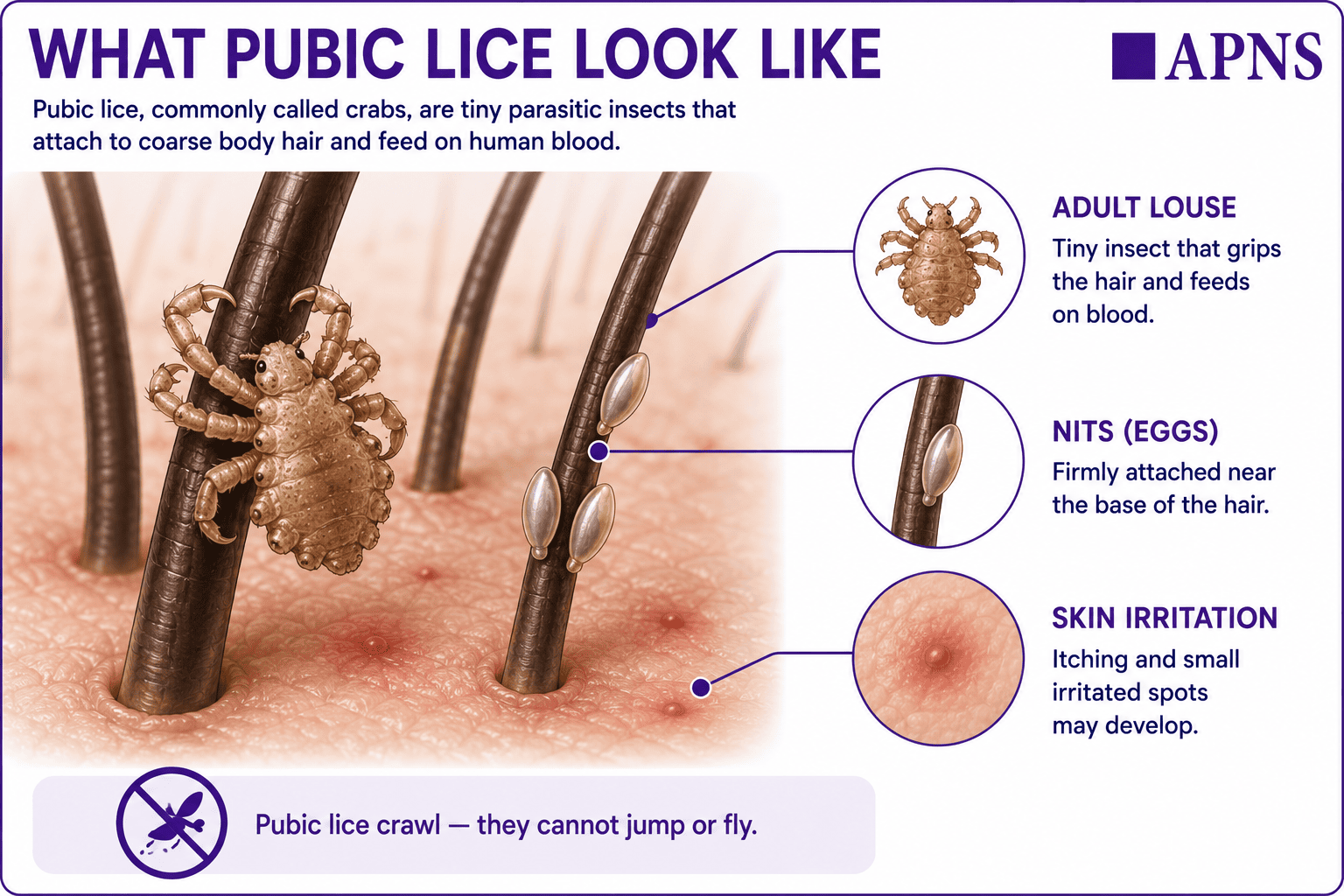
The cause is infestation by the human pubic louse, Pthirus pubis. Adult lice lay eggs on hair shafts. Eggs hatch in about a week, and the young lice mature and continue the cycle.
Spread is usually through close body contact, especially sexual contact. Less often, lice may spread through recently used bedding, towels, or clothing. Toilet-seat transmission is very unlikely, and pubic lice do not come from pets.
About Pubic ‘Crab’ Lice – Centers for Disease Control and Prevention
https://www.cdc.gov/lice/about/pubic-lice.html
Explains symptoms, spread, diagnosis, prevention, and basic treatment of pubic lice.
Shaving or other hair removal does not reliably eliminate pubic lice and is not a substitute for lice-killing treatment.
About Pubic ‘Crab’ Lice – Centers for Disease Control and Prevention
https://www.cdc.gov/lice/about/pubic-lice.html
Explains symptoms, spread, diagnosis, prevention, and basic treatment of pubic lice.
The following video content is provided to help you better understand this condition. These resources are intended for educational purposes and should not replace personalized medical advice from your healthcare provider.
No blood test or routine laboratory test is needed to confirm pubic lice. The insects or eggs can be examined under magnification when the diagnosis is uncertain.
Getting Tested for STIs – Centers for Disease Control and Prevention
https://www.cdc.gov/sti/testing/index.html
Explains STI testing and how to discuss which tests are appropriate with a healthcare professional.
Imaging is not used for pubic lice. A handheld magnifier, dermatoscope, or microscope may help distinguish lice and nits from scabs, lint, or skin flakes.
An eye-care examination is needed when lice or nits involve the eyelashes or when there is eye pain, redness, swelling, discharge, or vision change. Do not put regular lice medicine near the eyes.
Treatment Options
Most pubic lice can be treated with an over-the-counter product containing permethrin 1% or pyrethrins plus piperonyl butoxide. Apply it to all infested hair-bearing areas exactly as the label directs, then put on clean clothes.
After treatment, remove remaining nits with fingernails or a fine-toothed comb. Repeat treatment in 9–10 days if live lice are found. A clinician can prescribe another treatment when correct over-the-counter treatment fails or cannot be used.
Treatment of Pubic Lice – Centers for Disease Control and Prevention
https://www.cdc.gov/lice/treatment/pubic-lice.html
Gives step-by-step treatment, laundry, partner, repeat-treatment, and eyelash guidance.
Treatment works best when the person, their recent partners, and recently used items are addressed together.
Follow the exact product label and ask a pharmacist or clinician before treating a young child, pregnancy, breastfeeding, extensive broken skin, or an uncertain diagnosis.
Never apply standard pubic-lice medicine to the eyes, inside the vagina or rectum, or to severely irritated skin unless specifically directed by a healthcare professional.
Treatment of Pubic Lice – Centers for Disease Control and Prevention
https://www.cdc.gov/lice/treatment/pubic-lice.html
Gives step-by-step treatment, laundry, partner, repeat-treatment, and eyelash guidance.
Lindane Drug Information – NIH MedlinePlus
https://medlineplus.gov/druginfo/meds/a682651.html
Reviews serious safety warnings for lindane and why safer lice treatments are preferred.
Pubic lice do not need cutting, freezing, drainage, or surgery. Shaving, waxing, and sugaring do not reliably cure the infestation and may irritate already inflamed skin.
A clinician may manually remove lice or nits from eyelashes with fine forceps or a nit comb. Eye-area treatment should be supervised because ordinary lice products can injure the eye.
Pubic lice are curable. Correct treatment, cleaning of recently used items, and treatment of affected partners usually clear the infestation.
Itching may continue for several days after the lice are dead. Seeing live moving lice after treatment suggests failure or reinfestation. Nits alone may remain attached after successful treatment and do not always mean live infestation.
Treatment of Pubic Lice – Centers for Disease Control and Prevention
https://www.cdc.gov/lice/treatment/pubic-lice.html
Gives step-by-step treatment, laundry, partner, repeat-treatment, and eyelash guidance.
They are usually spread through sexual contact, although they are insects rather than a bacterial or viral STI. Testing for other STIs is recommended.
It is very rare. Pubic lice usually spread through close body contact and survive poorly away from a person.
No. Human pubic lice do not live on pets.
No. Hair removal does not reliably eliminate all lice or nits and may irritate the skin.
Not completely. Condoms reduce some sexual-health risks but do not cover all hair-bearing skin where lice can spread.
No. Fumigant sprays and foggers are unnecessary and can be toxic. Treat recently used clothing, towels, and bedding instead.
Yes. Pubic lice can be eliminated with proper treatment and control of reinfestation. The treatment kills lice; it does not protect against a future exposure.
Persistent live lice may result from incomplete application, resistance, untreated partners, or contact with infested items. A healthcare professional should confirm the diagnosis before stronger or repeated treatment.
Pubic lice usually do not cause a medical emergency. Contact a healthcare professional promptly if treatment fails, the diagnosis is uncertain, the eyes are involved, the affected person is pregnant, or a child has pubic lice.
Seek urgent or emergency care for:
CALL 911
APNS does not provide emergency medical services. If you believe you are experiencing a medical emergency, including (but not limited to) chest pain, difficulty breathing, stroke symptoms, severe allergic reactions, anaphylaxis, uncontrolled bleeding, seizures, loss of consciousness, or any other potentially life-threatening condition, you are instructed to call 911 immediately or go immediately to the nearest emergency department.
About Pubic ‘Crab’ Lice – Centers for Disease Control and Prevention
https://www.cdc.gov/lice/about/pubic-lice.html
Explains symptoms, spread, diagnosis, prevention, and basic treatment of pubic lice.
Treatment of Pubic Lice – Centers for Disease Control and Prevention
https://www.cdc.gov/lice/treatment/pubic-lice.html
Gives step-by-step treatment, laundry, partner, repeat-treatment, and eyelash guidance.
Pubic Lice (Crabs) – NIH MedlinePlus
https://medlineplus.gov/pubiclice.html
Provides patient-friendly information about pubic lice, symptoms, spread, testing, and treatment.
Getting Tested for STIs – Centers for Disease Control and Prevention
https://www.cdc.gov/sti/testing/index.html
Explains STI testing and how to discuss which tests are appropriate with a healthcare professional.
Lindane Drug Information – NIH MedlinePlus
https://medlineplus.gov/druginfo/meds/a682651.html
Reviews serious safety warnings for lindane and why safer lice treatments are preferred.
This guide is intended for educational purposes only and should not replace medical advice, diagnosis, testing, or treatment from your healthcare provider. Genital itching may have many causes, including pubic lice, scabies, dermatitis, fungal infection, or an STI, and each requires different care. Use lice medicines exactly as directed and never apply ordinary lice products near the eyes. Seek prompt professional care for eye involvement, treatment failure, infection of scratched skin, pregnancy, possible medicine poisoning, or pubic lice in a child.
At APNS, our providers take the time to understand your condition and your goals. We offer comprehensive telehealth visits at a fixed rate — no membership fees, no insurance required, and no unexpected charges. Whether you’re newly diagnosed or looking for a provider who actually listens, we’re here to help.