

Crohn’s disease is a long-term inflammatory bowel disease (IBD) that causes chronic inflammation anywhere along the digestive tract, from the mouth to the anus. It most commonly affects the end of the small intestine (ileum) and the beginning of the large intestine (colon). Unlike ulcerative colitis, which affects only the inner lining of the colon, Crohn’s disease can involve all layers of the bowel wall and may occur in patches of healthy and inflamed tissue.
Crohn’s disease is a lifelong condition that often alternates between flare-ups (when symptoms worsen) and remission (when symptoms improve or disappear). Although there is currently no cure, medications, healthy lifestyle habits, and regular medical care can help control inflammation, reduce symptoms, and improve quality of life.
Crohn’s Disease – NIH MedlinePlus
https://medlineplus.gov/crohnsdisease.html
Provides easy-to-understand information about Crohn’s disease, including symptoms, diagnosis, treatment, and living with the condition.
Crohn’s Disease – National Institute of Diabetes and Digestive and Kidney Diseases (NIDDK)
https://www.niddk.nih.gov/health-information/digestive-diseases/crohns-disease
Explains what Crohn’s disease is, common symptoms, causes, diagnosis, and treatment options.
Crohn’s disease affects hundreds of thousands of people in the United States and is one of the two major forms of inflammatory bowel disease (IBD), along with ulcerative colitis. It can develop at any age but is most commonly diagnosed between the ages of 15 and 35.
Inflammatory Bowel Disease (IBD) – Centers for Disease Control and Prevention (CDC)
https://www.cdc.gov/ibd/
Provides information about inflammatory bowel disease, including Crohn’s disease and ulcerative colitis.
Symptoms of Crohn’s disease vary depending on which part of the digestive tract is affected and how severe the inflammation is.
Common symptoms may include:
Some people may also develop symptoms outside of the digestive tract, including joint pain, skin rashes, or eye inflammation.
Your healthcare provider will review your symptoms, medical history, and perform a physical examination. Laboratory tests, stool testing, imaging studies, and endoscopic procedures help confirm the diagnosis and determine the location and severity of inflammation.
A colonoscopy with biopsies is one of the most common tests used to diagnose Crohn’s disease.
Crohn’s Disease – NIDDK
https://www.niddk.nih.gov/health-information/digestive-diseases/crohns-disease
Explains how Crohn’s disease is diagnosed and what tests may be recommended.
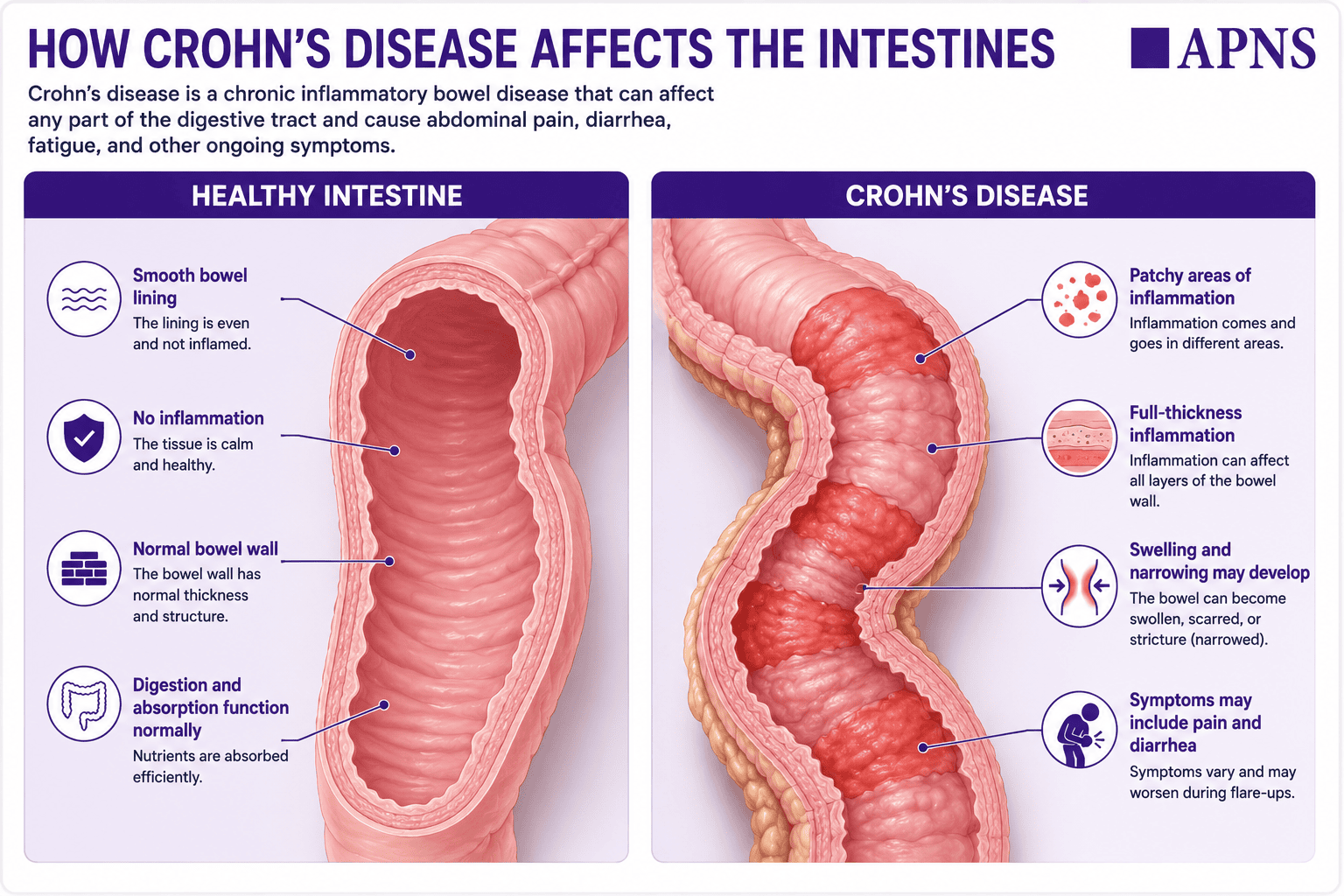
The exact cause of Crohn’s disease is unknown. Researchers believe it develops when the immune system mistakenly attacks healthy tissue in the digestive tract. Genetics, environmental factors, and changes in the gut microbiome may also contribute.
Common risk factors include:
Crohn’s Disease – NIDDK
https://www.niddk.nih.gov/health-information/digestive-diseases/crohns-disease
Learn about the possible causes and risk factors associated with Crohn’s disease.
Although triggers vary from person to person, several factors may contribute to flare-ups.
Common triggers include:
Crohn’s Disease – Crohn’s & Colitis Foundation
https://www.crohnscolitisfoundation.org/
Provides practical information about recognizing triggers and managing Crohn’s disease flare-ups.
Crohn’s disease cannot currently be prevented. However, following your treatment plan and maintaining healthy lifestyle habits can reduce flare-ups and lower your risk of complications.
Helpful prevention tips include:
Crohn’s Disease – National Institute of Diabetes and Digestive and Kidney Diseases (NIDDK)
https://www.niddk.nih.gov/health-information/digestive-diseases/crohns-disease
Provides practical guidance for managing Crohn’s disease and reducing complications.
The following video content is provided to help you better understand this condition. These resources are intended for educational purposes and should not replace personalized medical advice from your healthcare provider.
Laboratory tests help evaluate inflammation, nutritional deficiencies, anemia, and infection.
Common laboratory tests may include:
Calprotectin Stool Test – NIH MedlinePlus
https://medlineplus.gov/lab-tests/calprotectin-stool-test/
Explains how stool testing helps evaluate inflammation in the digestive tract.
Several tests help diagnose Crohn’s disease and determine which parts of the digestive tract are affected.
Common diagnostic tests include:
Crohn’s Disease – NIDDK
https://www.niddk.nih.gov/health-information/digestive-diseases/crohns-disease
Learn how imaging studies and endoscopic procedures are used to diagnose and monitor Crohn’s disease.
Treatment focuses on reducing inflammation, controlling symptoms, maintaining remission, preventing complications, and improving quality of life.
Treatment options may include:
Crohn’s Disease – Crohn’s & Colitis Foundation
https://www.crohnscolitisfoundation.org/
Provides information about medications, nutrition, surgery, and long-term management of Crohn’s disease.
Healthy lifestyle habits can help reduce flare-ups and improve overall digestive health.
Helpful lifestyle changes include:
Diet and Nutrition – Crohn’s & Colitis Foundation
https://www.crohnscolitisfoundation.org/
Provides practical nutrition recommendations for people living with Crohn’s disease.
Several medications are available to reduce inflammation, relieve symptoms, and help maintain remission.
Common medications include:
Crohn’s Disease Medications – Crohn’s & Colitis Foundation
https://www.crohnscolitisfoundation.org/
Provides information about medications used to treat Crohn’s disease and maintain remission.
Some people with Crohn’s disease may need procedures to diagnose, monitor, or treat their condition. While many people successfully manage Crohn’s disease with medications, procedures or surgery may be recommended if complications develop or medications are no longer effective.
Common procedures may include:
Crohn’s Disease – National Institute of Diabetes and Digestive and Kidney Diseases (NIDDK)
https://www.niddk.nih.gov/health-information/digestive-diseases/crohns-disease
Learn about procedures and surgical treatment options for Crohn’s disease.
Crohn’s disease is a lifelong condition that usually alternates between periods of remission and flare-ups. Many people successfully control their symptoms with medications, healthy lifestyle habits, and regular medical care.
Although surgery may become necessary for some people, it is important to know that surgery does not cure Crohn’s disease. Inflammation may return in another area of the digestive tract, so ongoing treatment and follow-up care remain important.
Daily self-care is an important part of managing Crohn’s disease and reducing flare-ups.
Helpful tips include:
Diet and Nutrition – Crohn’s & Colitis Foundation
https://www.crohnscolitisfoundation.org/
Provides practical nutrition guidance and self-care recommendations for people living with Crohn’s disease.
Crohn’s disease can affect any part of the digestive tract and involves all layers of the bowel wall. Ulcerative colitis affects only the colon and rectum and involves only the inner lining of the colon.
Yes. Some people develop joint pain, skin rashes, eye inflammation, osteoporosis, or liver problems related to Crohn’s disease.
Not everyone needs surgery. Many people successfully manage Crohn’s disease with medications, but surgery may be necessary if complications develop or medications no longer control inflammation.
Stress does not cause Crohn’s disease, but it may worsen symptoms or contribute to flare-ups.
Yes. Many people with Crohn’s disease lead active, productive lives by following their treatment plan, attending regular healthcare appointments, and managing flare-ups promptly.

Consider asking your healthcare provider:
Crohn’s disease is often managed by a team of healthcare professionals. Depending on your symptoms and disease severity, your healthcare provider may recommend seeing one or more specialists.
You may be referred to:
Crohn’s & Colitis Foundation
https://www.crohnscolitisfoundation.org/
Provides patient education, support resources, and information about specialty care for inflammatory bowel disease.
There is currently no cure for Crohn’s disease. However, many people achieve long periods of remission with medications, healthy lifestyle habits, and regular medical care.
Even if surgery becomes necessary, Crohn’s disease can return in another part of the digestive tract. Continuing your treatment plan helps reduce the risk of future flare-ups and complications.
Call 911 or seek emergency medical care immediately if you experience:
Seek prompt medical care if you notice:
Crohn’s Disease – NIH MedlinePlus
https://medlineplus.gov/crohnsdisease.html
Learn about Crohn’s disease complications and when emergency medical care is needed.
CALL 911
APNS does not provide emergency medical services. If you believe you are experiencing a medical emergency, including (but not limited to) chest pain, difficulty breathing, stroke symptoms, severe allergic reactions, anaphylaxis, uncontrolled bleeding, seizures, loss of consciousness, or any other potentially life-threatening condition, you are instructed to call 911 immediately or go immediately to the nearest emergency department.
Crohn’s Disease – NIH MedlinePlus
https://medlineplus.gov/crohnsdisease.html
Easy-to-understand information about Crohn’s disease, including symptoms, diagnosis, treatment, and living with the condition.
National Institute of Diabetes and Digestive and Kidney Diseases (NIDDK) – Crohn’s Disease
https://www.niddk.nih.gov/health-information/digestive-diseases/crohns-disease
Comprehensive information about Crohn’s disease, medications, nutrition, surgery, and long-term management.
Crohn’s & Colitis Foundation
https://www.crohnscolitisfoundation.org/
Evidence-based patient education about Crohn’s disease, treatment options, nutrition, support resources, and living with inflammatory bowel disease.
Centers for Disease Control and Prevention (CDC) – Inflammatory Bowel Disease (IBD)
https://www.cdc.gov/ibd/
Reliable information about inflammatory bowel disease, public health information, and patient resources.
This guide is intended for educational purposes only and should not replace medical advice, diagnosis, or treatment from your healthcare provider. Always follow the recommendations of your healthcare team regarding your individual health needs. Contact your healthcare provider if your symptoms worsen, you develop a flare-up, or your medications are no longer controlling your symptoms. Call 911 immediately if you experience severe abdominal pain, heavy rectal bleeding, persistent vomiting, signs of bowel obstruction, severe dehydration, confusion, or another medical emergency.
At APNS, our providers take the time to understand your condition and your goals. We offer comprehensive telehealth visits at a fixed rate — no membership fees, no insurance required, and no unexpected charges. Whether you’re newly diagnosed or looking for a provider who actually listens, we’re here to help.