

Fatigue is a feeling of persistent tiredness, lack of energy, or exhaustion that does not improve completely with rest. It is different from simply feeling sleepy after a busy day. Fatigue can affect your physical energy, mental focus, motivation, and ability to complete everyday activities.
Fatigue is a symptom, not a disease. It can have many different causes, including lack of sleep, stress, medical conditions, medications, infections, nutritional deficiencies, or mental health conditions. Finding and treating the underlying cause is the best way to improve fatigue.
Fatigue – NIH MedlinePlus
https://medlineplus.gov/fatigue.html
Provides easy-to-understand information about fatigue, common causes, diagnosis, treatment, and self-care.
Fatigue – Cleveland Clinic
https://my.clevelandclinic.org/health/symptoms/21206-fatigue
Explains what fatigue is, possible causes, and when to seek medical care.
Fatigue is one of the most common reasons people visit a healthcare provider. It affects people of all ages and may be temporary or long-lasting depending on the underlying cause.
Fatigue – NIH MedlinePlus
https://medlineplus.gov/fatigue.html
Provides general information about fatigue and common contributing factors.
Fatigue can affect both your body and your mind. Symptoms vary depending on the underlying cause.
Common symptoms may include:
Your healthcare provider will ask about your symptoms, sleep habits, medical history, medications, stress levels, and daily activities. A physical examination and laboratory testing may be recommended to help identify the underlying cause.
Additional testing depends on your symptoms and medical history.
Fatigue – NIH MedlinePlus
https://medlineplus.gov/fatigue.html
Explains how healthcare providers evaluate fatigue and determine possible causes.
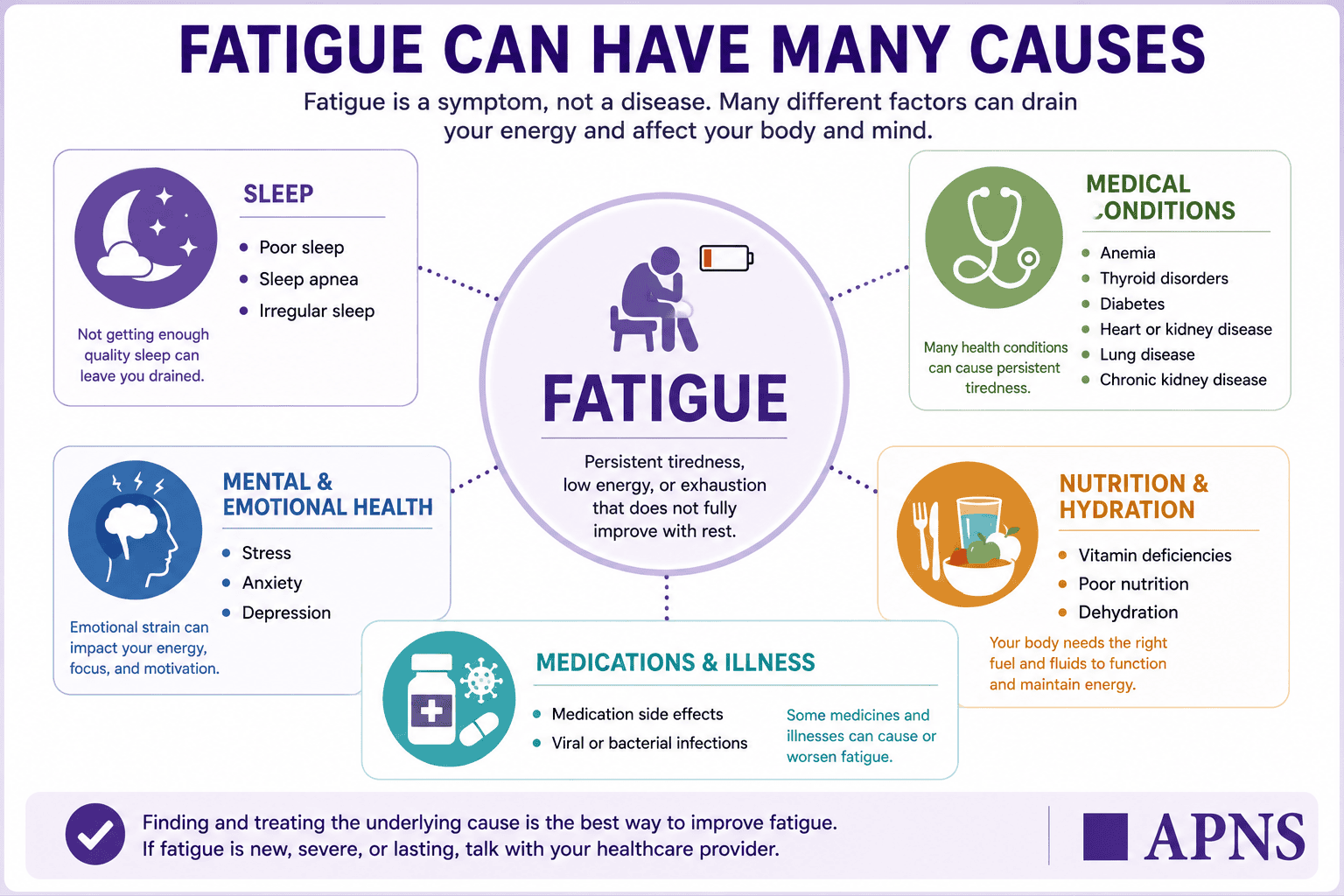
Fatigue has many possible causes. Sometimes it is related to lifestyle habits, while other times it may be a sign of an underlying medical condition.
Common causes include:
Fatigue – NIH MedlinePlus
https://medlineplus.gov/fatigue.html
Learn about the many possible causes of fatigue and when additional evaluation may be needed.
Several factors can increase fatigue or make symptoms more noticeable.
Common factors include:
Fatigue – Cleveland Clinic
https://my.clevelandclinic.org/health/symptoms/21206-fatigue
Provides information about factors that commonly contribute to fatigue.
Although fatigue cannot always be prevented, healthy lifestyle habits can reduce your risk and improve your overall energy level.
Helpful prevention tips include:
Healthy Living – Centers for Disease Control and Prevention (CDC)
https://www.cdc.gov/healthy-weight-growth/about/index.html
Provides practical guidance for maintaining overall health through nutrition, physical activity, sleep, and other healthy lifestyle habits.
The following video content is provided to help you better understand this condition. These resources are intended for educational purposes and should not replace personalized medical advice from your healthcare provider.
Laboratory tests may help identify common medical conditions that contribute to fatigue.
Common laboratory tests may include:
Laboratory Tests – NIH MedlinePlus
https://medlineplus.gov/lab-tests/
Provides information about common laboratory tests used to evaluate fatigue.
Laboratory tests may help identify common medical conditions that contribute to fatigue.
Common laboratory tests may include:
Laboratory Tests – NIH MedlinePlus
https://medlineplus.gov/lab-tests/
Provides information about common laboratory tests used to evaluate fatigue.
Treatment depends on the underlying cause of your fatigue. Managing the medical condition, improving sleep, making healthy lifestyle changes, and treating nutritional deficiencies often improve symptoms.
Treatment options may include:
Fatigue – Cleveland Clinic
https://my.clevelandclinic.org/health/symptoms/21206-fatigue
Provides practical information about treating fatigue based on its underlying cause.
Healthy daily habits can improve energy levels and reduce fatigue over time.
Helpful lifestyle changes include:
Healthy Sleep – Centers for Disease Control and Prevention (CDC)
https://www.cdc.gov/sleep/
Provides practical information about healthy sleep habits and improving sleep quality.
There is no single medication that treats fatigue. Treatment depends on the underlying cause. If fatigue is caused by another medical condition, treating that condition often improves symptoms.
Medications may include:
Fatigue – NIH MedlinePlus
https://medlineplus.gov/fatigue.html
Learn more about fatigue and why treatment focuses on identifying and managing the underlying cause.
Most people with fatigue do not need a medical procedure. However, if your healthcare provider suspects an underlying condition, additional testing or procedures may be recommended to help determine the cause.
Possible procedures or evaluations may include:
Fatigue – Cleveland Clinic
https://my.clevelandclinic.org/health/symptoms/21206-fatigue
Learn about the evaluation of fatigue and when additional testing may be recommended.
The long-term outlook depends on what is causing your fatigue. Some people recover quickly once the underlying cause is treated, while others may require ongoing treatment for chronic medical conditions.
Working closely with your healthcare provider, following your treatment plan, and maintaining healthy lifestyle habits can help improve your energy level and overall quality of life.
Healthy daily habits can often improve energy levels and reduce fatigue.
Helpful tips include:
Healthy Sleep – Centers for Disease Control and Prevention (CDC)
https://www.cdc.gov/sleep/
Provides practical information about healthy sleep habits and improving sleep quality.
Occasional tiredness is common, but persistent fatigue that lasts for several weeks or interferes with daily activities should be discussed with your healthcare provider.
Yes. Ongoing stress, anxiety, and depression can contribute to both physical and mental fatigue.
Yes. Even mild dehydration can reduce energy levels and make you feel fatigued.
Yes. Regular physical activity often improves energy levels over time, although it is important to start slowly if you have been inactive or have a medical condition.
You should schedule an appointment if fatigue is severe, lasts for several weeks, interferes with daily life, or is accompanied by other concerning symptoms.

Questions To Ask Your Provider
Consider asking your healthcare provider:
Depending on the suspected cause of your fatigue, your healthcare provider may recommend seeing a specialist.
You may be referred to:
Fatigue – NIH MedlinePlus
https://medlineplus.gov/fatigue.html
Provides information about fatigue, possible causes, and when referral to a specialist may be appropriate.
Fatigue itself is not a disease but a symptom of another condition. Whether it can be completely resolved depends on its underlying cause.
Many people experience significant improvement once the cause of their fatigue is identified and treated. For others with chronic medical conditions, fatigue may improve with ongoing treatment and healthy lifestyle habits.
Call 911 or seek emergency medical care immediately if you experience:
Seek prompt medical evaluation if your fatigue is accompanied by:
Fatigue – NIH MedlinePlus
https://medlineplus.gov/fatigue.html
Learn when fatigue may be a sign of a more serious medical condition and when to seek immediate medical care.
CALL 911
APNS does not provide emergency medical services. If you believe you are experiencing a medical emergency, including (but not limited to) chest pain, difficulty breathing, stroke symptoms, severe allergic reactions, anaphylaxis, uncontrolled bleeding, seizures, loss of consciousness, or any other potentially life-threatening condition, you are instructed to call 911 immediately or go immediately to the nearest emergency department.
Fatigue – NIH MedlinePlus
https://medlineplus.gov/fatigue.html
Easy-to-understand information about fatigue, common causes, diagnosis, treatment, and self-care.
Cleveland Clinic – Fatigue
https://my.clevelandclinic.org/health/symptoms/21206-fatigue
Comprehensive patient education about fatigue, possible causes, evaluation, and treatment.
Centers for Disease Control and Prevention (CDC) – Sleep
https://www.cdc.gov/sleep/
Reliable information about healthy sleep habits and improving sleep quality.
National Heart, Lung, and Blood Institute (NHLBI) – Sleep Health
https://www.nhlbi.nih.gov/health/sleep
Evidence-based information about healthy sleep, sleep disorders, and improving overall health.
This guide is intended for educational purposes only and should not replace medical advice, diagnosis, or treatment from your healthcare provider. Always follow the recommendations of your healthcare team regarding your individual health needs. Contact your healthcare provider if your fatigue persists, worsens, or interferes with your daily activities. Call 911 immediately if you experience chest pain, severe difficulty breathing, loss of consciousness, signs of a stroke, or another medical emergency.
At APNS, our providers take the time to understand your condition and your goals. We offer comprehensive telehealth visits at a fixed rate — no membership fees, no insurance required, and no unexpected charges. Whether you’re newly diagnosed or looking for a provider who actually listens, we’re here to help.