

Food poisoning is very common. The CDC estimates that about 48 million people in the United States become sick from foodborne illnesses each year, leading to approximately 128,000 hospitalizations and 3,000 deaths. (cdc.gov)
Anyone can develop food poisoning, but the risk of severe illness is higher for:
Symptoms depend on the organism or toxin involved.
Common symptoms include:
More severe symptoms may include:
Symptoms may begin within a few hours after eating contaminated food or may not appear for several days depending on the specific cause.
Symptoms of Food Poisoning – CDC
https://www.cdc.gov/food-safety/signs-symptoms/index.html
Explains common symptoms and when medical evaluation is needed.
A healthcare provider may diagnose food poisoning based on symptoms, foods recently eaten, travel history, and possible exposures.
Your provider may ask:
Many mild cases do not require testing.
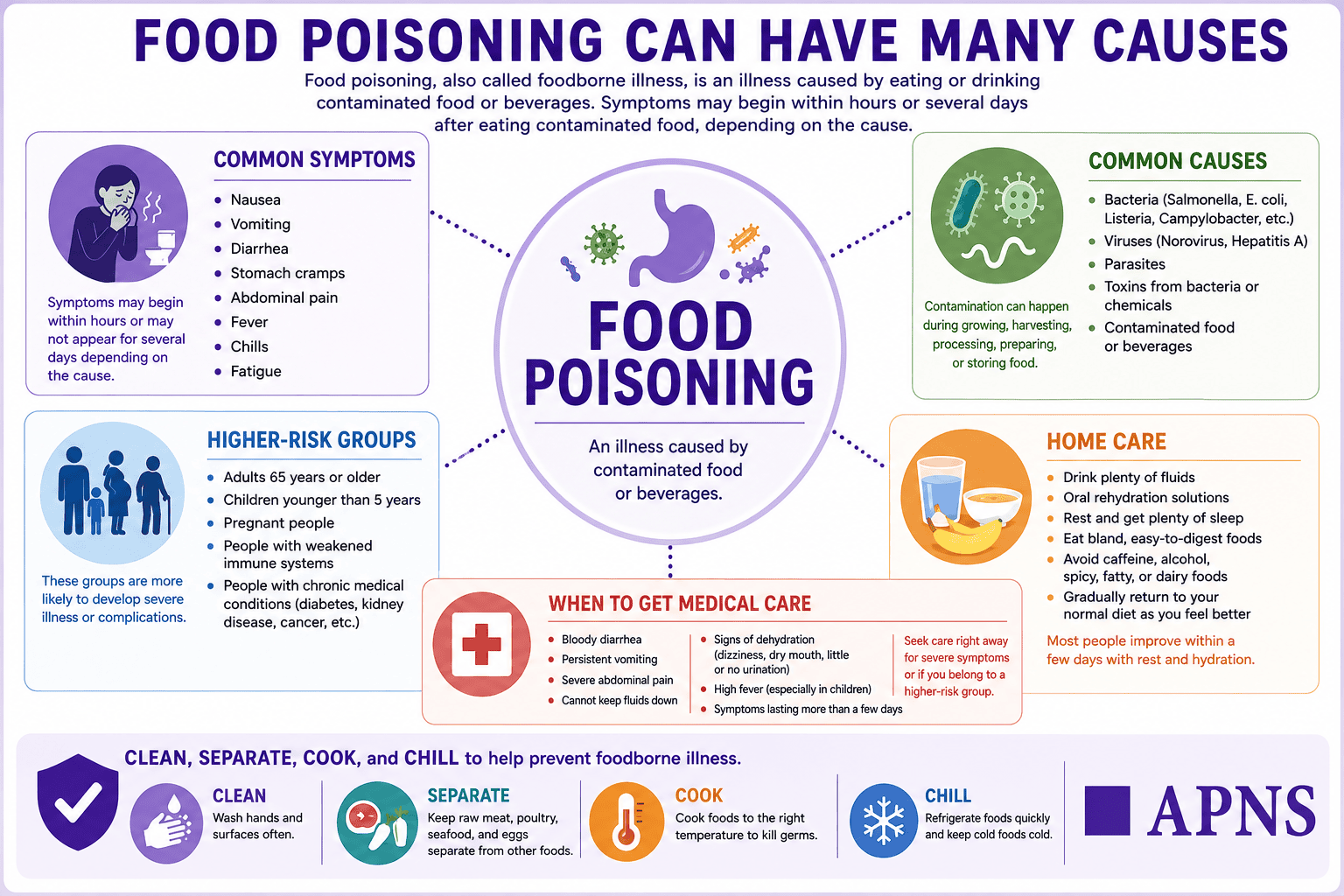
Food poisoning occurs when harmful germs or toxins contaminate food or beverages.
Common causes include:
Foods commonly associated with food poisoning include:
Improper food storage, cross-contamination, poor hand hygiene, and inadequate cooking temperatures increase the risk.
Causes of Food Poisoning – CDC
https://www.cdc.gov/food-safety/causes/index.html
Explains common organisms responsible for foodborne illness and how contamination occurs.
Factors that may worsen illness include:
Dehydration is one of the most common complications and may become serious quickly in young children, older adults, and people with chronic illness.
Reduce your risk by:
The CDC recommends following four key food safety steps: Clean, Separate, Cook, and Chill. (cdc.gov)
Food Safety – CDC
https://www.cdc.gov/food-safety/prevention/index.html
Provides practical guidance for preventing foodborne illness at home.
The following video content is provided to help you better understand this condition. These resources are intended for educational purposes and should not replace personalized medical advice from your healthcare provider.
Testing depends on symptom severity.
Possible tests include:
Not everyone with diarrhea requires stool testing. Testing is generally reserved for severe illness, bloody diarrhea, prolonged symptoms, outbreaks, or high-risk patients.
Foodborne Illness Testing – NIH MedlinePlus
https://medlineplus.gov/lab-tests/
Provides information about laboratory testing used to diagnose infections.
Food poisoning usually does not require imaging.
Possible tests include:
Testing is directed toward identifying the cause or excluding other illnesses such as appendicitis, gallbladder disease, inflammatory bowel disease, or bowel obstruction.
Treatment depends on the cause and severity.
Treatment may include:
Most viral food poisoning does not require antibiotics.
Treatment focuses on preventing dehydration while the illness resolves.
Treating Food Poisoning – CDC
https://www.cdc.gov/food-safety/treatment/index.html
Provides recommendations for hydration, home care, and medical treatment.
Helpful habits include:
Medication depends on the cause.
Possible medications include:
Do not start antibiotics without medical advice. Some infections, such as Shiga toxin-producing E. coli, may become more dangerous if antibiotics are used.
Food Poisoning Medicines – NIH MedlinePlus
https://medlineplus.gov/foodborneillness.html
Provides information about treatment and medication considerations.
Most cases require no procedures.
Hospital care may include:
Most people recover completely within several days.
Recovery depends on:
Some infections can lead to complications such as:
Most complications are uncommon.
For mild illness:
Good choices as appetite returns include:
Seek medical care if symptoms worsen or dehydration develops.
Some causes, such as norovirus, can spread from person to person, while others spread mainly through contaminated food.
Many cases improve within 24–72 hours, although some infections last longer depending on the cause.
Not usually. Antibiotics help only certain bacterial infections and may worsen some types of food poisoning.
No. Continue drinking fluids and begin eating bland foods as tolerated.
Sports drinks may help replace some fluids, but oral rehydration solutions are usually better for significant diarrhea because they contain a more appropriate balance of electrolytes.
Avoid work, especially food preparation or healthcare duties, until vomiting has stopped and diarrhea has resolved according to your healthcare provider’s advice or workplace policies.
Yes. Bloody diarrhea can occur with certain bacterial infections and requires prompt medical evaluation.
Yes. Severe dehydration, bloodstream infection, kidney injury, and certain toxins can become life-threatening if not treated promptly.

Consider asking:
You may be referred to:
Yes. Most food poisoning resolves completely without long-term problems.
Some bacterial, parasitic, or toxin-related illnesses require specific treatment. Prompt hydration greatly improves recovery and reduces complications.
Call 911 or seek emergency medical care immediately if you have:
Seek urgent medical evaluation for:
Botulism can cause blurred vision, drooping eyelids, difficulty swallowing, slurred speech, and muscle weakness. These symptoms require immediate emergency care.
CALL 911
APNS does not provide emergency medical services. If you believe you are experiencing a medical emergency, including (but not limited to) chest pain, difficulty breathing, stroke symptoms, severe allergic reactions, anaphylaxis, uncontrolled bleeding, seizures, loss of consciousness, or any other potentially life-threatening condition, you are instructed to call 911 immediately or go immediately to the nearest emergency department.
Food Poisoning – Centers for Disease Control and Prevention
https://www.cdc.gov/food-safety/about/food-poisoning.html
General information about foodborne illness, symptoms, causes, treatment, and prevention.
Food Safety – CDC
https://www.cdc.gov/food-safety/prevention/index.html
Provides food handling and storage recommendations to reduce the risk of illness.
Food Poisoning – NIH MedlinePlus
https://medlineplus.gov/foodborneillness.html
Patient-friendly information about food poisoning, diagnosis, treatment, and prevention.
Food Safety – U.S. Food & Drug Administration
https://www.fda.gov/food
Provides food safety education, recalls, and safe food handling information.
This guide is intended for educational purposes only and should not replace medical advice, diagnosis, or treatment from your healthcare provider. Food poisoning may be caused by bacteria, viruses, parasites, toxins, or chemicals, and some illnesses require specific testing or treatment. Do not take antibiotics unless prescribed by a healthcare professional, as they are not helpful for most viral illnesses and may worsen certain bacterial infections. Seek prompt medical care for bloody diarrhea, persistent vomiting, severe dehydration, high fever, severe abdominal pain, or symptoms lasting longer than expected. Call 911 immediately for difficulty breathing, loss of consciousness, seizures, severe allergic reactions, or symptoms of botulism such as blurred vision, difficulty swallowing, slurred speech, or progressive muscle weakness.
At APNS, our providers take the time to understand your condition and your goals. We offer comprehensive telehealth visits at a fixed rate — no membership fees, no insurance required, and no unexpected charges. Whether you’re newly diagnosed or looking for a provider who actually listens, we’re here to help.