

Gout is a common type of inflammatory arthritis caused by a buildup of uric acid in the blood. When uric acid levels become too high, sharp crystals can form in and around the joints, leading to sudden episodes of severe pain, swelling, redness, and warmth. Gout most often affects the big toe, but it can also occur in the ankles, knees, feet, wrists, fingers, and elbows.
Gout attacks often begin suddenly and may last for several days to weeks if left untreated. While gout can be very painful, it is highly treatable. Medications, healthy lifestyle changes, and managing uric acid levels can help prevent future attacks and protect your joints from long-term damage.
Gout – NIH MedlinePlus
https://medlineplus.gov/gout.html
Provides easy-to-understand information about gout, including symptoms, diagnosis, treatment, medications, and prevention.
Gout – National Institute of Arthritis and Musculoskeletal and Skin Diseases (NIAMS)
https://www.niams.nih.gov/health-topics/gout
Explains what gout is, why it develops, and how it is treated.
Gout affects millions of adults in the United States and is one of the most common forms of inflammatory arthritis. It is more common in men, although women are at increased risk after menopause. The risk of developing gout also increases with age.
Gout – Centers for Disease Control and Prevention (CDC)
https://www.cdc.gov/arthritis/basics/gout.html
Provides information about gout, risk factors, and arthritis management.
Gout symptoms often begin suddenly, frequently during the night, and can become severe within a few hours.
Common symptoms may include:
Your healthcare provider will review your symptoms, medical history, and perform a physical examination. Because other conditions can cause similar symptoms, laboratory tests and imaging may also be recommended.
The most accurate way to diagnose gout is by identifying uric acid crystals in fluid removed from an affected joint.
Gout – NIAMS
https://www.niams.nih.gov/health-topics/gout
Explains how gout is diagnosed and the tests commonly used.
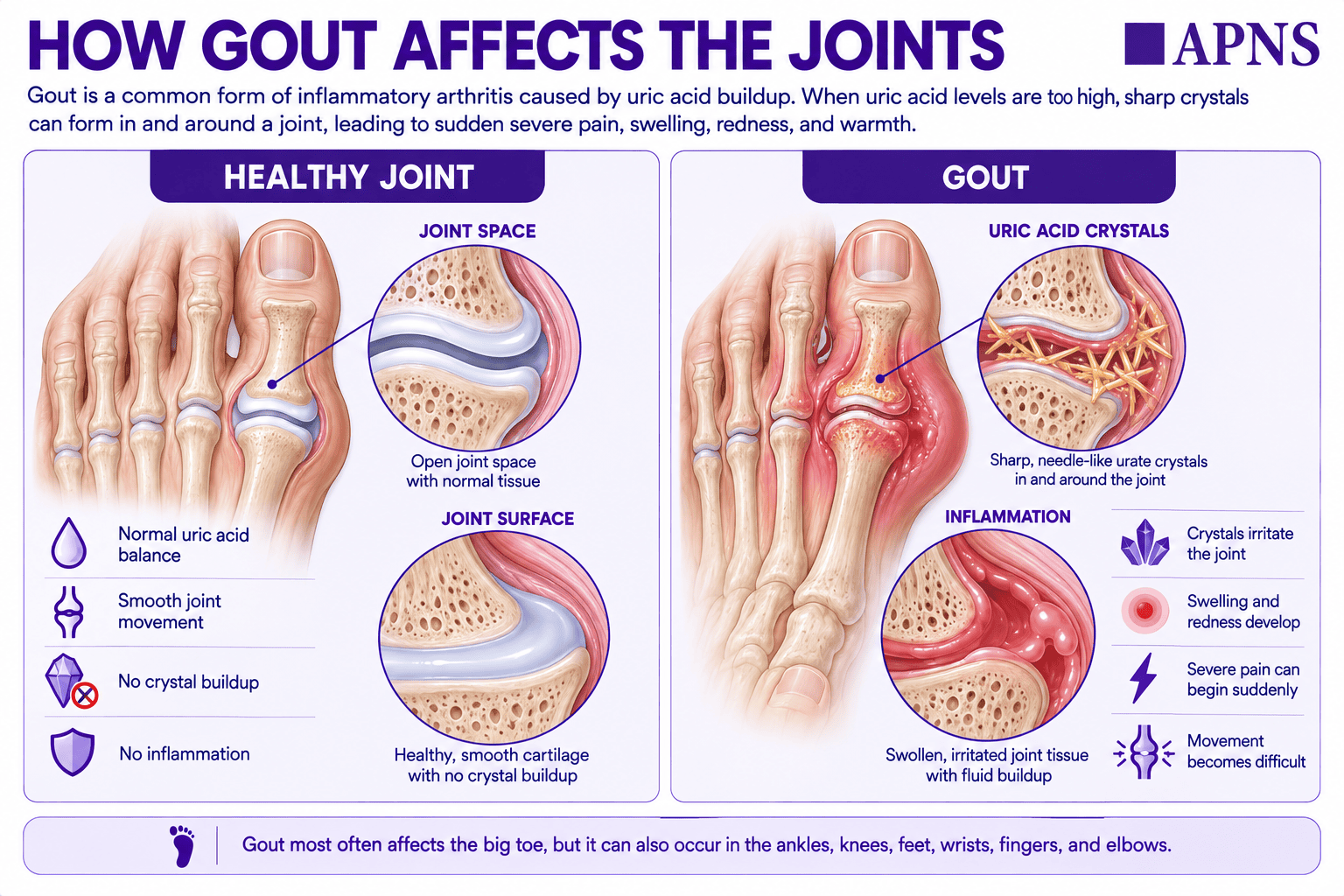
Gout develops when there is too much uric acid in the bloodstream. Uric acid is produced when the body breaks down substances called purines, which are naturally found in the body and in certain foods. When uric acid builds up faster than the kidneys can remove it, crystals may form in the joints.
Common causes and risk factors include:
Gout – NIAMS
https://www.niams.nih.gov/health-topics/gout
Learn about the causes of gout, uric acid buildup, and risk factors.
Several lifestyle factors and medical conditions can increase uric acid levels or trigger a gout attack.
Common triggers include:
Gout Diet – Mayo Clinic
https://www.mayoclinic.org/diseases-conditions/gout/in-depth/gout-diet/art-20048524
Provides practical information about foods that may increase or decrease the risk of gout attacks.
Healthy lifestyle habits and taking medications as prescribed can greatly reduce your risk of future gout attacks.
Helpful prevention tips include:
Gout – National Institute of Arthritis and Musculoskeletal and Skin Diseases (NIAMS)
https://www.niams.nih.gov/health-topics/gout
Provides practical recommendations for preventing gout attacks and protecting joint health.
The following video content is provided to help you better understand this condition. These resources are intended for educational purposes and should not replace personalized medical advice from your healthcare provider.
Laboratory testing helps confirm the diagnosis, measure uric acid levels, and evaluate kidney function.
Common laboratory tests may include:
Uric Acid Test – NIH MedlinePlus
https://medlineplus.gov/lab-tests/uric-acid-test/
Explains what a uric acid test measures and how the results are interpreted.
Several diagnostic tests may help confirm gout or evaluate joint damage.
Common diagnostic tests include:
Gout – American College of Rheumatology
https://rheumatology.org/patients/gout
Learn about the tests used to diagnose gout and monitor the condition.
Treatment focuses on relieving pain during a gout attack, lowering uric acid levels, and preventing future flare-ups and joint damage.
Treatment options may include:
Gout Treatment – American College of Rheumatology
https://rheumatology.org/patients/gout
Provides information about medications and long-term management of gout.
Healthy lifestyle habits can help lower uric acid levels and reduce the risk of future gout attacks.
Helpful lifestyle changes include:
Gout Diet – Mayo Clinic
https://www.mayoclinic.org/diseases-conditions/gout/in-depth/gout-diet/art-20048524
Provides practical nutrition recommendations for people living with gout.
Several medications can help relieve pain during gout attacks and lower uric acid levels to prevent future flare-ups.
Common medications include:
Allopurinol – NIH MedlinePlus
https://medlineplus.gov/druginfo/meds/a682673.html
Explains how allopurinol works, common side effects, and safe use.
Colchicine – NIH MedlinePlus
https://medlineplus.gov/druginfo/meds/a682711.html
Provides information about colchicine, how it treats gout attacks, and possible side effects.
Most people with gout do not need surgery. Treatment usually focuses on lowering uric acid levels, relieving pain during flare-ups, and preventing future attacks. However, procedures may be recommended if gout causes complications or severe joint damage.
Common procedures may include:
Gout – American College of Rheumatology
https://rheumatology.org/patients/gout
Learn about procedures that may be recommended for gout and how they help manage the condition.
Managing gout at home can help reduce flare-ups and improve your overall health.
Helpful tips include:
Gout Diet – Mayo Clinic
https://www.mayoclinic.org/diseases-conditions/gout/in-depth/gout-diet/art-20048524
Provides practical nutrition recommendations to help reduce gout flare-ups.
Foods high in purines—such as organ meats, some seafood, and large amounts of red meat—may increase uric acid levels. Limiting alcohol and sugary drinks may also help reduce gout attacks.
A gout attack may improve over several days or weeks, but without treatment, future attacks are more likely to occur.
Yes. Staying well hydrated helps your kidneys remove uric acid from your body.
Yes. Although gout often begins in the big toe, it can affect multiple joints, especially if it is not well controlled.
Some people, especially those with recurrent gout attacks or high uric acid levels, may benefit from long-term uric acid-lowering medication. Your healthcare provider will determine the best treatment plan for you.

Consider asking your healthcare provider:
Many people with gout receive care from their primary care provider. Depending on your symptoms and medical history, your provider may recommend seeing a specialist.
You may be referred to:
American College of Rheumatology – Gout
https://rheumatology.org/patients/gout
Provides patient education about gout, treatment options, and specialty care.
Gout is a long-term medical condition, but it is highly treatable. Although there is no permanent cure, keeping uric acid levels within a healthy range can prevent gout attacks and reduce the risk of long-term complications.
Many people remain free of gout flare-ups for years by following their treatment plan and maintaining healthy lifestyle habits.
Call 911 or seek emergency medical care immediately if you experience:
Seek prompt medical care if you notice:
Gout – NIH MedlinePlus
https://medlineplus.gov/gout.html
Learn about gout complications and when emergency medical care is needed.
CALL 911
APNS does not provide emergency medical services. If you believe you are experiencing a medical emergency, including (but not limited to) chest pain, difficulty breathing, stroke symptoms, severe allergic reactions, anaphylaxis, uncontrolled bleeding, seizures, loss of consciousness, or any other potentially life-threatening condition, you are instructed to call 911 immediately or go immediately to the nearest emergency department.
Gout – NIH MedlinePlus
https://medlineplus.gov/gout.html
Easy-to-understand information about gout, including symptoms, diagnosis, treatment, medications, and prevention.
National Institute of Arthritis and Musculoskeletal and Skin Diseases (NIAMS) – Gout
https://www.niams.nih.gov/health-topics/gout
Comprehensive information about gout, uric acid, treatment options, and long-term management.
American College of Rheumatology – Gout
https://rheumatology.org/patients/gout
Evidence-based patient education about gout, medications, healthy lifestyle habits, and specialty care.
Centers for Disease Control and Prevention (CDC) – Gout
https://www.cdc.gov/arthritis/basics/gout.html
Reliable information about gout, arthritis management, and reducing the risk of future flare-ups.
This guide is intended for educational purposes only and should not replace medical advice, diagnosis, or treatment from your healthcare provider. Always follow the recommendations of your healthcare team regarding your individual health needs. Contact your healthcare provider if your gout symptoms worsen, become more frequent, or your medications are not working as expected. Call 911 immediately if you experience severe joint pain with fever, signs of a serious infection, chest pain, difficulty breathing, or another medical emergency.
At APNS, our providers take the time to understand your condition and your goals. We offer comprehensive telehealth visits at a fixed rate — no membership fees, no insurance required, and no unexpected charges. Whether you’re newly diagnosed or looking for a provider who actually listens, we’re here to help.