

Hashimoto’s thyroiditis, also called Hashimoto’s disease or chronic autoimmune thyroiditis, is an autoimmune disorder in which the body’s immune system mistakenly attacks the thyroid gland. Over time, this ongoing inflammation damages the thyroid and reduces its ability to produce thyroid hormone, often leading to hypothyroidism (underactive thyroid).
Hashimoto’s thyroiditis is the most common cause of hypothyroidism in the United States. The condition usually develops gradually over many years, and many people do not notice symptoms until thyroid hormone levels become low. Although there is no cure for Hashimoto’s disease, it can usually be managed successfully with thyroid hormone replacement medication.
Hashimoto’s Disease – NIH MedlinePlus
https://medlineplus.gov/hashimotosdisease.html
Provides easy-to-understand information about Hashimoto’s disease, including symptoms, diagnosis, treatment, and long-term management.
Hashimoto’s Thyroiditis – American Thyroid Association
https://www.thyroid.org/hashimotos-thyroiditis/
Explains what Hashimoto’s disease is, common symptoms, causes, diagnosis, and treatment.
Hashimoto’s thyroiditis is one of the most common autoimmune diseases and the leading cause of hypothyroidism in areas where iodine intake is adequate, including the United States. It is much more common in women than men and most often develops during middle adulthood, although it can occur at any age.
American Thyroid Association – Hashimoto’s Thyroiditis
https://www.thyroid.org/hashimotos-thyroiditis/
Provides information about who is most likely to develop Hashimoto’s disease and common risk factors.
Many people have few or no symptoms early in the disease. As thyroid hormone levels decrease, symptoms of hypothyroidism gradually develop.
Common symptoms may include:
Your healthcare provider will review your symptoms, perform a physical examination, and order blood tests to evaluate thyroid function and look for antibodies that indicate autoimmune thyroid disease.
A diagnosis is commonly made using thyroid hormone testing along with thyroid antibody testing.
Hashimoto’s Disease – NIH MedlinePlus
https://medlineplus.gov/hashimotosdisease.html
Explains how Hashimoto’s disease is diagnosed and monitored.
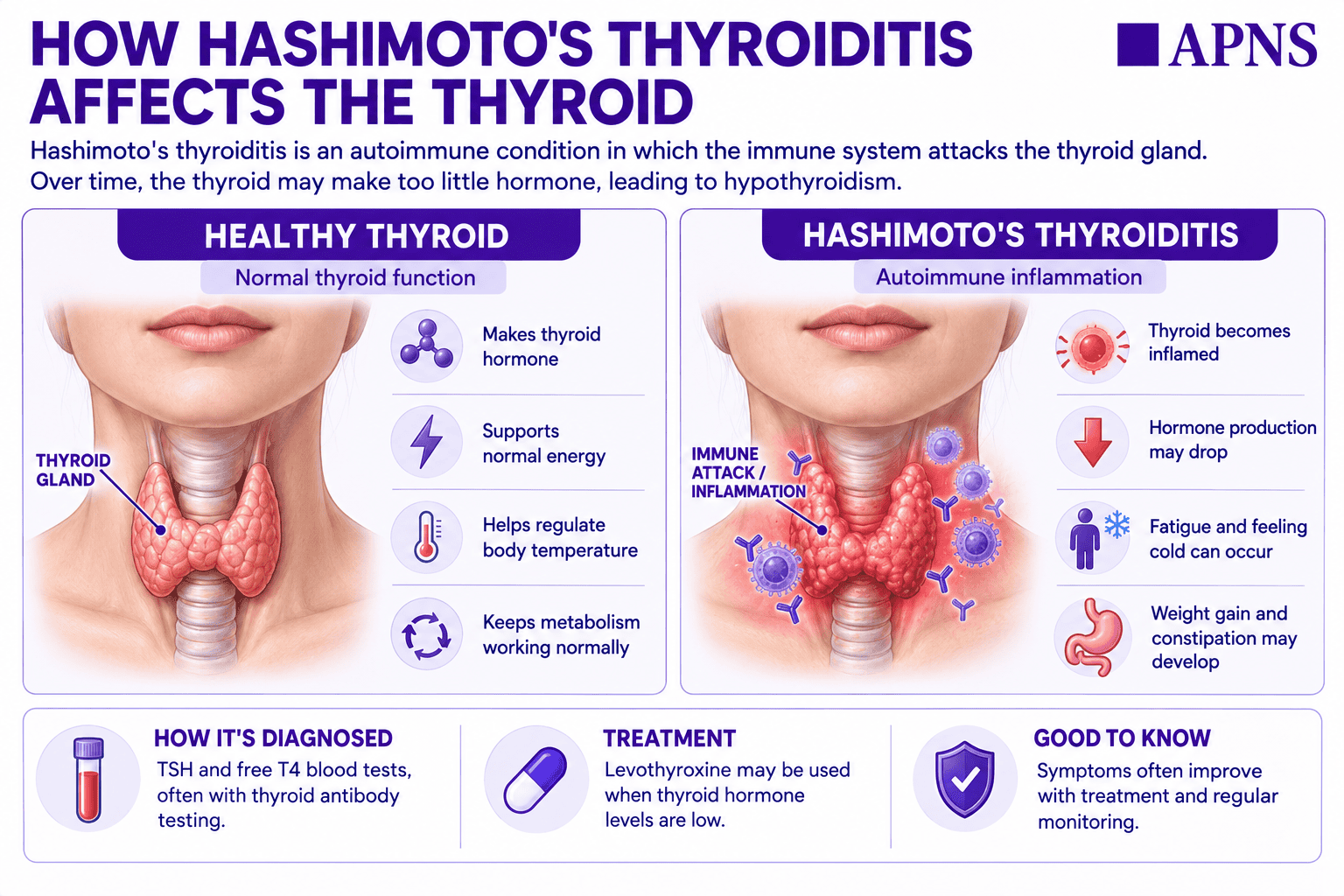
Hashimoto’s thyroiditis occurs when the immune system mistakenly attacks healthy thyroid tissue, causing chronic inflammation and gradual destruction of the thyroid gland.
Common risk factors include:
Hashimoto’s Disease – NIH MedlinePlus
https://medlineplus.gov/hashimotosdisease.html
Learn about the causes and risk factors associated with Hashimoto’s thyroiditis.
Several factors may worsen symptoms or interfere with thyroid hormone treatment.
Common factors include:
American Thyroid Association
https://www.thyroid.org/
Provides practical guidance on taking thyroid medications correctly and managing Hashimoto’s disease.
Hashimoto’s thyroiditis cannot currently be prevented because it is an autoimmune disease. However, early diagnosis, regular monitoring, and appropriate treatment can help prevent complications related to hypothyroidism.
Helpful prevention tips include:
American Thyroid Association
https://www.thyroid.org/
Provides practical information about thyroid health, medication management, and long-term care.
The following video content is provided to help you better understand this condition. These resources are intended for educational purposes and should not replace personalized medical advice from your healthcare provider.
Laboratory testing is essential for diagnosing and monitoring Hashimoto’s thyroiditis.
Common laboratory tests may include:
TSH Test – NIH MedlinePlus
https://medlineplus.gov/lab-tests/tsh-thyroid-stimulating-hormone-test/
Explains how TSH testing is used to diagnose and monitor Hashimoto’s thyroiditis.
Most people with Hashimoto’s disease do not require extensive imaging. However, additional testing may be recommended if thyroid enlargement or nodules are present.
Common diagnostic tests include:
American Thyroid Association – Thyroid Function Tests
https://www.thyroid.org/thyroid-function-tests/
Provides information about thyroid blood tests, ultrasound, and thyroid nodule evaluation.
Treatment focuses on replacing thyroid hormone when the thyroid is no longer able to produce enough on its own.
Treatment options may include:
Hashimoto’s Thyroiditis – American Thyroid Association
https://www.thyroid.org/hashimotos-thyroiditis/
Provides information about treatment options and long-term management of Hashimoto’s disease.
Healthy lifestyle habits can support thyroid health and improve your overall well-being.
Helpful lifestyle changes include:
American Thyroid Association
https://www.thyroid.org/
Provides practical guidance for living well with Hashimoto’s thyroiditis.
Most people with Hashimoto’s thyroiditis who develop hypothyroidism are treated with thyroid hormone replacement.
Common medications include:
Levothyroxine – NIH MedlinePlus
https://medlineplus.gov/druginfo/meds/a682461.html
Provides information about levothyroxine, proper use, side effects, and monitoring.
Most people with Hashimoto’s thyroiditis do not require surgery or invasive procedures. Treatment usually involves monitoring thyroid function with regular blood tests and taking thyroid hormone replacement medication if hypothyroidism develops. However, certain procedures may be recommended if thyroid nodules, an enlarged thyroid (goiter), or thyroid cancer is suspected.
Common procedures may include:
American Thyroid Association
https://www.thyroid.org/
Learn about thyroid ultrasounds, biopsies, surgery, and long-term monitoring for Hashimoto’s thyroiditis.
Hashimoto’s thyroiditis is usually a lifelong condition. Most people gradually develop hypothyroidism over time and require lifelong thyroid hormone replacement therapy. With proper treatment and regular monitoring, most people experience excellent symptom control and live healthy, active lives.
Your healthcare provider will monitor your thyroid hormone levels regularly and adjust your medication if needed.
Daily self-care is an important part of managing Hashimoto’s thyroiditis.
Helpful tips include:
American Thyroid Association – Hashimoto’s Thyroiditis
https://www.thyroid.org/hashimotos-thyroiditis/
Provides practical guidance for managing Hashimoto’s disease and taking thyroid medication correctly.
No. Hashimoto’s thyroiditis is an autoimmune disease that damages the thyroid gland. Over time, it commonly leads to hypothyroidism, but they are not the same condition.
Many people with Hashimoto’s disease eventually require lifelong thyroid hormone replacement because the thyroid gradually loses its ability to produce enough hormone.
Yes. Weight gain may occur as thyroid hormone levels decrease and metabolism slows. Treating hypothyroidism often improves metabolism, although healthy eating and regular exercise remain important.
Yes. Fatigue is one of the most common symptoms, particularly when hypothyroidism develops.
Most people do not need a special diet. Eating a balanced diet and discussing supplements or major dietary changes with your healthcare provider is recommended.

Consider asking your healthcare provider:
Many people with Hashimoto’s thyroiditis receive care from their primary care provider. Depending on your condition, your provider may recommend seeing a specialist.
You may be referred to:
American Thyroid Association
https://www.thyroid.org/
Provides patient education about thyroid disorders, specialty care, and treatment options.
There is currently no cure for Hashimoto’s thyroiditis because it is an autoimmune disease. However, it is highly treatable. Most people who develop hypothyroidism can successfully manage their condition with daily thyroid hormone replacement medication.
With appropriate treatment and routine follow-up, most people maintain normal thyroid hormone levels and enjoy an excellent quality of life.
Call 911 or seek emergency medical care immediately if you experience:
These symptoms may be signs of myxedema coma, a rare but life-threatening complication of severe untreated hypothyroidism.
Seek prompt medical evaluation if you notice:
Hashimoto’s Disease – NIH MedlinePlus
https://medlineplus.gov/hashimotosdisease.html
Learn about Hashimoto’s disease, possible complications, and when emergency medical care is needed.
CALL 911
APNS does not provide emergency medical services. If you believe you are experiencing a medical emergency, including (but not limited to) chest pain, difficulty breathing, stroke symptoms, severe allergic reactions, anaphylaxis, uncontrolled bleeding, seizures, loss of consciousness, or any other potentially life-threatening condition, you are instructed to call 911 immediately or go immediately to the nearest emergency department.
Hashimoto’s Disease – NIH MedlinePlus
https://medlineplus.gov/hashimotosdisease.html
Easy-to-understand information about Hashimoto’s disease, including symptoms, diagnosis, treatment, and long-term management.
American Thyroid Association – Hashimoto’s Thyroiditis
https://www.thyroid.org/hashimotos-thyroiditis/
Comprehensive patient education about Hashimoto’s disease, hypothyroidism, thyroid hormone replacement, and follow-up care.
National Institute of Diabetes and Digestive and Kidney Diseases (NIDDK)
https://www.niddk.nih.gov/health-information/endocrine-diseases
Reliable information about thyroid disease and other endocrine disorders.
Hormone Health Network
https://www.hormone.org/
Evidence-based patient education about thyroid disorders, autoimmune thyroid disease, and endocrine health.
This guide is intended for educational purposes only and should not replace medical advice, diagnosis, or treatment from your healthcare provider. Always follow the recommendations of your healthcare team regarding your individual health needs. Contact your healthcare provider if your symptoms worsen, new symptoms develop, or your medication is no longer controlling your thyroid condition. Call 911 immediately if you experience severe difficulty breathing, chest pain, loss of consciousness, severe confusion, or symptoms of myxedema coma or another medical emergency.
At APNS, our providers take the time to understand your condition and your goals. We offer comprehensive telehealth visits at a fixed rate — no membership fees, no insurance required, and no unexpected charges. Whether you’re newly diagnosed or looking for a provider who actually listens, we’re here to help.