

Hemorrhoids are swollen or enlarged veins in the lower rectum or around the anus. They are very common and can occur inside the rectum (internal hemorrhoids) or under the skin around the anus (external hemorrhoids). Hemorrhoids can cause discomfort, itching, pain, swelling, or bleeding during bowel movements.
Hemorrhoids often develop from increased pressure on the veins in the rectal area. They can usually be managed with healthy lifestyle changes, home treatments, and medications. In some cases, medical procedures may be needed if symptoms are severe or do not improve with conservative treatment.
Hemorrhoids – NIH MedlinePlus
https://medlineplus.gov/hemorrhoids.html
Provides easy-to-understand information about hemorrhoids, including symptoms, diagnosis, treatment, and prevention.
Hemorrhoids – National Institute of Diabetes and Digestive and Kidney Diseases (NIDDK)
https://www.niddk.nih.gov/health-information/digestive-diseases/hemorrhoids
Explains what hemorrhoids are, common symptoms, causes, diagnosis, and treatment options.
Hemorrhoids are one of the most common conditions affecting the digestive tract. Nearly 1 in 20 Americans have hemorrhoids, and about half of adults over age 50 experience hemorrhoid symptoms at some point in their lives.
Hemorrhoids – NIDDK
https://www.niddk.nih.gov/health-information/digestive-diseases/hemorrhoids
Provides information about how common hemorrhoids are and who is most likely to develop them.
Symptoms depend on whether the hemorrhoids are internal or external and how severe they are.
Common symptoms may include:
Tenderness while sitting
Your healthcare provider will ask about your symptoms, review your medical history, and perform a physical examination. Depending on your symptoms, your provider may examine the outside of the anus or perform a gentle examination of the rectum.
Additional testing may be recommended if you have rectal bleeding, are older, or have other symptoms that require evaluation.
Hemorrhoids – NIDDK
https://www.niddk.nih.gov/health-information/digestive-diseases/hemorrhoids
Explains how hemorrhoids are diagnosed and when additional testing may be recommended.
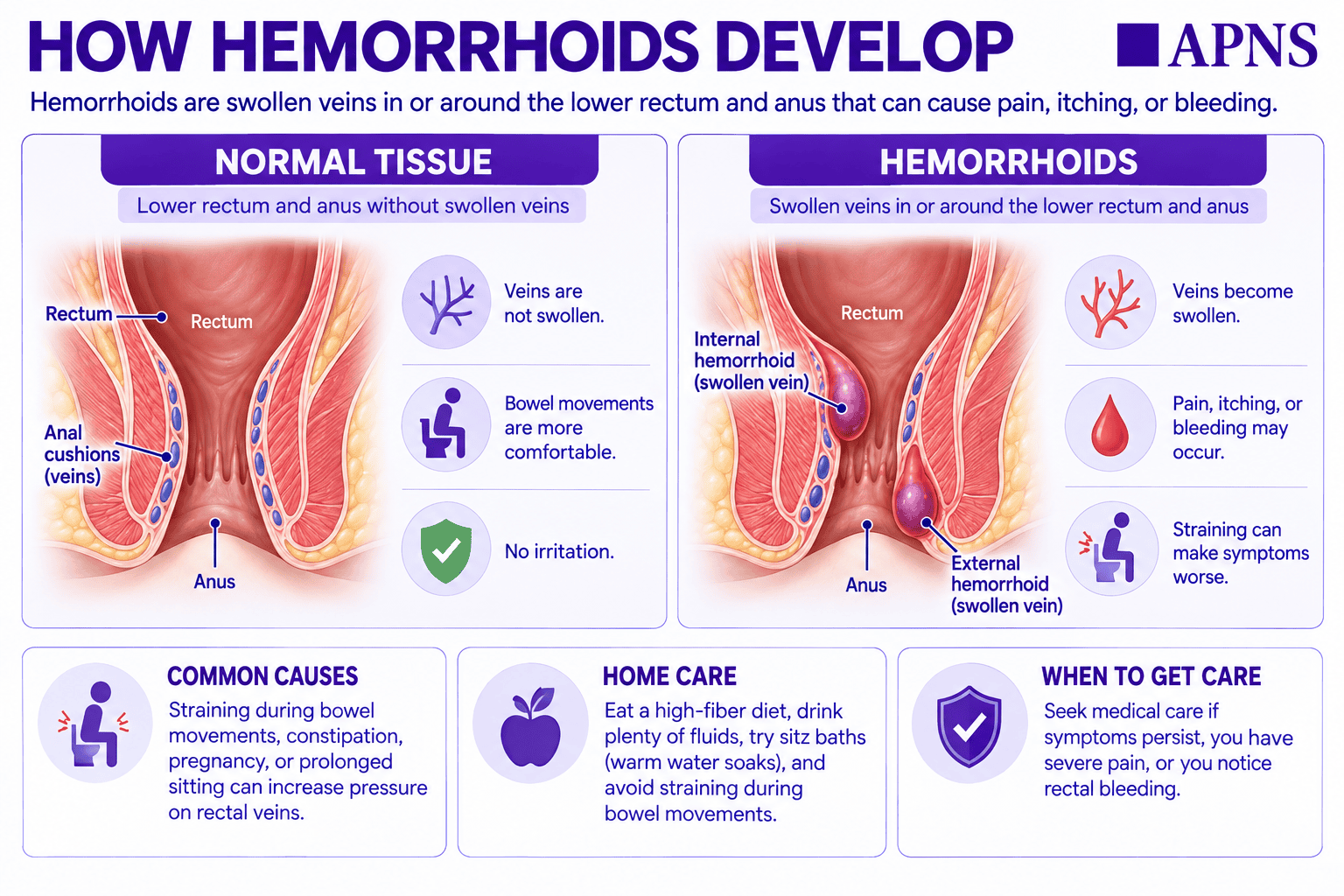
Hemorrhoids develop when increased pressure causes the veins in the lower rectum or anus to become swollen.
Common causes and risk factors include:
Hemorrhoids – NIDDK
https://www.niddk.nih.gov/health-information/digestive-diseases/hemorrhoids
Learn about the common causes and risk factors for hemorrhoids.
Several habits and conditions can increase pressure on the veins around the rectum and worsen hemorrhoid symptoms.
Common factors include:
Hemorrhoids – Cleveland Clinic
https://my.clevelandclinic.org/health/diseases/15120-hemorrhoids
Provides practical information about hemorrhoid symptoms, causes, and ways to reduce flare-ups.
Healthy bowel habits can help reduce your risk of developing hemorrhoids or experiencing future flare-ups.
Helpful prevention tips include:
Eating, Diet, & Nutrition for Hemorrhoids – National Institute of Diabetes and Digestive and Kidney Diseases (NIDDK)
https://www.niddk.nih.gov/health-information/digestive-diseases/hemorrhoids/eating-diet-nutrition
Provides practical guidance on nutrition and healthy bowel habits to help prevent hemorrhoids.
The following video content is provided to help you better understand this condition. These resources are intended for educational purposes and should not replace personalized medical advice from your healthcare provider.
Most people with hemorrhoids do not need laboratory testing. However, blood tests may be recommended if there has been significant bleeding or another condition is suspected.
Common laboratory tests may include:
Complete Blood Count (CBC) – NIH MedlinePlus
https://medlineplus.gov/lab-tests/complete-blood-count-cbc/
Explains what a CBC measures and why it may be ordered.
Additional testing depends on your age, symptoms, and medical history.
Common diagnostic tests may include:
Hemorrhoids – NIDDK
https://www.niddk.nih.gov/health-information/digestive-diseases/hemorrhoids
Learn about the examinations and procedures used to diagnose hemorrhoids.
Treatment depends on the severity of your symptoms. Many hemorrhoids improve with home care and lifestyle changes, while persistent or severe hemorrhoids may require office-based procedures or surgery.
Treatment options may include:
Hemorrhoids – American Society of Colon and Rectal Surgeons (ASCRS)
https://fascrs.org/patients/diseases-and-conditions/a-z/hemorrhoids-expanded-version
Provides information about hemorrhoid treatments, procedures, and recovery.
Healthy bowel habits can help reduce hemorrhoid symptoms and lower the risk of future flare-ups.
Helpful lifestyle changes include:
Eating, Diet, & Nutrition for Hemorrhoids – NIDDK
https://www.niddk.nih.gov/health-information/digestive-diseases/hemorrhoids/eating-diet-nutrition
Provides practical nutrition recommendations for preventing and managing hemorrhoids.
Several medications may help relieve hemorrhoid symptoms and make bowel movements more comfortable.
Common medications include:
Hemorrhoids – NIH MedlinePlus
https://medlineplus.gov/hemorrhoids.html
Provides information about medications and home treatments commonly used to manage hemorrhoid symptoms.
If hemorrhoid symptoms do not improve with lifestyle changes and medications, your healthcare provider may recommend an office-based procedure or surgery. These treatments are often effective at relieving symptoms and preventing recurrent problems.
Common procedures may include:
Hemorrhoids – American Society of Colon and Rectal Surgeons (ASCRS)
https://fascrs.org/patients/diseases-and-conditions/a-z/hemorrhoids-expanded-version
Learn about office procedures and surgical treatment options for hemorrhoids.
Most hemorrhoids improve with healthy lifestyle changes, home care, and medications. Some people experience occasional flare-ups, while others may need additional treatment if symptoms continue or return.
Following healthy bowel habits and reducing straining during bowel movements can help lower your risk of future hemorrhoids.
Simple home treatments can often relieve hemorrhoid symptoms and promote healing.
Helpful tips include:
Eating, Diet, & Nutrition for Hemorrhoids – National Institute of Diabetes and Digestive and Kidney Diseases (NIDDK)
https://www.niddk.nih.gov/health-information/digestive-diseases/hemorrhoids/eating-diet-nutrition
Provides practical nutrition recommendations for preventing and managing hemorrhoids.
Many small hemorrhoids improve with home care and healthy lifestyle changes. More severe hemorrhoids may require medical treatment or a procedure.
Small amounts of bright red blood during or after a bowel movement can occur with hemorrhoids. However,
, as other conditions can cause similar symptoms.
No. Hemorrhoids do not cause colorectal cancer, but the symptoms can be similar. Your healthcare provider may recommend additional testing if needed.
Yes. A high-fiber diet helps soften stool, reduce straining, and lower the risk of future hemorrhoids.
Most people do not need surgery. Surgical treatment is usually reserved for large, painful, or recurrent hemorrhoids that do not improve with other treatments.

Consider asking your healthcare provider:
Many hemorrhoids can be treated by your primary care provider. If symptoms are severe, recurrent, or complicated, your provider may recommend seeing a specialist.
You may be referred to:
American Society of Colon and Rectal Surgeons (ASCRS)
https://fascrs.org/patients
Provides patient education about hemorrhoids, colorectal conditions, and available treatments.
Most hemorrhoids improve with conservative treatment, and many resolve completely. However, hemorrhoids can return, especially if constipation, straining, or prolonged sitting on the toilet continues.
Healthy bowel habits, adequate fiber intake, staying hydrated, and regular physical activity can help reduce the risk of future hemorrhoids.
Call 911 or seek emergency medical care immediately if you experience:
Seek prompt medical evaluation if you notice:
Hemorrhoids – NIH MedlinePlus
https://medlineplus.gov/hemorrhoids.html
Learn when hemorrhoid symptoms require medical evaluation and when emergency care is needed.
CALL 911
APNS does not provide emergency medical services. If you believe you are experiencing a medical emergency, including (but not limited to) chest pain, difficulty breathing, stroke symptoms, severe allergic reactions, anaphylaxis, uncontrolled bleeding, seizures, loss of consciousness, or any other potentially life-threatening condition, you are instructed to call 911 immediately or go immediately to the nearest emergency department.
Hemorrhoids – NIH MedlinePlus
https://medlineplus.gov/hemorrhoids.html
Easy-to-understand information about hemorrhoids, including symptoms, diagnosis, treatment, and prevention.
National Institute of Diabetes and Digestive and Kidney Diseases (NIDDK) – Hemorrhoids
https://www.niddk.nih.gov/health-information/digestive-diseases/hemorrhoids
Comprehensive information about hemorrhoids, treatment options, nutrition, and long-term management.
American Society of Colon and Rectal Surgeons (ASCRS)
https://fascrs.org/patients/diseases-and-conditions/a-z/hemorrhoids-expanded-version
Evidence-based patient education about hemorrhoids, office procedures, surgery, and recovery.
Cleveland Clinic – Hemorrhoids
https://my.clevelandclinic.org/health/diseases/15120-hemorrhoids
Reliable patient education about symptoms, diagnosis, treatment, and prevention.
This guide is intended for educational purposes only and should not replace medical advice, diagnosis, or treatment from your healthcare provider. Always follow the recommendations of your healthcare team regarding your individual health needs. Contact your healthcare provider if your symptoms persist, worsen, or you experience recurrent rectal bleeding. Call 911 immediately if you develop heavy rectal bleeding, severe dizziness, fainting, severe abdominal pain, or another medical emergency.
At APNS, our providers take the time to understand your condition and your goals. We offer comprehensive telehealth visits at a fixed rate — no membership fees, no insurance required, and no unexpected charges. Whether you’re newly diagnosed or looking for a provider who actually listens, we’re here to help.