
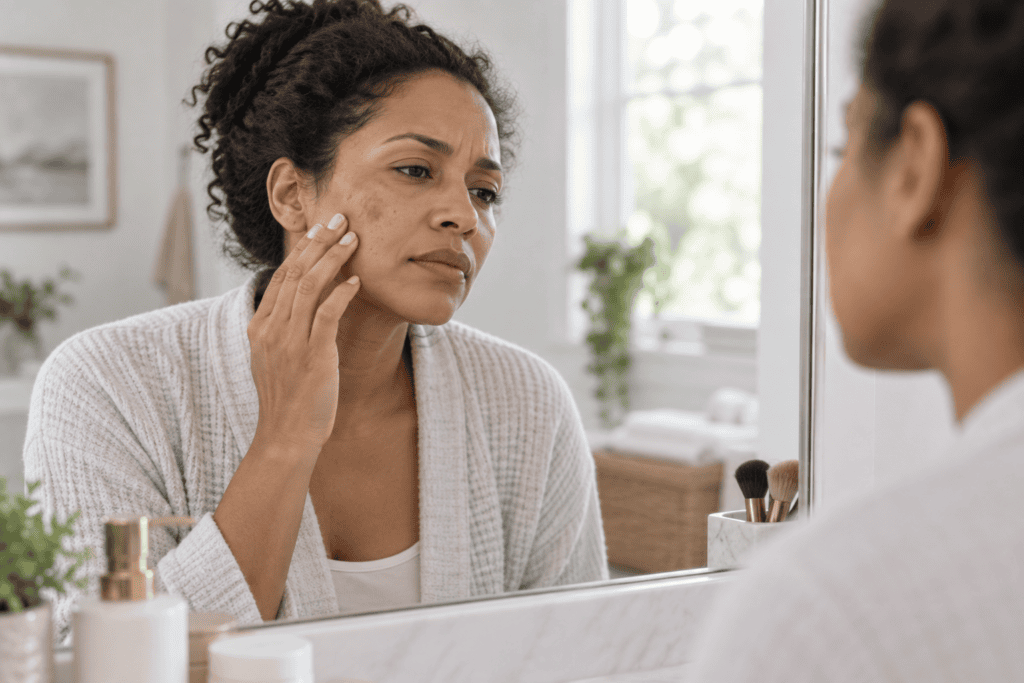
Hyperpigmentation means an area of skin is darker than the surrounding skin because it contains extra pigment, usually melanin. It can appear as freckles, spots, patches, or widespread darkening on any skin tone and may affect the face, body, lips, nails, or skin folds.
Hyperpigmentation is a description, not one diagnosis. Common causes include acne or rash healing, sun exposure, melasma, friction, medicines, and medical conditions. Most causes are harmless, but a new or changing dark spot sometimes needs examination for skin cancer or another illness.
Skin-Care Guidance for Dark Spots – American Academy of Dermatology
https://www.aad.org/public/everyday-care/skin-care-secrets/routine
Links to dermatologist guidance on fading dark spots, gentle routines, and safer skin care.
Moles and Melanoma Warning Signs – National Cancer Institute
https://www.cancer.gov/types/skin/moles-fact-sheet
Reviews changing pigmented lesions, the ABCDE warning signs, biopsy, and melanoma risk.
Dark spots are extremely common and can affect anyone. Post-inflammatory hyperpigmentation is especially noticeable and may last longer in medium-to-deep skin tones.
Sun spots become more common with age and cumulative ultraviolet exposure. Acne, eczema, shaving irritation, injuries, and cosmetic procedures are frequent triggers at any adult age.
Post-Inflammatory Hyperpigmentation After Acne – American Academy of Dermatology
https://www.aad.org/public/diseases/acne/derm-treat/scars/symptoms
Explains that flat post-acne dark spots are pigment changes rather than scars and may fade over time.
Skin Cancer and Hyperpigmentation in Darker Skin – American Academy of Dermatology
https://www.aad.org/public/diseases/skin-cancer/find/skin-of-color
Explains tinted sunscreen, visible-light protection, skin checks, and cancer signs across skin tones.
Hyperpigmentation itself usually does not hurt or itch. Symptoms such as scale, pain, bleeding, texture change, hair loss, weight loss, fatigue, or other illness may point to the underlying cause.
A clinician reviews when the pigment began, what came before it, symptoms, sun exposure, skin routine, procedures, medicines, pregnancy or hormones, family history, and general health. The color, shape, pattern, texture, and body location help identify the cause.
A full skin examination may distinguish post-inflammatory pigment, melasma, sun spots, acanthosis nigricans, medication changes, infection, moles, and skin cancer. Diagnosis should come before bleaching or procedures.
Moles and Melanoma Warning Signs – National Cancer Institute
https://www.cancer.gov/types/skin/moles-fact-sheet
Reviews changing pigmented lesions, the ABCDE warning signs, biopsy, and melanoma risk.
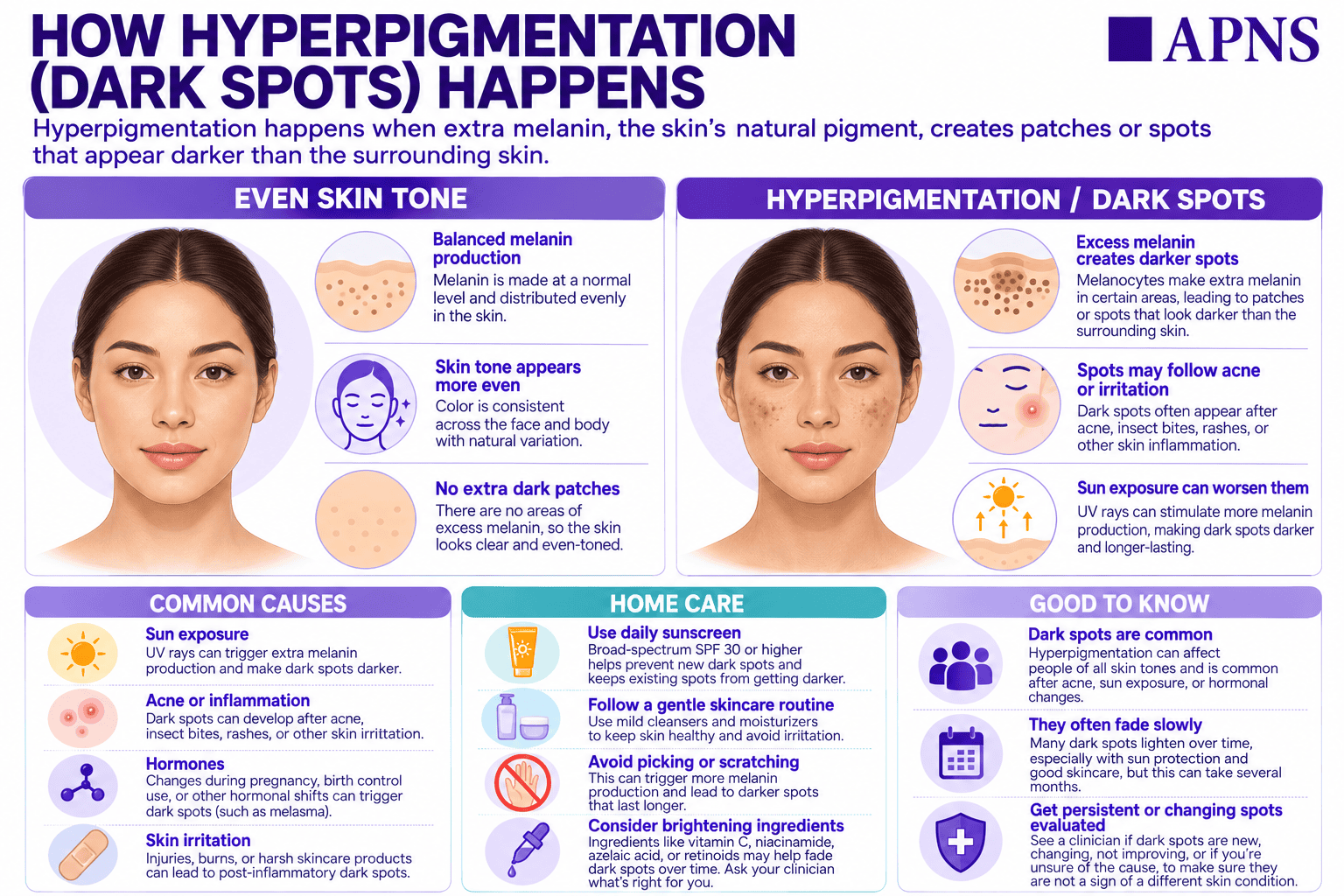
Treatment works best after the specific cause is identified and controlled.
Inflammation can create more pigment, so aggressive treatment may darken the skin instead of clearing it.
FDA Warning About Skin-Lightening Products
https://www.fda.gov/consumers/health-fraud-scams/fda-warns-consumers-skin-products-containing-mercury-andor-hydroquinone
Warns about illegal products containing mercury or nonprescription hydroquinone and their serious health risks.
FDA Warning About At-Home Chemical Peels
https://www.fda.gov/drugs/drug-safety-and-availability/fda-warns-against-purchasing-or-using-chemical-peel-skin-products-without-professional-supervision
Explains burn, scar, infection, and pigment risks from strong chemical peels used without supervision.
Not every cause is preventable, but early treatment of inflammation and consistent light protection reduce many dark spots and recurrences.
Skin Cancer and Hyperpigmentation in Darker Skin – American Academy of Dermatology
https://www.aad.org/public/diseases/skin-cancer/find/skin-of-color
Explains tinted sunscreen, visible-light protection, skin checks, and cancer signs across skin tones.
FDA Warning About Skin-Lightening Products
https://www.fda.gov/consumers/health-fraud-scams/fda-warns-consumers-skin-products-containing-mercury-andor-hydroquinone
Warns about illegal products containing mercury or nonprescription hydroquinone and their serious health risks.
The following video content is provided to help you better understand this condition. These resources are intended for educational purposes and should not replace personalized medical advice from your healthcare provider.
Labs
Most localized dark spots need no laboratory tests. Tests are selected when the history or skin pattern suggests an internal cause.
Broad hormone or vitamin testing is not routinely useful without other clinical clues.
A biopsy is the only way to confirm melanoma. Do not attempt to lighten or remove a suspicious spot before it is assessed.
Moles and Melanoma Warning Signs – National Cancer Institute
https://www.cancer.gov/types/skin/moles-fact-sheet
Reviews changing pigmented lesions, the ABCDE warning signs, biopsy, and melanoma risk.
Treatment depends on the cause, pigment depth, body area, skin tone, sensitivity, pregnancy status, and goals.
Some harmless spots need no treatment. A dermatologist should confirm that a lesion is benign before cosmetic removal.
Consistent gentle care is more effective than frequent product changes or aggressive exfoliation.
Retinoids and some other treatments are avoided during pregnancy. Discuss treatment during pregnancy, breastfeeding, or fertility care, and never use unlabeled or nonprescription hydroquinone lighteners.
FDA Warning About Skin-Lightening Products
https://www.fda.gov/consumers/health-fraud-scams/fda-warns-consumers-skin-products-containing-mercury-andor-hydroquinone
Warns about illegal products containing mercury or nonprescription hydroquinone and their serious health risks.
Procedures carry a higher risk of post-inflammatory color change in deeper skin tones and should be performed by qualified clinicians with relevant experience. Avoid strong at-home peels.
FDA Warning About At-Home Chemical Peels
https://www.fda.gov/drugs/drug-safety-and-availability/fda-warns-against-purchasing-or-using-chemical-peel-skin-products-without-professional-supervision
Explains burn, scar, infection, and pigment risks from strong chemical peels used without supervision.
Superficial spots may fade over months after the trigger stops. Deeper gray or blue-gray pigment can take longer, and some sun spots or medication changes persist without treatment.
Recurrence is common when sun, visible light, acne, eczema, friction, hormones, or irritation continues. Maintenance sun protection and control of the underlying condition improve results.
Post-Inflammatory Hyperpigmentation After Acne – American Academy of Dermatology
https://www.aad.org/public/diseases/acne/derm-treat/scars/symptoms
Explains that flat post-acne dark spots are pigment changes rather than scars and may fade over time.
Do not bleach, cut, burn, freeze, sand, or peel dark spots at home. Home mole-removal products can delay cancer diagnosis and cause scars or infection.
No. Pigment changes do not spread from person to person.
No. Most are benign, but a new or changing lesion can be skin cancer and should be examined.
Flat brown or gray spots are usually post-inflammatory pigment rather than true scars and often fade with time.
It prevents new darkening and helps existing pigment fade; many people also need treatment of the cause.
Iron oxides protect against visible light, which can worsen pigment, especially in deeper skin tones.
There are no FDA-approved legally marketed OTC hydroquinone skin-lightening drugs in the United States.
Sometimes, but the wrong device or setting can cause burns, scars, or darker pigment. Diagnosis and skin-tone expertise matter.
Asymmetry, irregular Border, uneven Color, changing Diameter, and Evolving. Any evolving or unusual lesion deserves assessment.

Some causes fade completely after inflammation or a trigger resolves. Others, such as sun spots, melasma, or chronic disease-related pigment, are managed rather than permanently cured.
The best result comes from treating the cause, protecting skin from light, and using a patient, low-irritation plan. Cosmetic improvement is optional when a condition is harmless.
Most hyperpigmentation is not urgent. Seek prompt medical care for:
Call emergency services for collapse, breathing difficulty, confusion, or signs of adrenal crisis or anaphylaxis. In the United States, contact Poison Control at 1-800-222-1222 for suspected toxic skin-lightening exposure.
Moles and Melanoma Warning Signs – National Cancer Institute
https://www.cancer.gov/types/skin/moles-fact-sheet
Reviews changing pigmented lesions, the ABCDE warning signs, biopsy, and melanoma risk.
FDA Warning About Skin-Lightening Products
https://www.fda.gov/consumers/health-fraud-scams/fda-warns-consumers-skin-products-containing-mercury-andor-hydroquinone
Warns about illegal products containing mercury or nonprescription hydroquinone and their serious health risks.
CALL 911
APNS does not provide emergency medical services. If you believe you are experiencing a medical emergency, including (but not limited to) chest pain, difficulty breathing, stroke symptoms, severe allergic reactions, anaphylaxis, uncontrolled bleeding, seizures, loss of consciousness, or any other potentially life-threatening condition, you are instructed to call 911 immediately or go immediately to the nearest emergency department.
Skin-Care Guidance for Dark Spots – American Academy of Dermatology
https://www.aad.org/public/everyday-care/skin-care-secrets/routine
Links to dermatologist guidance on fading dark spots, gentle routines, and safer skin care.
Skin Cancer and Hyperpigmentation in Darker Skin – American Academy of Dermatology
https://www.aad.org/public/diseases/skin-cancer/find/skin-of-color
Explains tinted sunscreen, visible-light protection, skin checks, and cancer signs across skin tones.
Post-Inflammatory Hyperpigmentation After Acne – American Academy of Dermatology
https://www.aad.org/public/diseases/acne/derm-treat/scars/symptoms
Explains that flat post-acne dark spots are pigment changes rather than scars and may fade over time.
Moles and Melanoma Warning Signs – National Cancer Institute
https://www.cancer.gov/types/skin/moles-fact-sheet
Reviews changing pigmented lesions, the ABCDE warning signs, biopsy, and melanoma risk.
FDA Warning About Skin-Lightening Products
https://www.fda.gov/consumers/health-fraud-scams/fda-warns-consumers-skin-products-containing-mercury-andor-hydroquinone
Warns about illegal products containing mercury or nonprescription hydroquinone and their serious health risks.
This guide is educational and does not replace professional medical care. Hyperpigmentation has many causes, and changing, bleeding, raised, painful, rapidly growing, or unusual spots require examination before cosmetic treatment. Avoid illegal skin lighteners, home mole-removal products, and unsupervised chemical peels. Discuss treatment during pregnancy or breastfeeding with a qualified clinician.
At APNS, our providers take the time to understand your condition and your goals. We offer comprehensive telehealth visits at a fixed rate — no membership fees, no insurance required, and no unexpected charges. Whether you’re newly diagnosed or looking for a provider who actually listens, we’re here to help.