

Launching September 2027

Neck Pain

Neck Pain At A Glance

  • Neck pain, or cervicalgia, is discomfort involving the muscles, ligaments, joints, nerves, bones, or discs of the neck.
  • It may feel like aching, stiffness, tightness, burning, muscle spasm, or sharp pain and can spread into the head, shoulders, upper back, arms, or hands.
  • Common causes include muscle strain, poor posture, prolonged computer or phone use, awkward sleeping positions, whiplash, arthritis, disc problems, and compressed nerves.
  • Numbness, tingling, or weakness extending into an arm or hand may occur when a cervical nerve is irritated or compressed.
  • Most new uncomplicated neck pain does not require immediate imaging and is usually evaluated through symptoms and a physical examination.
  • Treatment may include gentle activity, heat or cold, range-of-motion exercises, physical therapy, posture changes, medications, and selected procedures when needed.

Table of Contents

Table of Contents

What Is Neck Pain?

Neck pain, sometimes called cervical pain or cervicalgia, is discomfort affecting the muscles, ligaments, nerves, joints, spinal bones, or discs in the neck. It may feel like aching, tightness, stiffness, burning, muscle spasm, or sharp pain. The discomfort may remain in the neck or spread into the head, shoulders, upper back, arms, or hands.

Neck pain may develop after sleeping in an awkward position, prolonged computer or phone use, lifting, exercise, a fall, or a motor vehicle accident. It may also result from arthritis, a compressed nerve, a disc problem, spinal narrowing, or another medical condition. Most uncomplicated neck pain improves with time, gentle activity, and appropriate treatment.

Learn More

Neck Pain – NIH MedlinePlus

Provides patient-friendly information about common causes, symptoms, home care, and warning signs.

Neck Injuries and Disorders – NIH MedlinePlus

Provides information about muscle strain, whiplash, nerve problems, arthritis, and other neck conditions.

How Common Is Neck Pain?

Neck pain is common and can affect adults of any age. It frequently develops from muscle tension, repetitive activity, prolonged sitting, poor workstation positioning, awkward sleeping positions, injuries, or age-related changes in the cervical spine.

The risk may be higher in people who:

  • Work at a computer for long periods
  • Frequently look down at a phone or tablet
  • Perform repetitive lifting or overhead work
  • Have previously injured their neck
  • Drive for extended periods
  • Experience high levels of stress
  • Have arthritis or spinal-disc changes
  • Smoke or use nicotine
  • Have weak neck, shoulder, or upper-back muscles
  • Participate in contact sports
  • Have osteoporosis

Age-related cervical spine changes are common, but not everyone with these changes develops pain.

What Symptoms Might You Notice?

Neck pain may begin suddenly or develop gradually.

Common symptoms include:

  • Aching or soreness
  • Neck stiffness
  • Muscle tightness or spasms
  • Sharp or burning pain
  • Reduced ability to turn or tilt the head
  • Pain that worsens with movement
  • Pain after prolonged sitting
  • Pain spreading into the shoulders or upper back
  • Headaches that begin near the back of the neck
  • Tenderness when touching the neck muscles
  • Clicking, grinding, or popping
  • Difficulty finding a comfortable sleeping position
  • Pain traveling into an arm or hand
  • Numbness or tingling in an arm, hand, or fingers
  • Arm, hand, or finger weakness
  • Dizziness or balance problems after an injury

Pain, numbness, tingling, or weakness extending into an arm may occur when a cervical nerve is irritated or compressed.

How Is Neck Pain Diagnosed?

A healthcare provider may diagnose neck pain by asking about the symptoms and performing a physical examination.

The provider may ask:

  • When the pain began
  • Whether an accident or injury occurred
  • Where the pain is located
  • Whether it spreads into the shoulder or arm
  • Whether numbness, tingling, or weakness is present
  • Whether headaches or dizziness occur
  • Which movements worsen the pain
  • Whether fever, weight loss, or night sweats are present
  • Whether walking or balance has changed
  • Whether bladder or bowel function has changed
  • Whether you have osteoporosis, arthritis, cancer, or immune-system problems
  • Which medications you take
  • How symptoms affect work, sleep, and daily activities

The examination may include:

  • Checking posture
  • Testing neck movement
  • Examining areas of tenderness
  • Testing arm and hand strength
  • Checking sensation and reflexes
  • Evaluating shoulder movement
  • Watching walking and balance
  • Checking for signs of nerve or spinal-cord compression

Most new uncomplicated neck pain does not require immediate imaging. Testing is more likely when symptoms follow significant trauma, persist despite treatment, or suggest fracture, infection, cancer, or neurological injury.
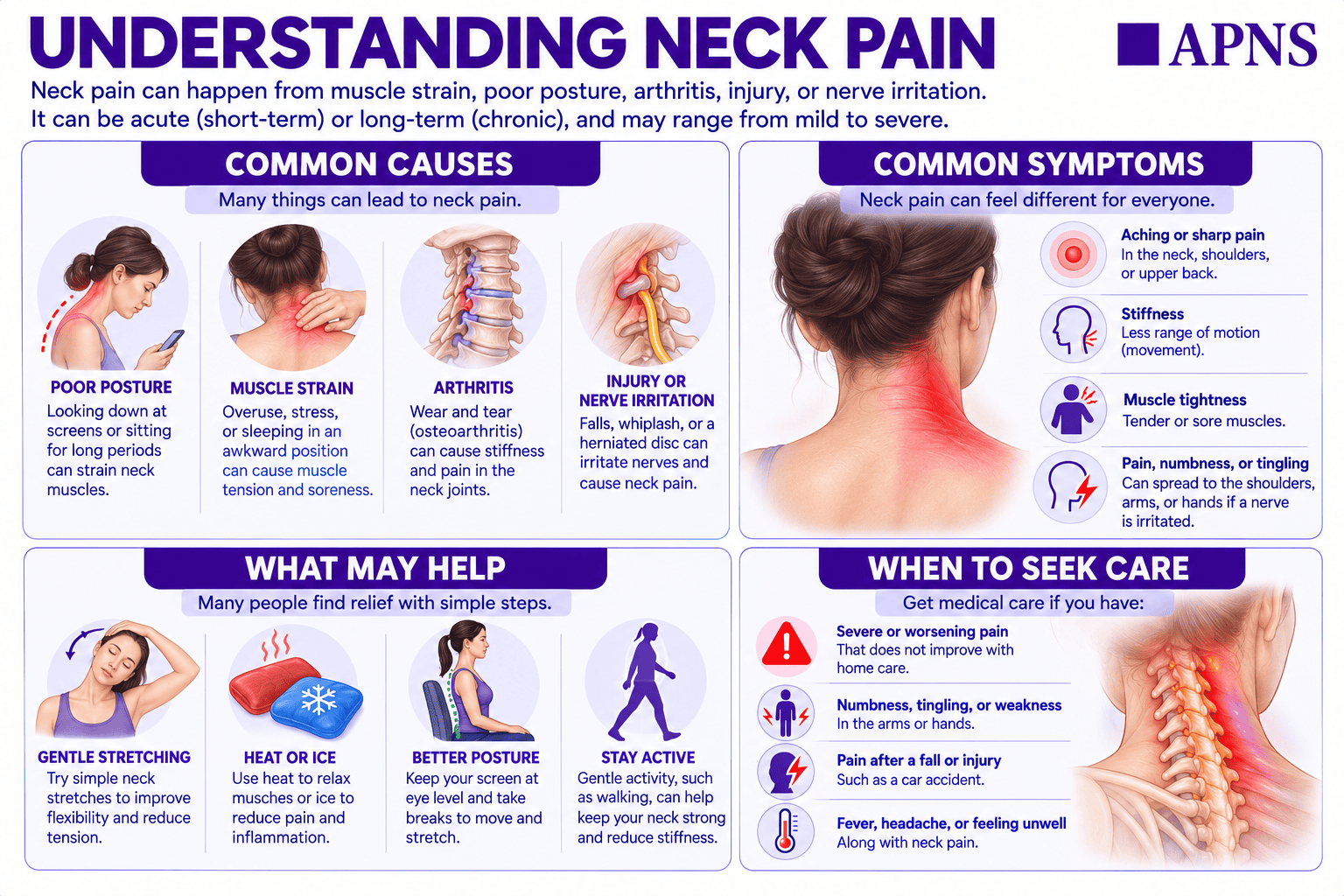
Neck Pain infographic – click to enlarge

What Causes Neck Pain?

Neck pain may result from muscle strain, injury, arthritis, nerve compression, inflammation, or another medical condition.

Common causes include:

  • Muscle or ligament strain
  • Prolonged computer or phone use
  • Poor posture
  • Sleeping in an awkward position
  • Repetitive lifting or overhead activity
  • Stress-related muscle tension
  • Whiplash
  • Falls or sports injuries
  • Motor vehicle accidents
  • Cervical osteoarthritis
  • Cervical spondylosis
  • Herniated or bulging discs
  • Pinched cervical nerves
  • Cervical spinal stenosis
  • Degenerative disc changes
  • Shoulder or upper-back conditions
  • Temporomandibular joint problems
  • Fibromyalgia
  • Inflammatory arthritis
  • Osteoporosis-related fractures
  • Less commonly, infection, cancer, or blood-vessel problems

Whiplash is a soft-tissue injury caused by rapid back-and-forth movement of the head and neck. It commonly occurs during vehicle collisions but may also follow sports injuries or falls.

What Can Make Neck Pain Worse?

Factors that may worsen neck pain or delay recovery include:

  • Holding the neck in one position for a long time
  • Looking down at a phone or tablet
  • Poor workstation setup
  • Sleeping without adequate neck support
  • Heavy or repetitive lifting
  • Carrying a heavy bag on one shoulder
  • Continuing painful activity after an injury
  • Sudden or forceful neck movements
  • Prolonged bed rest
  • Complete avoidance of normal movement
  • Poor sleep
  • Emotional stress
  • Smoking or nicotine use
  • Returning to sports too soon
  • Using an overly tight neck brace
  • Ignoring progressive numbness or weakness
  • Forceful neck manipulation after trauma

Prolonged inactivity may increase stiffness and muscle weakness. However, severe pain after an accident or symptoms suggesting spinal-cord injury require medical evaluation before exercises or forceful movement are attempted.

Prevention

Not every episode can be prevented, but healthy movement and workplace habits may reduce risk.

Helpful prevention measures include:

  • Keep screens near eye level.
  • Keep the head centered over the shoulders.
  • Avoid looking downward for long periods.
  • Take regular movement breaks.
  • Change sitting and standing positions.
  • Use a supportive chair.
  • Keep the keyboard and mouse close.
  • Avoid holding a phone between the ear and shoulder.
  • Strengthen neck, shoulder, and upper-back muscles.
  • Exercise regularly.
  • Warm up before sports or strenuous activity.
  • Increase exercise intensity gradually.
  • Wear appropriate protective equipment.
  • Use safe lifting techniques.
  • Avoid carrying heavy bags on one shoulder.
  • Use seat belts and properly adjusted head restraints.
  • Prevent falls at home and work.
  • Maintain bone health.
  • Stop smoking or using nicotine.
  • Complete rehabilitation after an injury.

Correct posture supports the neck’s natural curve and keeps the head aligned over the shoulders.

Learn More About Neck Pain

The following video content is provided to help you better understand this condition. These resources are intended for educational purposes and should not replace personalized medical advice from your healthcare provider.

Labs

Most uncomplicated neck pain does not require laboratory testing.

Possible tests include:

  • Complete Blood Count: May identify infection, anemia, or another medical concern.
  • C-Reactive Protein: Measures inflammation.
  • Erythrocyte Sedimentation Rate: Helps evaluate infection or inflammatory disease.
  • Blood Cultures: May be ordered when a spinal infection is suspected.
  • Kidney and Liver Function Tests: May guide safe medication use.
  • Calcium and Vitamin D: May be considered when bone weakness is suspected.
  • Rheumatoid Factor: May support an evaluation for rheumatoid arthritis.
  • Anti-CCP Antibody: May help identify rheumatoid arthritis.
  • Antinuclear Antibody: May be ordered when an autoimmune condition is suspected.
  • Thyroid Testing: May be considered when muscle symptoms occur with possible thyroid disease.
  • Lyme Disease Testing: May be appropriate when symptoms and exposure history suggest Lyme disease.

Blood tests cannot diagnose an ordinary muscle strain. They are used when the history or examination suggests infection, inflammation, autoimmune disease, or another underlying condition.

Learn More

Medical Tests – NIH MedlinePlus

Provides patient information about common blood and laboratory tests.

Diagnostics

Imaging or nerve testing may be recommended when symptoms are severe, persistent, or associated with injury or neurological changes.

Possible tests include:

  • X-Ray: Checks for fractures, arthritis, alignment changes, and some bone abnormalities.
  • Magnetic Resonance Imaging: Shows discs, nerves, the spinal cord, ligaments, infection, and tumors.
  • Computed Tomography Scan: Provides detailed images of the bones and may identify complex fractures.
  • Electromyography: Evaluates electrical activity in muscles when nerve injury is suspected.
  • Nerve-Conduction Study: Measures how well electrical signals travel through nerves.
  • Bone-Density Scan: Evaluates osteoporosis and fracture risk.
  • CT Angiography or MR Angiography: May be used when a blood-vessel condition is suspected.
  • Lumbar Puncture: Rarely needed but may help diagnose meningitis or another nervous-system infection.

An MRI may be considered when neck pain occurs with progressive arm or leg weakness, severe numbness, walking problems, spinal-cord symptoms, suspected infection, cancer, or persistent nerve-related pain.

Treatment & Management

Treatment Options

Treatment depends on the cause, severity, duration, and presence of nerve or spinal-cord symptoms.

Options may include:

  • Continuing gentle activity
  • Temporary activity modification
  • Heat or cold therapy
  • Gentle range-of-motion exercises
  • Physical therapy
  • Posture and workstation adjustments
  • Strengthening exercises
  • Massage
  • Pain-relief medication
  • Anti-inflammatory medication
  • Short-term muscle-relaxing medication
  • Treatment for arthritis or inflammatory disease
  • Cervical traction in selected cases
  • Trigger-point injections
  • Spinal injections
  • Surgery for selected structural or neurological conditions

Most uncomplicated neck pain improves without surgery. Persistent or severe symptoms may require physical therapy, imaging, medication changes, injections, or specialist evaluation.

Learn More

Neck Pain or Spasms: Self-Care – NIH MedlinePlus

Provides guidance about activity, heat, cold, medication, exercise, and medical follow-up.

Lifestyle Changes

Lifestyle changes can reduce muscle strain and help prevent recurring pain.

Helpful changes include:

  • Keep the head centered over the shoulders.
  • Avoid looking downward for long periods.
  • Raise screens to eye level.
  • Use a chair with back and arm support.
  • Keep the keyboard and mouse within easy reach.
  • Change position regularly.
  • Take brief movement breaks.
  • Avoid holding a phone between the ear and shoulder.
  • Use headphones or a speaker for long calls.
  • Strengthen the neck, shoulders, and upper back.
  • Participate in regular physical activity.
  • Use safe lifting techniques.
  • Avoid carrying heavy bags on one shoulder.
  • Maintain a weight recommended by your provider.
  • Stop smoking or using nicotine.
  • Manage stress.
  • Get adequate sleep.
  • Use a pillow that keeps the neck in a comfortable position.

Good posture keeps the head above the shoulders while maintaining the natural curves of the spine.

Learn More

Guide to Good Posture – NIH MedlinePlus

Explains standing, sitting, sleeping, and workplace positioning that supports the spine.

Medications

Medication may reduce pain and inflammation but may not correct the underlying cause.

Possible medications include:

  • Acetaminophen: May reduce mild to moderate pain but does not reduce inflammation.
  • Ibuprofen: A nonsteroidal anti-inflammatory drug that may reduce pain and inflammation.
  • Naproxen: A longer-acting nonsteroidal anti-inflammatory medication.
  • Topical Diclofenac: An anti-inflammatory gel used on selected painful areas.
  • Topical Lidocaine: May temporarily reduce pain in a small area.
  • Capsaicin or Menthol Products: May provide temporary relief.
  • Muscle Relaxants: May be prescribed for a short time when muscle spasms are significant.
  • Corticosteroids: Oral or injected medication may be used in selected inflammatory or nerve-related conditions.
  • Duloxetine: May be prescribed for selected chronic pain conditions.
  • Gabapentin or Pregabalin: May be considered for certain nerve-related symptoms.
  • Antibiotics: Used only when a bacterial infection is diagnosed.
  • Short-Term Opioid Medication: Rarely used when safer options have not provided enough relief.

Nonsteroidal anti-inflammatory drugs may increase the risk of stomach bleeding, kidney injury, elevated blood pressure, and heart problems. Acetaminophen can cause serious liver damage if too much is taken.

Muscle relaxants, gabapentin, pregabalin, and opioids may cause drowsiness, dizziness, falls, or impaired driving. Avoid alcohol and other sedating substances unless a healthcare professional confirms that the combination is safe.

Learn More

Pain Relievers – NIH MedlinePlus

Provides information about prescription and nonprescription pain medications, risks, and safe use.

Procedures

Most neck pain does not require an invasive procedure.

Possible procedures include:

  • Trigger-Point Injection: Places medication into selected painful or tight muscles.
  • Cervical Epidural Steroid Injection: May reduce inflammation around a compressed nerve in selected cases.
  • Facet-Joint Injection: May help diagnose or temporarily treat pain from small spinal joints.
  • Medial Branch Block: Tests whether selected nerves are carrying pain from a facet joint.
  • Radiofrequency Ablation: Uses heat to interrupt selected pain signals.
  • Discectomy: Removes part of a damaged disc pressing on a nerve or the spinal cord.
  • Cervical Fusion: Permanently joins selected vertebrae.
  • Artificial Disc Replacement: Replaces a damaged cervical disc in carefully selected patients.
  • Laminectomy or Laminoplasty: Creates more space for the spinal cord in selected cases of cervical stenosis.
  • Fracture Stabilization: Uses surgical hardware when a cervical fracture is unstable.

Surgery may be considered for progressive weakness, spinal-cord compression, severe instability, fracture, or persistent symptoms caused by a correctable structural problem.

What Should You Expect Long-Term?

Most uncomplicated neck pain improves within several days to several weeks. Symptoms may briefly worsen before improving, particularly after a soft-tissue injury.

Recovery depends on:

  • The underlying cause
  • Whether an injury occurred
  • Whether a nerve or the spinal cord is affected
  • Age and general health
  • Physical activity level
  • Workplace demands
  • Previous neck injuries
  • Smoking or nicotine use
  • Sleep and stress
  • Following rehabilitation recommendations

Some people develop recurring or chronic pain. Long-term management may include exercise, posture changes, physical therapy, medication, treatment of arthritis, and occasional specialist care.

Persistent pain does not always mean that damage is continuing. Sleep problems, muscle weakness, stress, reduced activity, and increased nervous-system sensitivity may contribute to chronic pain.

What Can You Do At Home?

For uncomplicated neck pain without warning signs:

  • Continue gentle daily activity.
  • Avoid prolonged bed rest.
  • Temporarily reduce heavy lifting and painful activities.
  • Change position regularly.
  • Apply a wrapped cold pack after a recent injury.
  • Use gentle heat for muscle tightness or stiffness.
  • Limit heat or cold to approximately 15–20 minutes.
  • Place a cloth between the skin and the heat or cold source.
  • Perform gentle neck movements as tolerated.
  • Avoid forceful stretching.
  • Use medication only as directed.
  • Adjust the height of screens and work surfaces.
  • Use a supportive sleeping position.
  • Contact a healthcare provider if symptoms worsen or do not improve.

Gentle neck movement may help prevent stiffness. Exercises should be stopped if they cause severe pain, dizziness, new numbness, tingling, weakness, or loss of balance.

Do not use forceful neck manipulation after an accident or when you have osteoporosis, severe headache, dizziness, weakness, numbness, balance changes, or other warning signs.

Frequently Asked Questions

Is neck pain usually serious?

No. Most neck pain is caused by muscle tension, posture, overuse, or a minor soft-tissue injury. Severe trauma, progressive weakness, fever, or spinal-cord symptoms require prompt evaluation.

What is cervicalgia?

Cervicalgia is a medical term for pain located in the neck.

What is a pinched nerve in the neck?

A cervical nerve may become irritated or compressed by inflammation, disc changes, arthritis, or spinal narrowing. Symptoms may include pain, tingling, numbness, or weakness extending into an arm or hand.

Should I rest my neck completely?

Usually not. Briefly reducing painful activity may help, but prolonged inactivity can increase stiffness and weakness. Gentle movement is generally encouraged when serious injury has been ruled out.

Should I use heat or ice?

Cold may help after a recent injury. Heat may help stiffness or muscle spasm. Protect the skin and stop if symptoms worsen.

Do I need an MRI?

Most new uncomplicated neck pain does not require an MRI. Imaging may be appropriate after major trauma or when there is progressive weakness, spinal-cord symptoms, suspected infection, cancer, fracture, or persistent nerve-related pain.

Can looking down at my phone cause neck pain?

Prolonged downward head positioning can strain neck and upper-back muscles. Raising the device, taking breaks, and changing position may help.

Can stress cause neck pain?

Stress can increase muscle tension, interfere with sleep, and make pain feel more intense.

Can neck pain cause headaches?

Yes. Muscle tension and cervical joint problems may cause headaches that begin at the back of the head or neck.

Is cracking my neck dangerous?

Occasional painless joint sounds are common. Repeated forceful twisting or manipulation should be avoided, especially after trauma or when dizziness, severe headache, weakness, numbness, or vascular risk is present.

How long does neck pain last?

Mild neck pain may improve within days. More significant soft-tissue injuries may take several weeks. Persistent pain may require medical evaluation and rehabilitation.

Questions To Ask Your Provider

Consider asking:

  • What is most likely causing my neck pain?
  • Could a nerve be compressed?
  • Are there signs of spinal-cord involvement?
  • Do I need an X-ray, CT scan, or MRI?
  • Which activities should I avoid?
  • Should I use heat or cold?
  • Which medication is safest for me?
  • Would physical therapy help?
  • Which exercises are safe?
  • Should I change my workstation?
  • What type of pillow may be appropriate?
  • Is cervical traction safe for me?
  • Should I avoid neck manipulation?
  • Do I need a referral to a spine specialist?
  • When can I return to work, driving, or sports?
  • Which symptoms require urgent or emergency care?

Specialist Referrals

Many cases can be managed by a primary care provider.

You may be referred to:

  • Physical Therapist: Improves movement, strength, posture, and body mechanics.
  • Physiatrist: Specializes in nonsurgical rehabilitation of spinal, nerve, muscle, and joint conditions.
  • Orthopedic Spine Specialist: Evaluates fractures, instability, arthritis, and structural spinal problems.
  • Neurosurgeon: Evaluates spinal-cord or nerve compression and selected surgical conditions.
  • Neurologist: Assesses weakness, numbness, headaches, or unexplained neurological symptoms.
  • Rheumatologist: Evaluates inflammatory arthritis and autoimmune disease.
  • Pain Management Specialist: Treats persistent pain with medication, rehabilitation, injections, or other procedures.
  • Sports Medicine Specialist: Evaluates activity-related neck injuries.
  • Emergency or Trauma Specialist: Treats serious injuries and possible spinal-cord damage.

Infectious Disease Specialist: Assists when a spinal infection is suspected or diagnosed.

Is Neck Pain Curable?

Whether neck pain is curable depends on the cause.

A mild muscle or ligament strain may heal completely. Pain from prolonged posture, awkward sleeping, or temporary muscle spasm often improves with activity changes, home care, and exercise.

Chronic conditions such as cervical arthritis, spinal stenosis, or degenerative disc disease may not have a permanent cure. However, treatment can often:

  • Reduce pain
  • Improve neck movement
  • Strengthen supporting muscles
  • Reduce nerve irritation
  • Improve sleep and daily function
  • Prevent or reduce flare-ups
  • Protect spinal-cord and nerve function
  • Delay or avoid surgery

Emergency Symptoms / When To Seek Immediate Help

Call 911 or seek emergency medical care immediately if neck pain occurs with:

  • Severe neck pain after a major accident, fall, or impact
  • Inability to move after an injury
  • New weakness or paralysis in an arm or leg
  • Loss of feeling in the arms, legs, or body
  • Loss of bladder or bowel control
  • Difficulty walking or remaining balanced
  • Difficulty breathing
  • Loss of consciousness
  • Sudden severe headache unlike previous headaches
  • Facial drooping, speech difficulty, or one-sided weakness
  • Sudden vision loss or double vision
  • Severe dizziness with neurological symptoms
  • A cold, pale, or weak arm
  • A severe allergic reaction after medication

Do not move a person with a suspected neck or spinal injury unless remaining in place creates an immediate danger. Keep the head and neck as still as possible and call emergency services.

Seek urgent same-day medical evaluation for:

  • Fever with severe headache and a stiff neck
  • Fever or chills with worsening neck pain
  • New arm or hand weakness
  • Progressive numbness or tingling
  • New clumsiness of the hands
  • Difficulty with buttons, writing, or gripping
  • New walking or balance problems
  • Severe pain after even a minor fall when osteoporosis is present
  • Unexplained weight loss
  • A history of cancer with new neck pain
  • Severe night pain
  • Recent serious infection
  • Recent spinal procedure or injection
  • Immune suppression
  • Long-term corticosteroid use
  • Pain that is rapidly worsening
  • Symptoms that do not improve with appropriate care

Numbness or weakness affecting the arms or hands may result from cervical nerve or spinal-cord compression. More severe spinal stenosis can also affect walking, balance, and bladder or bowel function.

CALL 911

APNS does not provide emergency medical services. If you believe you are experiencing a medical emergency, including (but not limited to) chest pain, difficulty breathing, stroke symptoms, severe allergic reactions, anaphylaxis, uncontrolled bleeding, seizures, loss of consciousness, or any other potentially life-threatening condition, you are instructed to call 911 immediately or go immediately to the nearest emergency department.

Official Resources / External Links

Neck Pain – NIH MedlinePlus

Provides information about neck structures, causes, symptoms, self-care, and warning signs.

Neck Injuries and Disorders – NIH MedlinePlus

Provides patient education about strains, whiplash, arthritis, nerve compression, and other neck conditions.

Neck Pain or Spasms: Self-Care – NIH MedlinePlus

Explains activity, heat, cold, medication, exercises, and when to contact a healthcare provider.

Cervical Spondylosis – NIH MedlinePlus

Provides information about age-related changes affecting the cervical discs, bones, and joints.

Spinal Stenosis – National Institute of Arthritis and Musculoskeletal and Skin Diseases

Explains spinal narrowing, nerve and spinal-cord symptoms, diagnosis, and treatment.

Guide to Good Posture – NIH MedlinePlus

Provides guidance for healthy posture during sitting, standing, and daily activities.

This guide is intended for educational purposes only and should not replace medical advice, diagnosis, imaging, or treatment from your healthcare provider. Neck pain may be caused by muscle strain, whiplash, arthritis, a disc problem, nerve compression, spinal-cord compression, fracture, osteoporosis, inflammatory disease, infection, cancer, a blood-vessel problem, or another condition requiring specific treatment. Consult a healthcare professional before beginning a new exercise program, regularly taking pain medication, using cervical traction, or receiving forceful neck manipulation. Seek urgent medical evaluation for fever, progressive numbness, weakness, hand clumsiness, walking problems, severe night pain, unexplained weight loss, or worsening symptoms after an injury. Call 911 immediately for severe trauma, paralysis, loss of bladder or bowel control, difficulty breathing, loss of consciousness, stroke symptoms, sudden severe headache, or another medical emergency.

Get personalized care for Neck Pain

At APNS, our providers take the time to understand your condition and your goals. We offer comprehensive telehealth visits at a fixed rate — no membership fees, no insurance required, and no unexpected charges. Whether you’re newly diagnosed or looking for a provider who actually listens, we’re here to help.