

What Is Obsessive-Compulsive Disorder?
Obsessive-compulsive disorder, commonly called OCD, is a mental health condition involving recurring, unwanted thoughts, images, doubts, or urges called obsessions. These experiences can cause intense anxiety, fear, disgust, guilt, or discomfort. A person may then feel driven to perform repeated actions or mental rituals called compulsions to reduce the distress or prevent something feared from happening.
Compulsions may provide temporary relief, but the fear and doubt usually return. This creates a repeating cycle that can consume significant time and interfere with work, school, relationships, sleep, and daily activities. OCD is not simply liking order, being careful, or having particular preferences. It is a treatable condition that can range from mild to severe.
Obsessive-Compulsive Disorder – National Institute of Mental Health
Explains OCD symptoms, contributing factors, diagnosis, psychotherapy, medication, and specialized treatment.
Obsessive-Compulsive Disorder – NIH MedlinePlus
Provides patient-friendly information about obsessions, compulsions, testing, and treatment.
OCD can affect people of any sex, gender, culture, education level, or background. Symptoms often begin during childhood, adolescence, or early adulthood, although they may appear at other ages.
Some people recognize that their fears or rituals are excessive, while others have limited insight into their symptoms. OCD commonly occurs with depression, anxiety disorders, tic disorders, eating disorders, or substance-use problems.
The risk may be higher in people who have:
OCD is not caused by poor character, weakness, or lack of self-control.
People with OCD may experience obsessions, compulsions, or both.
Common Obsessions
Obsessions are intrusive and unwanted. Examples include:
Having an intrusive thought does not mean that a person agrees with it, wants it, or will act on it. OCD thoughts are often distressing precisely because they conflict with the person’s values.
Common Compulsions
Compulsions may be visible actions or private mental rituals, including:
OCD symptoms are generally time-consuming, cause significant distress, or interfere with important areas of life.
OCD is diagnosed through a mental health evaluation. There is no single blood test, brain scan, or online questionnaire that can confirm the diagnosis.
A healthcare professional may ask about:
The clinician may use a structured assessment such as the Yale-Brown Obsessive Compulsive Scale, often called the Y-BOCS, to measure symptom severity and monitor response to treatment.
The evaluation should distinguish OCD from conditions that can look similar, including:
OCD and obsessive-compulsive personality disorder are different conditions. OCD involves unwanted obsessions and compulsions, while obsessive-compulsive personality disorder involves a long-term pattern of perfectionism, control, rules, and orderliness that may feel appropriate to the person.
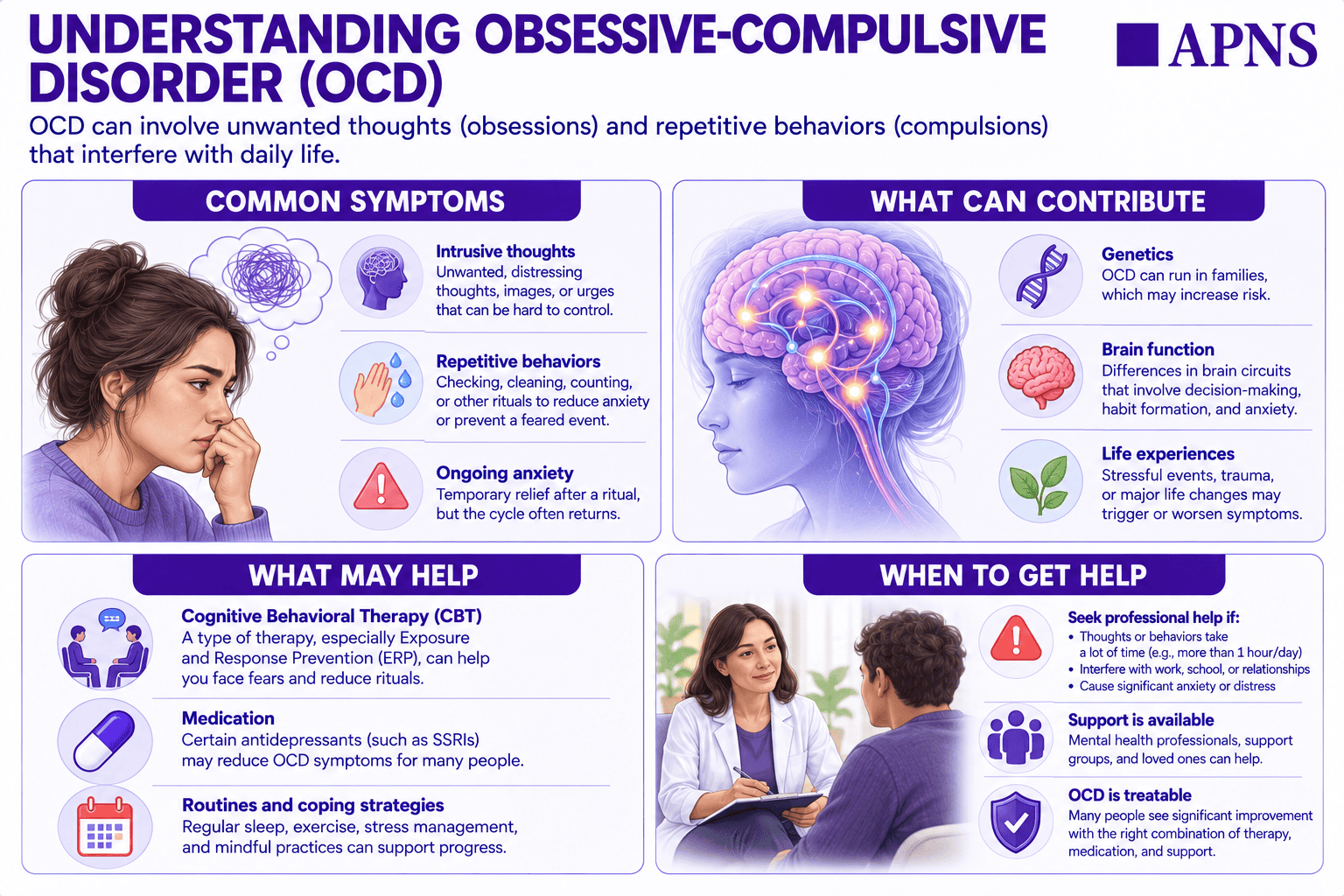
The exact cause of OCD is not fully understood. It likely develops through a combination of biological, genetic, psychological, and environmental factors.
Possible contributing factors include:
Stress does not necessarily cause OCD, but it may trigger or worsen symptoms in someone who is vulnerable.
Factors that may worsen OCD include:
Compulsions and reassurance may reduce anxiety briefly, but they usually strengthen the OCD cycle over time.
OCD cannot always be prevented, but early recognition and appropriate treatment may reduce its effect on daily life.
Helpful measures include:
Avoid blaming yourself or another person for OCD symptoms. Shame and secrecy often delay treatment.
The following video content is provided to help you better understand this condition. These resources are intended for educational purposes and should not replace personalized medical advice from your healthcare provider.
Laboratory testing does not diagnose OCD, but testing may help identify medical conditions that contribute to new or unusual symptoms.
Possible tests include:
Routine extensive laboratory testing is usually unnecessary when symptoms have developed gradually and the history clearly supports OCD.
Most people with OCD do not need medical imaging.
Possible assessments include:
Brain imaging, an electroencephalogram, or other neurological testing may be considered when symptoms begin suddenly, follow a head injury, occur with seizures, or include significant confusion, movement abnormalities, personality changes, or other neurological signs.
The main treatments for OCD are specialized psychotherapy, medication, or a combination of both. Treatment should be based on symptom severity, medical history, personal preference, access to care, previous response, and co-occurring conditions.
Treatment options may include:
Exposure and Response Prevention
Exposure and response prevention, commonly called ERP, is a specialized form of cognitive behavioral therapy and is a leading treatment for OCD.
During ERP, a person gradually and safely faces thoughts, objects, situations, or uncertainties that trigger OCD while practicing not performing the usual compulsion. Over time, the person learns that distress can decrease without rituals and that uncertainty can be tolerated.
ERP should be:
The goal is not to prove with complete certainty that nothing bad will happen. The goal is to reduce compulsions and improve the ability to live with ordinary uncertainty.
Lifestyle measures can support treatment but do not replace ERP or prescribed medication.
Helpful strategies include:
Trying to eliminate every intrusive thought is usually unrealistic. Treatment focuses on changing how the person responds to the thought.
Several antidepressant medications can reduce OCD symptoms. OCD frequently requires a longer medication trial and sometimes higher doses than depression, although dosing must always be managed by a qualified prescriber. Improvement may take several weeks or longer.
Common medication options include:
Other selective serotonin reuptake inhibitors may also be used based on clinical judgment, treatment history, and individual needs.
Possible side effects include:
Clomipramine may cause:
Medication safety guidance:
If an adequate medication trial does not provide enough improvement, a psychiatrist may recommend switching medications, combining ERP with medication, or adding another medication. Antipsychotic medication may sometimes be added for severe or treatment-resistant OCD, particularly when a tic disorder is also present. It is not generally used as the only treatment for OCD.
Most people with OCD do not require a procedure.
Specialized options for severe or treatment-resistant OCD may include:
A specialist should confirm that appropriate ERP and adequate medication trials have been attempted before invasive treatment is considered.
OCD is often a long-lasting condition, but symptoms can improve substantially with appropriate treatment. Some people achieve minimal symptoms, while others continue to experience occasional intrusive thoughts but become much less controlled by compulsions.
Recovery may involve:
Symptoms may worsen during stressful periods. Continued practice of ERP skills and ongoing follow-up can help prevent a temporary flare from becoming severe.
Treatment progress is not always steady. Brief increases in anxiety may occur when compulsions are reduced, but this does not necessarily mean treatment is failing.
Home strategies should support a professional treatment plan.
Helpful steps include:
Avoid creating highly complicated self-directed exposures that could be unsafe. Work with a trained clinician when symptoms involve medical fears, trauma, eating restrictions, dangerous objects, or severe distress.
Family members can support treatment by offering encouragement without repeatedly answering OCD-driven reassurance questions or participating in rituals.
No. Some people with OCD have concerns about order or symmetry, but many do not. OCD involves distressing obsessions and compulsions that interfere with life.
Intrusive thoughts are common in OCD and do not mean that a person wants to act on them. People with OCD are often deeply distressed because the thoughts conflict with their values.
No. An unwanted thought, image, or urge is not the same as intention or behavior. A clinician should still evaluate any actual desire, plan, or risk of harming someone.
Yes. Compulsions may include reviewing memories, counting mentally, praying, replacing thoughts, analyzing feelings, or trying to achieve certainty.
Reassurance may briefly reduce anxiety, but repeated OCD-driven reassurance often strengthens the cycle. A therapist can help family members respond supportively without participating in compulsions.
This informal term is sometimes used for OCD in which compulsions are less visible. People may still perform mental rituals, avoidance, checking, reviewing, or reassurance seeking.
Yes. OCD can involve repeated doubts about love, compatibility, attraction, loyalty, or whether a relationship is “right.”
Yes. This may involve fears of sin, wrongdoing, dishonesty, offense, or failing to follow moral rules perfectly. It is sometimes called scrupulosity.
OCD may attach to identity-related uncertainty and lead to repeated checking or analysis. A qualified clinician should provide respectful assessment without treating any identity itself as an illness.
Yes. Insight varies. Some people know their fears are excessive, while others feel the feared outcome is highly likely.
Trying to force thoughts away often makes them more noticeable. ERP teaches a person to allow thoughts without responding with rituals.
Symptoms may fluctuate, but clinically significant OCD often requires treatment. Early support can reduce the amount of time the condition disrupts a person’s life.
The length varies based on severity, frequency of sessions, home practice, co-occurring conditions, and treatment access. Improvement usually requires repeated practice rather than one exposure.
Medication may reduce symptoms but does not guarantee that they will disappear permanently. Combining medication with ERP may be especially helpful for moderate or severe symptoms.
No. They are different diagnoses. OCD involves intrusive obsessions and compulsions, while obsessive-compulsive personality disorder involves a broader pattern of perfectionism, control, rigidity, and preoccupation with rules.

Consider asking:
What options exist if the first treatments do not work?
OCD may be treated by a primary care provider, therapist, or psychiatric specialist depending on symptom severity.
Possible referrals include:
Not every therapist who provides general anxiety treatment is trained in ERP. It is appropriate to ask directly about OCD-specific training and experience.
OCD is often described as a chronic or long-lasting condition, so there is no guaranteed permanent cure. However, effective treatments can greatly reduce symptoms and help people regain control of their daily lives.
Treatment can help a person:
A person does not need to eliminate every intrusive thought to recover. The goal is for the thoughts to have less power and no longer dictate behavior.
Call 911 or go to the nearest emergency department if a person:
For suicidal thoughts, emotional crisis, or concern about someone’s safety in the United States, call or text 988 to reach the 988 Suicide & Crisis Lifeline.
Seek urgent same-day mental health or medical care for:
Intrusive thoughts about harm are not automatically an emergency when they are unwanted and accompanied by fear and avoidance. However, an actual wish, plan, preparation, or intention to harm oneself or another person requires immediate professional assessment.
CALL 911
APNS does not provide emergency medical services. If you believe you are experiencing a medical emergency, including (but not limited to) chest pain, difficulty breathing, stroke symptoms, severe allergic reactions, anaphylaxis, uncontrolled bleeding, seizures, loss of consciousness, or any other potentially life-threatening condition, you are instructed to call 911 immediately or go immediately to the nearest emergency department.
Obsessive-Compulsive Disorder – National Institute of Mental Health
Explains OCD symptoms, possible causes, psychotherapy, medication, and current research.
When Unwanted Thoughts or Repetitive Behaviors Take Over – NIMH
Provides detailed patient education about obsessions, compulsions, ERP, medication, and finding help.
Obsessive-Compulsive Disorder – NIH MedlinePlus
Provides patient-friendly information, treatment resources, and links to additional educational materials.
Explains how healthcare professionals assess OCD symptoms and rule out other conditions.
Obsessive-Compulsive and Related Disorders – American Psychiatric Association
Provides information about OCD and related disorders, psychotherapy, medication, and treatment selection.
988 Suicide & Crisis Lifeline – Substance Abuse and Mental Health Services Administration
Provides information about free crisis support available by calling or texting 988.
This guide is intended for educational purposes only and should not replace assessment, diagnosis, psychotherapy, medication management, or emergency care from a qualified healthcare professional. Intrusive thoughts may occur with OCD, depression, trauma-related conditions, generalized anxiety, psychosis, bipolar disorder, substance use, neurological illness, or other conditions requiring different treatment. Having an unwanted intrusive thought does not automatically mean a person wants to act on it, but any actual intention, plan, or preparation to harm oneself or another person requires immediate professional assessment. Do not begin, stop, or change psychiatric medication without consulting the prescriber. Exposure and response prevention should be individualized and should not involve dangerous, illegal, medically unsafe, or nonconsensual activities. Seek urgent care when rituals prevent eating, drinking, sleeping, leaving home, maintaining hygiene, or completing basic self-care. In the United States, call or text 988 for suicidal thoughts or a mental health crisis. Call 911 or go to the nearest emergency department for an active suicide attempt, immediate danger, serious overdose, severe self-injury, or inability to remain safe.
At APNS, our providers take the time to understand your condition and your goals. We offer comprehensive telehealth visits at a fixed rate — no membership fees, no insurance required, and no unexpected charges. Whether you’re newly diagnosed or looking for a provider who actually listens, we’re here to help.