

Penile discharge is fluid that comes from the urethra, the opening at the tip of the penis, when you are not urinating or ejaculating. It may be clear, cloudy, white, yellow, green, bloody, thin, or thick. New or unusual discharge can be a sign of urethritis, which means inflammation of the urethra, and should be evaluated by a healthcare provider.
Not every fluid is abnormal. Pre-ejaculate during sexual arousal and semen with orgasm are normal. Smegma collects under the foreskin rather than coming from the urethra. Because appearance alone cannot identify the cause, testing—not guessing—is the safest way to know whether treatment is needed.
Urethritis and Cervicitis – CDC STI Treatment Guidelines
https://www.cdc.gov/std/treatment-guidelines/urethritis-and-cervicitis.htm
Explains urethritis symptoms, causes, testing, treatment principles, and follow-up for healthcare professionals and patients.
Urethritis – NIH MedlinePlus
https://medlineplus.gov/ency/article/000439.htm
Provides patient-friendly information about urethral inflammation, symptoms, tests, and treatment.
Penile discharge is a common reason adults seek sexual-health or urgent-care evaluation. Sexually transmitted infections (STIs), especially gonorrhea and chlamydia, are important causes, but non-STI irritation and other urinary conditions can also cause symptoms.
Many infections can occur without symptoms. A person may have an STI even when discharge is mild, comes and goes, or is absent, so a partner’s diagnosis or a recent exposure can still be a reason for testing.
Sexually Transmitted Infections – CDC
https://www.cdc.gov/sti/
Provides current information about STI symptoms, testing, treatment, prevention, and finding care.
Sexually Transmitted Infections – NIH MedlinePlus
https://medlineplus.gov/sexuallytransmittedinfections.html
Offers plain-language information and links about common STIs, symptoms, testing, and prevention.
Discharge may be the only symptom, or it may occur with:
Color, thickness, smell, and amount cannot reliably tell which infection is present. A clinician may need urine and swab tests even if symptoms seem mild.
A provider will ask when the discharge began, what it looks like, and whether you have burning, sores, testicular pain, urinary symptoms, fever, recent antibiotics, or a partner with symptoms or an STI. They may ask about oral, vaginal, and anal contact so testing includes every exposed body site.
The examination may include the penis, urethral opening, foreskin, testicles, groin, abdomen, and any sores or rash. The conversation should be private, respectful, and nonjudgmental. Tell the provider about allergies and all medicines before treatment.
Urethritis and Cervicitis – CDC STI Treatment Guidelines
https://www.cdc.gov/std/treatment-guidelines/urethritis-and-cervicitis.htm
Explains urethritis symptoms, causes, testing, treatment principles, and follow-up for healthcare professionals and patients.
Urethritis – NIH MedlinePlus
https://medlineplus.gov/ency/article/000439.htm
Provides patient-friendly information about urethral inflammation, symptoms, tests, and treatment.
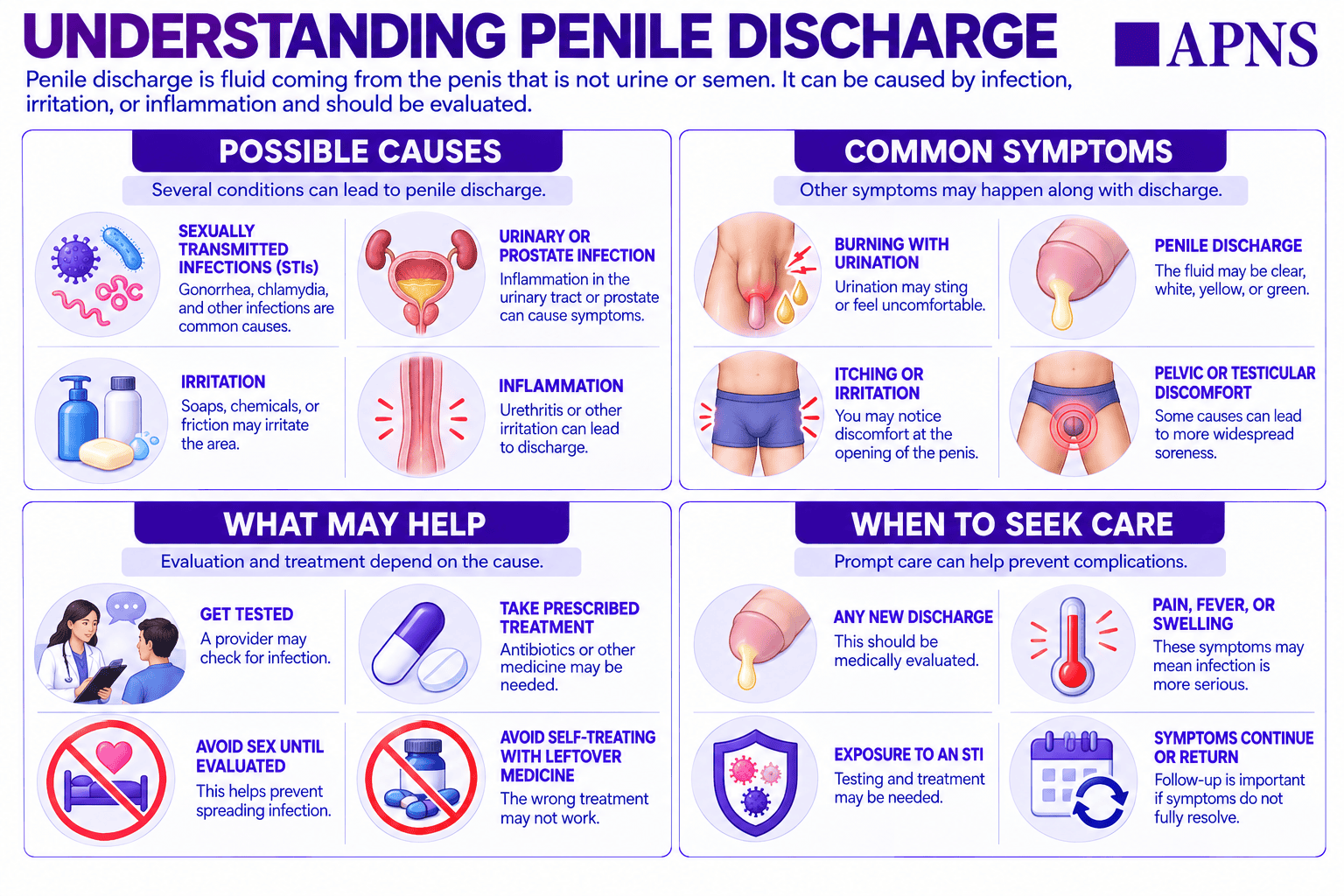
The most common cause is urethritis. It may be infectious or noninfectious.
An STI is a medical condition, not a sign of poor character or hygiene. Honest sexual-history information helps your clinician select the right tests and treatment.
Urethritis and Cervicitis – CDC STI Treatment Guidelines
https://www.cdc.gov/std/treatment-guidelines/urethritis-and-cervicitis.htm
Explains urethritis symptoms, causes, testing, treatment principles, and follow-up for healthcare professionals and patients.
About Gonorrhea – CDC
https://www.cdc.gov/gonorrhea/about/index.html
Explains gonorrhea symptoms, transmission, testing, treatment, and prevention.
About Chlamydia – CDC
https://www.cdc.gov/chlamydia/about/index.html
Explains chlamydia symptoms, testing, treatment, partner care, and prevention.
Symptoms may worsen when the underlying infection or inflammation remains untreated. Repeated irritation can also prolong discomfort.
Do not insert swabs, tools, or home remedies into the urethra. They can cause injury, worsen irritation, and affect testing.
Sexually Transmitted Infections – CDC
https://www.cdc.gov/sti/
Provides current information about STI symptoms, testing, treatment, prevention, and finding care.
Not all causes can be prevented, but you can reduce STI and irritation risks by:
Condoms lower risk but do not fully prevent infections spread by uncovered skin. Regular testing and prompt treatment remain important.
Sexually Transmitted Infections – CDC
https://www.cdc.gov/sti/
Provides current information about STI symptoms, testing, treatment, prevention, and finding care.
HIV Testing – CDC
https://www.cdc.gov/hiv/testing/index.html
Explains who should be tested for HIV, available tests, and where to obtain testing.
The following video content is provided to help you better understand this condition. These resources are intended for educational purposes and should not replace personalized medical advice from your healthcare provider.
Testing is based on symptoms, exposures, examination findings, and local recommendations. Possible tests include:
For a first-catch urine STI test, follow the collection instructions and avoid cleaning or collecting a midstream sample unless told to do so. Ask the clinic whether you should avoid urinating for a period before the test.
Urethral Discharge Culture – NIH MedlinePlus
https://medlineplus.gov/ency/article/003750.htm
Explains how a urethral sample may be collected, why it is tested, and what to expect.
HIV Testing – CDC
https://www.cdc.gov/hiv/testing/index.html
Explains who should be tested for HIV, available tests, and where to obtain testing.
Most cases are diagnosed without imaging. The key tests are urine or swab-based laboratory tests and a focused examination.
A negative test does not rule out every possible cause. Persistent symptoms require follow-up rather than repeated self-treatment.
Urethral Discharge Culture – NIH MedlinePlus
https://medlineplus.gov/ency/article/003750.htm
Explains how a urethral sample may be collected, why it is tested, and what to expect.
Urethritis and Cervicitis – CDC STI Treatment Guidelines
https://www.cdc.gov/std/treatment-guidelines/urethritis-and-cervicitis.htm
Explains urethritis symptoms, causes, testing, treatment principles, and follow-up for healthcare professionals and patients.
Treatment depends on the cause and may begin before every result is available when examination confirms urethritis or follow-up is uncertain. The provider considers likely organisms, allergies, recent antibiotics, local resistance patterns, and test results.
Do not treat penile discharge with over-the-counter yeast products or leftover antibiotics unless a clinician recommends them. The wrong medicine may not cure the infection and can make future treatment harder.
Urethritis and Cervicitis – CDC STI Treatment Guidelines
https://www.cdc.gov/std/treatment-guidelines/urethritis-and-cervicitis.htm
Explains urethritis symptoms, causes, testing, treatment principles, and follow-up for healthcare professionals and patients.
About Gonorrhea – CDC
https://www.cdc.gov/gonorrhea/about/index.html
Explains gonorrhea symptoms, transmission, testing, treatment, and prevention.
Simple steps can reduce irritation and help prevent transmission while you are being evaluated.
These steps support comfort and prevention but do not replace testing or prescription treatment.
Sexually Transmitted Infections – CDC
https://www.cdc.gov/sti/
Provides current information about STI symptoms, testing, treatment, prevention, and finding care.
Antibiotics are chosen for the suspected or confirmed infection. Depending on the diagnosis, treatment may involve an injection, oral tablets, or both; exact regimens can change as resistance and guidelines evolve.
Take every dose exactly as directed and do not share medicine. Tell the provider if you vomit a dose, miss doses, develop a rash or severe diarrhea, or have symptoms after treatment. Medication choice may differ with allergies, drug interactions, kidney or liver disease, or antibiotic resistance.
Urethritis and Cervicitis – CDC STI Treatment Guidelines
https://www.cdc.gov/std/treatment-guidelines/urethritis-and-cervicitis.htm
Explains urethritis symptoms, causes, testing, treatment principles, and follow-up for healthcare professionals and patients.
About Gonorrhea – CDC
https://www.cdc.gov/gonorrhea/about/index.html
Explains gonorrhea symptoms, transmission, testing, treatment, and prevention.
Most penile discharge does not require a procedure. Testing and medication are usually enough.
Ask why a procedure is recommended, what it will feel like, the risks and benefits, how to prepare, and what recovery or follow-up is expected.
Urethral Discharge Culture – NIH MedlinePlus
https://medlineplus.gov/ency/article/003750.htm
Explains how a urethral sample may be collected, why it is tested, and what to expect.
Most infectious causes improve with the correct treatment, but discharge may take a short time to fully stop. Untreated infection can spread to the epididymis or prostate, contribute to ongoing pain or fertility problems, and be passed to partners.
You can get many STIs again after successful treatment. Follow instructions about repeat testing; CDC commonly recommends retesting about three months after gonorrhea or chlamydia because reinfection is common. Persistent symptoms need reevaluation and may require testing for Mgen, trichomoniasis, resistance, or a noninfectious cause.
About Gonorrhea – CDC
https://www.cdc.gov/gonorrhea/about/index.html
Explains gonorrhea symptoms, transmission, testing, treatment, and prevention.
About Chlamydia – CDC
https://www.cdc.gov/chlamydia/about/index.html
Explains chlamydia symptoms, testing, treatment, partner care, and prevention.
While waiting for care or results:
A home STI test may be useful in some settings, but visible discharge, pain, or swelling deserves clinical evaluation because an examination and immediate treatment may be needed.
Sexually Transmitted Infections – CDC
https://www.cdc.gov/sti/
Provides current information about STI symptoms, testing, treatment, prevention, and finding care.
No. STIs are common causes, but irritation, urinary infection, prostatitis, balanitis, injury, and structural problems are also possible. Testing is needed.
No. White, yellow, green, clear, or cloudy discharge can overlap among causes. Color alone cannot diagnose an infection.
Yes. Many STIs cause no symptoms, so either partner may have an infection without knowing it.
Symptoms may fade while an infection remains. Waiting can allow complications or transmission, so new urethral discharge should be evaluated.
Clear fluid during sexual arousal is usually normal pre-ejaculate. Fluid that appears without arousal, especially with burning or irritation, should be checked.
Avoid sexual contact while awaiting evaluation. Your clinician can advise which recent partners should be notified now and help with confidential partner services.
Follow the instructions for your diagnosis. For gonorrhea, CDC advises waiting seven days after treatment and until all partners are treated and symptoms have resolved.

Consider asking:
Most cases can be managed in primary care, urgent care, or a sexual-health clinic. Referral may be appropriate to:
A local health department or sexual-health clinic may provide confidential testing, treatment, vaccines, and partner services.
Sexually Transmitted Infections – CDC
https://www.cdc.gov/sti/
Provides current information about STI symptoms, testing, treatment, prevention, and finding care.
Many common causes are curable. Gonorrhea, chlamydia, trichomoniasis, and many other bacterial infections can be cured with the correct prescription treatment, although reinfection is possible.
Some viral infections are manageable rather than curable, and noninfectious irritation improves only after the trigger is removed. Structural problems may require urologic treatment. Testing identifies which situation applies.
About Gonorrhea – CDC
https://www.cdc.gov/gonorrhea/about/index.html
Explains gonorrhea symptoms, transmission, testing, treatment, and prevention.
About Chlamydia – CDC
https://www.cdc.gov/chlamydia/about/index.html
Explains chlamydia symptoms, testing, treatment, partner care, and prevention.
Call 911 for severe allergic-reaction symptoms such as trouble breathing, throat swelling, fainting, or a rapidly spreading rash after medication.
Seek urgent or same-day medical care for:
Sudden testicular pain can be torsion, which is time-sensitive and may threaten the testicle. Do not wait for a routine STI appointment.
Urethritis – NIH MedlinePlus
https://medlineplus.gov/ency/article/000439.htm
Provides patient-friendly information about urethral inflammation, symptoms, tests, and treatment.
CALL 911
APNS does not provide emergency medical services. If you believe you are experiencing a medical emergency, including (but not limited to) chest pain, difficulty breathing, stroke symptoms, severe allergic reactions, anaphylaxis, uncontrolled bleeding, seizures, loss of consciousness, or any other potentially life-threatening condition, you are instructed to call 911 immediately or go immediately to the nearest emergency department.
Urethritis and Cervicitis – CDC STI Treatment Guidelines
https://www.cdc.gov/std/treatment-guidelines/urethritis-and-cervicitis.htm
Explains urethritis symptoms, causes, testing, treatment principles, and follow-up for healthcare professionals and patients.
Sexually Transmitted Infections – CDC
https://www.cdc.gov/sti/
Provides current information about STI symptoms, testing, treatment, prevention, and finding care.
About Gonorrhea – CDC
https://www.cdc.gov/gonorrhea/about/index.html
Explains gonorrhea symptoms, transmission, testing, treatment, and prevention.
About Chlamydia – CDC
https://www.cdc.gov/chlamydia/about/index.html
Explains chlamydia symptoms, testing, treatment, partner care, and prevention.
Sexually Transmitted Infections – NIH MedlinePlus
https://medlineplus.gov/sexuallytransmittedinfections.html
Offers plain-language information and links about common STIs, symptoms, testing, and prevention.
HIV Testing – CDC
https://www.cdc.gov/hiv/testing/index.html
Explains who should be tested for HIV, available tests, and where to obtain testing.
This guide is intended for educational purposes only and should not replace medical advice, diagnosis, testing, or treatment from a healthcare provider. Penile discharge has several possible causes, and appearance alone cannot determine whether an STI is present. Avoid sexual contact and seek timely evaluation for new or unusual discharge. Seek urgent care for sudden testicular pain, fever with worsening genital symptoms, inability to urinate, severe swelling, significant injury, or a serious medication reaction.
At APNS, our providers take the time to understand your condition and your goals. We offer comprehensive telehealth visits at a fixed rate — no membership fees, no insurance required, and no unexpected charges. Whether you’re newly diagnosed or looking for a provider who actually listens, we’re here to help.