

Pink eye, medically called conjunctivitis, is inflammation or infection of the conjunctiva, the thin, clear tissue that lines the inside of the eyelids and covers the white part of the eye. When the conjunctiva becomes irritated or inflamed, the eye may appear pink or red and may become watery, itchy, swollen, or produce discharge.
Common types of conjunctivitis include:
Viral and bacterial conjunctivitis can spread easily from person to person. Allergic and irritant conjunctivitis are not contagious.
Pink Eye – NIH MedlinePlus
https://medlineplus.gov/pinkeye.html
Provides easy-to-understand information about conjunctivitis, including symptoms, causes, treatment, and prevention.
Pink Eye – National Eye Institute (NEI)
https://www.nei.nih.gov/eye-health-information/eye-conditions-and-diseases/pink-eye
Provides information about the different types of pink eye, symptoms, treatment, and preventing its spread.
Pink eye is one of the most common and treatable eye conditions. It can affect people of all ages, although infectious conjunctivitis is especially common among children because viruses and bacteria spread easily in schools, daycare centers, households, and other close-contact environments.
Most cases are mild, but symptoms that include significant pain, light sensitivity, vision changes, or intense redness require prompt medical evaluation because they may indicate a more serious eye condition.
Conjunctivitis (Pink Eye) – Centers for Disease Control and Prevention (CDC)
https://www.cdc.gov/conjunctivitis/
Provides information about pink eye, symptoms, causes, treatment, and prevention.
Symptoms may affect one or both eyes and vary depending on the cause.
Common symptoms may include:
Symptoms may differ by type:
A healthcare provider usually diagnoses pink eye by reviewing your symptoms and examining your eyes and eyelids. They may ask about:
Because viral, bacterial, allergic, and other eye conditions can have similar symptoms, an eye examination may be needed to identify the cause and rule out more serious conditions.
Conjunctivitis: What Is Pink Eye? – American Academy of Ophthalmology (AAO)
https://www.aao.org/eye-health/diseases/pink-eye-conjunctivitis
Provides information about the causes, symptoms, and evaluation of conjunctivitis.
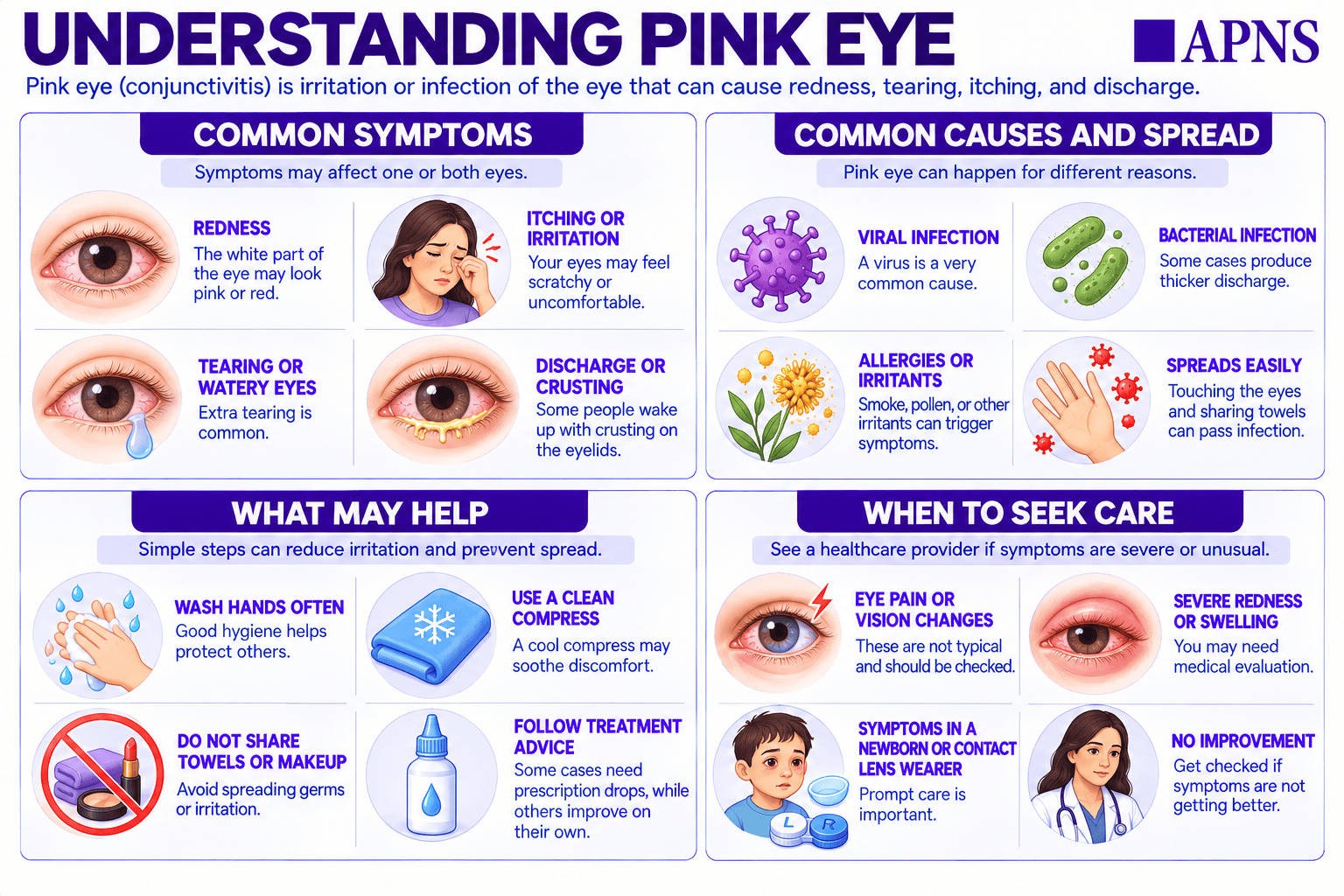
Pink eye can have infectious and noninfectious causes.
Common causes include:
Viral conjunctivitis is often associated with the same viruses that cause respiratory infections. Bacterial conjunctivitis may be caused by several different bacteria. Allergic conjunctivitis develops when the immune system reacts to an allergen.
Pink Eye: Causes and How It Spreads – CDC
https://www.cdc.gov/conjunctivitis/causes/
Explains the infectious and noninfectious causes of conjunctivitis and how contagious forms spread.
Several factors may worsen irritation, delay recovery, or increase the spread of infectious conjunctivitis.
Common factors include:
Contact lens wearers with eye redness should remove their lenses and seek medical advice because contact lens-related infections can sometimes affect the cornea and threaten vision.
How to Prevent Pink Eye – CDC
https://www.cdc.gov/conjunctivitis/prevention/
Provides practical guidance for preventing the spread of infectious conjunctivitis.
Good hygiene can reduce the risk of catching or spreading viral and bacterial conjunctivitis.
Helpful prevention tips include:
How to Prevent Pink Eye – CDC
https://www.cdc.gov/conjunctivitis/prevention/
Provides detailed recommendations for preventing infectious conjunctivitis and reducing its spread.
The following video content is provided to help you better understand this condition. These resources are intended for educational purposes and should not replace personalized medical advice from your healthcare provider.
Most cases of pink eye do not require laboratory testing.
Laboratory tests may be recommended when symptoms are severe, recurrent, unusual, or do not improve with standard treatment.
Possible laboratory tests include:
Newborns with eye redness, swollen eyelids, or discharge require prompt medical evaluation because neonatal conjunctivitis can cause serious complications.
Pink Eye in Newborns – CDC
https://www.cdc.gov/conjunctivitis/newborns/
Provides information about newborn conjunctivitis, warning signs, causes, and treatment.
Most people do not require imaging or extensive diagnostic testing.
Common evaluations may include:
Eye pain, reduced vision, significant light sensitivity, or severe redness may suggest corneal involvement or another serious condition rather than uncomplicated conjunctivitis.
Pink Eye – National Eye Institute (NEI)
https://www.nei.nih.gov/eye-health-information/eye-conditions-and-diseases/pink-eye
Provides information about how pink eye is evaluated and when specialist care may be needed.
Treatment depends on the cause of conjunctivitis.
Treatment options may include:
Most viral cases improve without prescription treatment. Antibiotics do not treat viral or allergic conjunctivitis. Many mild bacterial cases also improve without antibiotics, although antibiotic eye medication may shorten the illness and may be recommended in certain situations.
How to Treat Pink Eye – CDC
https://www.cdc.gov/conjunctivitis/treatment/
Provides information about treatment for viral, bacterial, and allergic conjunctivitis.
Healthy habits can relieve symptoms and reduce the spread of contagious pink eye.
Helpful lifestyle changes include:
How to Prevent Pink Eye – CDC
https://www.cdc.gov/conjunctivitis/prevention/
Provides recommendations for preventing pink eye and reducing its spread.
Medication depends on the cause of your symptoms.
Common medications may include:
Do not use someone else’s eye medication or leftover antibiotic drops. Steroid-containing eye drops should only be used under the supervision of an eye-care professional because they can worsen certain infections and cause serious complications.
Antibiotic Eye Drops – American Academy of Ophthalmology
https://www.aao.org/eye-health/treatments/antibiotic-eye-drops
Provides information about when antibiotic eye drops are used and why they require medical guidance.
Most people with pink eye do not require surgery or invasive procedures. Treatment usually involves supportive care, eye drops, medication when appropriate, and prevention of further irritation or transmission.
Possible procedures or office-based treatments may include:
Chemical exposure to the eye requires immediate irrigation with clean water or saline and urgent medical guidance.
Pink Eye – National Eye Institute (NEI)
https://www.nei.nih.gov/eye-health-information/eye-conditions-and-diseases/pink-eye
Learn about pink eye evaluation, treatment, and when urgent eye care is needed.
Most cases of conjunctivitis resolve without permanent eye damage.
Repeated, severe, or untreated infections can occasionally involve the cornea and affect vision. Contact lens wearers, newborns, and people with weakened immune systems have a higher risk of serious complications.
Home care may relieve mild symptoms and reduce transmission.
Helpful tips include:
Treatment for Pink Eye – National Eye Institute (NEI)
https://www.nei.nih.gov/eye-health-information/eye-conditions-and-diseases/pink-eye/treatment-pink-eye
Provides practical recommendations for relieving symptoms and preventing the spread of pink eye.
Viral and bacterial pink eye can be highly contagious. Allergic and irritant conjunctivitis are not contagious.
No. Antibiotics do not treat viral or allergic conjunctivitis. They may be prescribed for bacterial conjunctivitis depending on your symptoms, risk factors, and examination.
Policies vary. Your healthcare provider can advise you based on the cause, severity, ability to avoid close contact, and local workplace, school, or daycare requirements.
No. Remove your contact lenses when symptoms begin and do not resume wearing them until symptoms have resolved and your healthcare provider says it is safe.
Uncomplicated pink eye usually does not cause lasting vision problems. Blurred vision that does not clear after wiping away discharge, significant light sensitivity, or reduced vision requires prompt medical evaluation.

Consider asking your healthcare provider:
Many cases of pink eye are treated by a primary care provider, urgent care provider, pediatrician, optometrist, or ophthalmologist.
You may be referred to:
American Academy of Ophthalmology – Eye Health
https://www.aao.org/eye-health
Provides patient education about conjunctivitis, eye infections, and specialist eye care.
Most cases of pink eye are temporary and completely treatable.
Viral conjunctivitis usually clears as the immune system eliminates the virus. Bacterial conjunctivitis often resolves on its own or with antibiotic treatment when indicated. Allergic conjunctivitis improves when allergen exposure is reduced and allergy symptoms are treated.
Chronic or recurrent conjunctivitis may continue until the underlying cause, such as allergies, eyelid inflammation, dry eye, or repeated exposure to an irritant, is properly managed.
Call 911 or seek emergency medical care immediately if you experience:
Seek urgent medical evaluation if you notice:
How to Treat Pink Eye – CDC
https://www.cdc.gov/conjunctivitis/treatment/
Explains warning signs that require medical evaluation and when specialist care may be needed.
CALL 911
APNS does not provide emergency medical services. If you believe you are experiencing a medical emergency, including (but not limited to) chest pain, difficulty breathing, stroke symptoms, severe allergic reactions, anaphylaxis, uncontrolled bleeding, seizures, loss of consciousness, or any other potentially life-threatening condition, you are instructed to call 911 immediately or go immediately to the nearest emergency department.
Pink Eye – NIH MedlinePlus
https://medlineplus.gov/pinkeye.html
Easy-to-understand information about conjunctivitis, including symptoms, causes, treatment, and prevention.
Conjunctivitis (Pink Eye) – Centers for Disease Control and Prevention (CDC)
https://www.cdc.gov/conjunctivitis/
Comprehensive information about pink eye symptoms, causes, treatment, prevention, and contagiousness.
Pink Eye – National Eye Institute (NEI)
https://www.nei.nih.gov/eye-health-information/eye-conditions-and-diseases/pink-eye
Reliable patient education about the types of pink eye, home care, treatment, and warning signs.
American Academy of Ophthalmology – Conjunctivitis
https://www.aao.org/eye-health/diseases/pink-eye-conjunctivitis
Patient education about conjunctivitis, eye symptoms, treatment, and eye specialist care.
This guide is intended for educational purposes only and should not replace medical advice, diagnosis, or treatment from your healthcare provider or eye-care professional. Always follow the recommendations of your healthcare team regarding your individual health needs. Contact a healthcare provider promptly if symptoms worsen, do not improve as expected, or are accompanied by pain, light sensitivity, contact lens use, or vision changes. Seek immediate medical care for sudden vision loss, major eye trauma, serious chemical exposure, severe eye pain, or another medical emergency.
At APNS, our providers take the time to understand your condition and your goals. We offer comprehensive telehealth visits at a fixed rate — no membership fees, no insurance required, and no unexpected charges. Whether you’re newly diagnosed or looking for a provider who actually listens, we’re here to help.