

Premature ejaculation (PE) means ejaculating sooner during sexual activity than you or your partner would like. It may happen before penetration or shortly afterward and may feel difficult to delay. An occasional early ejaculation is common and does not necessarily mean you have a medical condition.
PE may be lifelong, beginning with a person’s earliest sexual experiences, or acquired after a period of typical ejaculation control. Healthcare providers consider timing, difficulty delaying ejaculation, how often it happens, and whether it causes distress—not timing alone. PE is common, treatable, and not a sign of weakness or failure.
Premature Ejaculation – NIH MedlinePlus
https://medlineplus.gov/ency/article/001524.htm
Explains common causes, symptoms, evaluation, and treatment in plain language.
Premature Ejaculation – Urology Care Foundation
https://www.urologyhealth.org/educational-resources/premature-ejaculation
Provides patient-focused information about diagnosis, behavioral methods, counseling, and medical treatments.
Premature ejaculation is one of the most commonly reported sexual concerns. Estimates vary because studies use different definitions, and many people do not discuss the concern with a healthcare provider.
PE can affect adults of any age. It may occur by itself or together with erectile dysfunction, anxiety, relationship stress, prostatitis, or another health concern.
Premature Ejaculation Patient Guide – Urology Care Foundation
Offers a detailed patient guide covering causes, diagnosis, treatment choices, and questions to discuss with a clinician.
The main concern is ejaculation that repeatedly occurs sooner than desired and feels difficult to control.
You may notice:
There is no single amount of time that defines satisfaction for every person or couple. A provider will focus on your experience, control, pattern, and level of distress.
A healthcare provider usually diagnoses PE by discussing your medical, sexual, and relationship history. They may ask when the concern began, how often it occurs, whether it happens with every partner or type of stimulation, how much control you feel you have, and how it affects you.
A focused physical examination may be performed, especially if PE began recently or you also have erection problems, pain, urinary symptoms, or other health changes. Honest answers help your provider recommend the safest treatment; these conversations are confidential.
Premature Ejaculation – Urology Care Foundation
https://www.urologyhealth.org/educational-resources/premature-ejaculation
Provides patient-focused information about diagnosis, behavioral methods, counseling, and medical treatments.
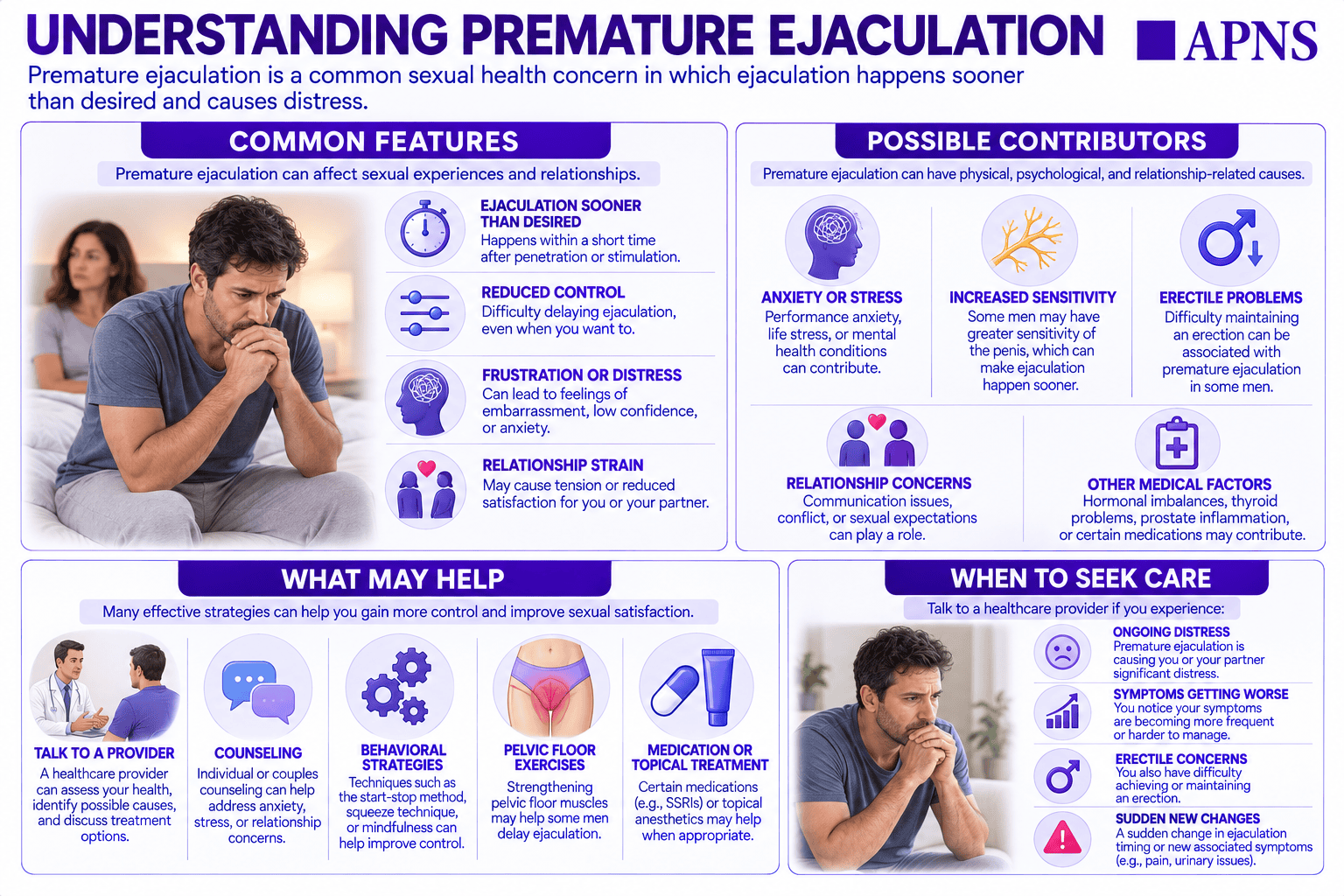
PE usually results from a combination of biological, psychological, and relationship factors rather than one single cause.
Possible contributing factors include:
Premature Ejaculation – NIH MedlinePlus
https://medlineplus.gov/ency/article/001524.htm
Explains common causes, symptoms, evaluation, and treatment in plain language.
Symptoms may become more noticeable when there is pressure to perform, a new relationship, long periods between sexual activity, fatigue, or conflict with a partner.
Other factors that may worsen PE include:
Not every case of PE can be prevented, especially lifelong PE. Early attention to stress, erection concerns, pain, and relationship difficulties may prevent the problem from becoming more distressing.
Helpful preventive steps include:
The following video content is provided to help you better understand this condition. These resources are intended for educational purposes and should not replace personalized medical advice from your healthcare provider.
Labs
Most people with PE do not need laboratory testing. Tests are chosen only when your history or examination suggests another condition.
Possible tests may include:
Urinalysis – NIH MedlinePlus
https://medlineplus.gov/lab-tests/urinalysis/
Explains why urine testing may be ordered and what the test involves.
TSH (Thyroid-Stimulating Hormone) Test – NIH MedlinePlus
https://medlineplus.gov/lab-tests/tsh-thyroid-stimulating-hormone-test/
Explains thyroid testing that may be considered when symptoms suggest a thyroid condition.
There is no scan or single test that confirms PE. Diagnosis is usually based on a careful conversation and, when needed, a focused examination.
Your provider may use a brief questionnaire to understand ejaculation control, distress, and relationship impact. Keeping a private record of when symptoms occur may help, but repeatedly timing intercourse with a stopwatch can increase anxiety and is not required unless your provider recommends it.
Disorders of Ejaculation Guideline – American Urological Association
https://www.auanet.org/guidelines-and-quality/guidelines/disorders-of-ejaculation
Summarizes evidence-based evaluation and treatment recommendations used by urology professionals.
Treatment is based on your goals, whether PE is lifelong or acquired, other health conditions, and your preferences. Many people benefit from combining behavioral strategies with counseling or medication.
Treatment options may include:
Premature Ejaculation Patient Guide – Urology Care Foundation
Offers a detailed patient guide covering causes, diagnosis, treatment choices, and questions to discuss with a clinician.
Lifestyle changes do not replace medical care, but they may reduce pressure and improve overall sexual well-being.
Helpful steps may include:
In the United States, medications commonly used specifically for PE are generally prescribed off-label, meaning the medication is approved for another purpose but evidence and clinical guidance support its use in selected patients. Your provider will review benefits, side effects, interactions, and other health conditions before prescribing.
Medication options may include:
Do not use another person’s prescription, combine medications without guidance, or stop an antidepressant suddenly. Opioids such as tramadol carry dependence and safety risks and are not routine first-choice treatment.
Disorders of Ejaculation Guideline – American Urological Association
https://www.auanet.org/guidelines-and-quality/guidelines/disorders-of-ejaculation
Summarizes evidence-based evaluation and treatment recommendations used by urology professionals.
Surgery and invasive procedures are not standard treatments for premature ejaculation. Most people are treated with behavioral methods, counseling, medication, or a combination of these approaches.
Be cautious about clinics advertising penile injections, nerve surgery, fillers, or other permanent procedures as a quick cure. These approaches may lack strong evidence and can cause pain, altered sensation, infection, or sexual dysfunction; seek an evaluation from a board-certified urologist before considering an invasive treatment.
Disorders of Ejaculation Guideline – American Urological Association
https://www.auanet.org/guidelines-and-quality/guidelines/disorders-of-ejaculation
Summarizes evidence-based evaluation and treatment recommendations used by urology professionals.
PE can be persistent, intermittent, or related to a temporary period of stress or another health concern. Some people improve with education and practice, while others benefit from ongoing treatment.
Treatment may require adjustment over time. Relapses can occur when stress increases or treatment stops, but this does not mean you have failed; follow-up can help identify a better approach.
Behavioral exercises can be practiced alone or with a consenting partner. Stop if an exercise causes pain, marked distress, or conflict.
Helpful strategies include:
Premature Ejaculation – Urology Care Foundation
https://www.urologyhealth.org/educational-resources/premature-ejaculation
Provides patient-focused information about diagnosis, behavioral methods, counseling, and medical treatments.
Occasional early ejaculation is common. Consider speaking with a provider when it happens repeatedly, feels difficult to control, or causes distress.
There is no universal time goal for satisfying sex. Clinicians consider timing along with control, frequency, distress, and whether the pattern is lifelong or newly acquired.
Masturbation does not automatically cause PE. A repeated habit of rushing may affect patterns for some people, and slower stop-start practice may help.
PE does not usually affect sperm quality. It can make conception more difficult if ejaculation consistently occurs before semen enters the vagina.
No. PE concerns ejaculation timing, while erectile dysfunction concerns getting or keeping an erection. They can occur together and should both be discussed.
It can. Use only as directed, remove excess product before contact, and consider a condom to reduce transfer.

Consider asking:
You may be referred to:
Sexual Problems in Men – NIH MedlinePlus
https://medlineplus.gov/sexualproblemsinmen.html
Reviews common sexual-health concerns, possible causes, testing, and when to contact a healthcare provider.
There is no single permanent cure that works for everyone, but PE is often very manageable. Some acquired cases improve when an underlying problem—such as anxiety, erectile dysfunction, relationship stress, or inflammation—is treated.
Behavioral methods, counseling, and medications can meaningfully improve control and reduce distress. A treatment that works may need to be continued or revisited if symptoms return.
Premature ejaculation itself is not a medical emergency. Contact your healthcare provider if symptoms begin suddenly, persist, cause significant distress, or occur with pelvic pain, urinary symptoms, blood in semen, erection problems, or medication side effects.
Call 911 or seek emergency medical care immediately for:
Sexual Problems in Men – NIH MedlinePlus
https://medlineplus.gov/sexualproblemsinmen.html
Reviews common sexual-health concerns, possible causes, testing, and when to contact a healthcare provider.
CALL 911
APNS does not provide emergency medical services. If you believe you are experiencing a medical emergency, including (but not limited to) chest pain, difficulty breathing, stroke symptoms, severe allergic reactions, anaphylaxis, uncontrolled bleeding, seizures, loss of consciousness, or any other potentially life-threatening condition, you are instructed to call 911 immediately or go immediately to the nearest emergency department.
Premature Ejaculation – NIH MedlinePlus
https://medlineplus.gov/ency/article/001524.htm
Explains common causes, symptoms, evaluation, and treatment in plain language.
Premature Ejaculation – Urology Care Foundation
https://www.urologyhealth.org/educational-resources/premature-ejaculation
Provides patient-focused information about diagnosis, behavioral methods, counseling, and medical treatments.
Premature Ejaculation Patient Guide – Urology Care Foundation
Offers a detailed patient guide covering causes, diagnosis, treatment choices, and questions to discuss with a clinician.
Sexual Problems in Men – NIH MedlinePlus
https://medlineplus.gov/sexualproblemsinmen.html
Reviews common sexual-health concerns, possible causes, testing, and when to contact a healthcare provider.
Disorders of Ejaculation Guideline – American Urological Association
https://www.auanet.org/guidelines-and-quality/guidelines/disorders-of-ejaculation
Summarizes evidence-based evaluation and treatment recommendations used by urology professionals.
Erectile Dysfunction – NIH MedlinePlus
https://medlineplus.gov/erectiledysfunction.html
Provides information about erection problems that can sometimes occur along with premature ejaculation.
This guide is intended for educational purposes only and should not replace medical advice, diagnosis, or treatment from your healthcare provider or urologist. Premature ejaculation can have several causes, and treatment should be individualized based on your health, medications, symptoms, and goals. Always follow your healthcare provider’s instructions, especially when using topical anesthetics, antidepressants, or erectile dysfunction medicines. Call 911 immediately for a severe allergic reaction, chest pain, difficulty breathing, loss of consciousness, an erection lasting four hours or longer, or another medical emergency.
At APNS, our providers take the time to understand your condition and your goals. We offer comprehensive telehealth visits at a fixed rate — no membership fees, no insurance required, and no unexpected charges. Whether you’re newly diagnosed or looking for a provider who actually listens, we’re here to help.