

Pharyngitis, commonly called a sore throat, is inflammation of the pharynx, the area at the back of your throat. A sore throat is one of the most common reasons people seek medical care and can range from mild irritation to severe pain when swallowing.
Most sore throats are caused by viral infections, such as the common cold, influenza (flu), COVID-19, or other respiratory viruses. Less commonly, sore throats are caused by bacterial infections, such as strep throat, which require treatment with antibiotics.
In addition to infections, sore throats can also be caused by allergies, dry air, smoking, acid reflux (GERD), excessive voice use, or environmental irritants.
Most viral sore throats improve within 5 to 10 days with rest, fluids, and symptom management.
Sore Throat – NIH MedlinePlus
https://medlineplus.gov/sorethroat.html
Provides easy-to-understand information about sore throats, causes, diagnosis, treatment, and prevention.
Group A Strep – Centers for Disease Control and Prevention (CDC)
https://www.cdc.gov/group-a-strep/
Provides information about bacterial sore throats (strep throat), testing, treatment, and prevention.
Sore throats are among the most common reasons people visit healthcare providers. Millions of people develop pharyngitis each year.
Approximately 70–85% of sore throats in adults and 60–70% in children are caused by viruses. A smaller percentage are caused by bacteria, most commonly Group A Streptococcus (strep throat).
Sore Throat – NIH MedlinePlus
https://medlineplus.gov/sorethroat.html
Provides information about common causes of sore throats and when medical evaluation is needed.
Symptoms vary depending on the cause of the sore throat.
Common symptoms may include:
Symptoms such as cough, runny nose, and sneezing usually suggest a viral infection, while sudden severe throat pain, fever, swollen lymph nodes, and white patches on the tonsils may suggest strep throat.
Your healthcare provider will review your symptoms, perform a physical examination, and examine your throat, mouth, ears, and neck.
If bacterial strep throat is suspected, testing is usually recommended before prescribing antibiotics.
Group A Strep – CDC
https://www.cdc.gov/group-a-strep/
Explains how sore throats are evaluated and when testing for strep throat is recommended.
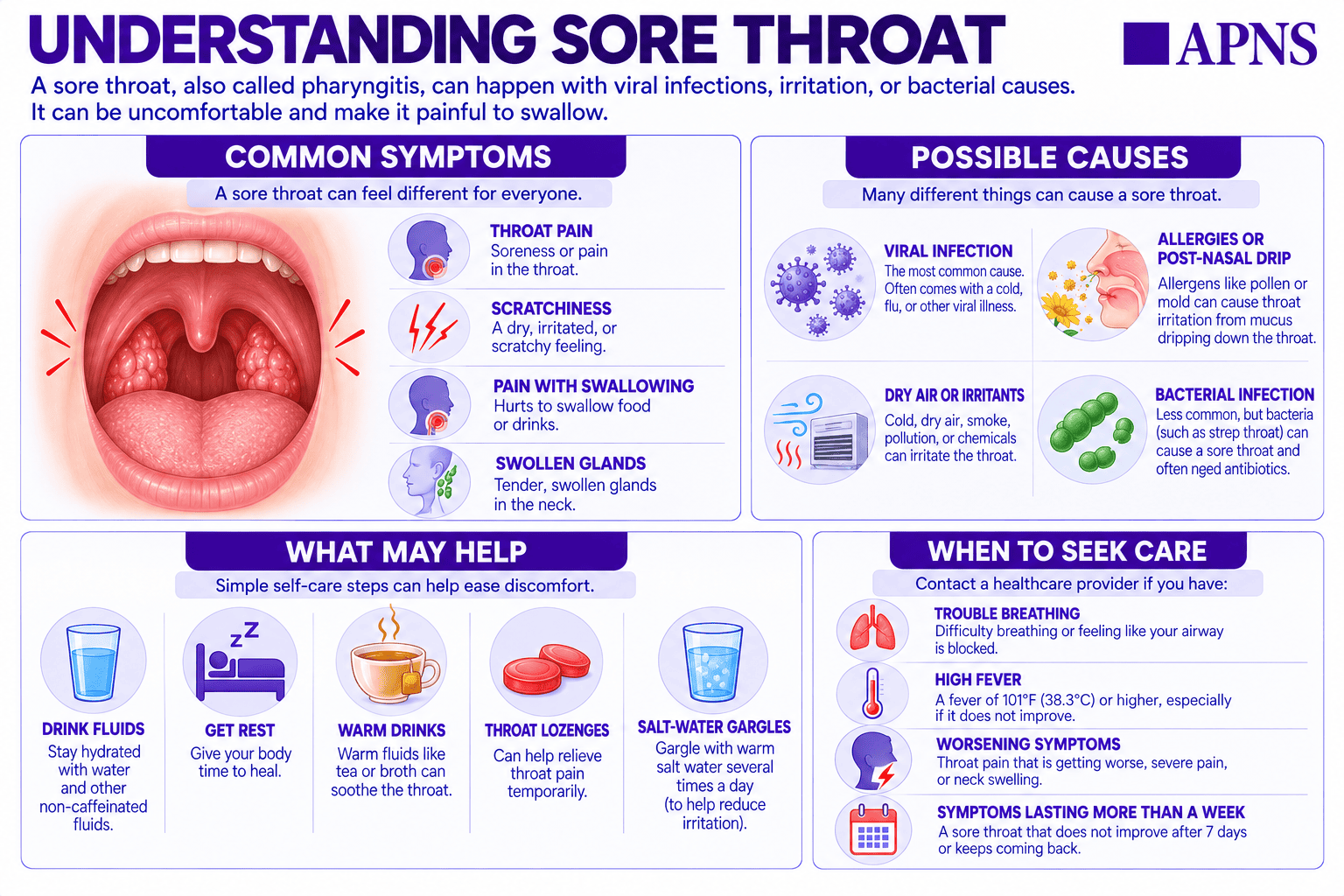
Most sore throats are caused by viral infections.
Common causes include:
Sore Throat – NIH MedlinePlus
https://medlineplus.gov/sorethroat.html
Learn about the causes of sore throats and ways to reduce your risk.
Several factors may worsen throat irritation or delay recovery.
Common factors include:
Sore Throat – NIH MedlinePlus
https://medlineplus.gov/sorethroat.html
Provides information about common causes and risk factors for persistent sore throats.
Many sore throats can be prevented by reducing exposure to viruses and bacteria and maintaining good overall health.
Helpful prevention tips include:
Centers for Disease Control and Prevention (CDC)
https://www.cdc.gov/
Provides practical recommendations for preventing respiratory infections and reducing disease transmission.
The following video content is provided to help you better understand this condition. These resources are intended for educational purposes and should not replace personalized medical advice from your healthcare provider.
Most viral sore throats do not require laboratory testing.
Laboratory tests may include:
Laboratory Tests – NIH MedlinePlus
https://medlineplus.gov/lab-tests/
Provides information about laboratory testing used to diagnose sore throats.
Most people with pharyngitis do not require imaging.
Additional testing may be recommended if complications are suspected.
Common diagnostic tests include:
ENT Health – American Academy of Otolaryngology–Head and Neck Surgery
https://www.enthealth.org/
Provides patient education about sore throats, throat disorders, and specialty evaluation.
Treatment depends on the cause of your sore throat.
Treatment options may include:
Sore Throat – NIH MedlinePlus
https://medlineplus.gov/sorethroat.html
Provides information about sore throat treatment and symptom relief.
Healthy habits can help relieve symptoms and promote recovery.
Helpful lifestyle changes include:
Sore Throat – NIH MedlinePlus
https://medlineplus.gov/sorethroat.html
Provides practical recommendations for relieving sore throat symptoms and preventing illness.
Treatment depends on the cause of your sore throat.
Common medications may include:
Group A Strep – CDC
https://www.cdc.gov/group-a-strep/
Provides information about antibiotic treatment for bacterial sore throats.
Most people with pharyngitis do not require surgery or invasive procedures. Treatment usually focuses on relieving symptoms while the underlying cause resolves. However, certain procedures may be recommended if bacterial infection, complications, or recurrent sore throats develop.
Common procedures may include:
ENT Health – American Academy of Otolaryngology–Head and Neck Surgery
https://www.enthealth.org/
Learn about sore throat evaluation, throat infections, and treatment options.
Most viral sore throats improve within 5–10 days. Bacterial sore throats, such as strep throat, usually begin improving within 24–48 hours after starting antibiotics.
Most people recover completely without complications. However, persistent or recurrent sore throats may require additional evaluation to identify underlying causes such as allergies, acid reflux (GERD), chronic tonsillitis, or other medical conditions.
Home care can help relieve symptoms and support recovery.
Helpful tips include:
Sore Throat – NIH MedlinePlus
https://medlineplus.gov/sorethroat.html
Provides practical recommendations for relieving sore throat symptoms and promoting recovery.
No. Most sore throats are caused by viruses, and antibiotics do not treat viral infections. Antibiotics should only be used when a bacterial infection is confirmed or strongly suspected.
Most viral sore throats improve within
. Strep throat often begins improving within
after starting antibiotics.
Yes. Postnasal drip from allergies can irritate the throat and cause soreness, especially during allergy seasons.
Yes. Stomach acid that reaches the throat can cause chronic irritation, hoarseness, coughing, and sore throat, particularly in the morning.
Seek medical evaluation if your sore throat lasts longer than one week, is severe, is associated with difficulty swallowing or breathing, or is accompanied by high fever or swollen neck glands.

Consider asking your healthcare provider:
Most sore throats are treated by a primary care provider. Depending on your symptoms or medical history, your provider may recommend seeing a specialist.
You may be referred to:
ENT Health – American Academy of Otolaryngology–Head and Neck Surgery
https://www.enthealth.org/
Provides patient education about throat disorders, chronic sore throats, and specialty care.
Yes. Most sore throats are temporary and resolve completely with supportive care or treatment of the underlying cause.
Viral sore throats improve as your immune system clears the infection. Bacterial sore throats, such as strep throat, are usually cured with antibiotics. If allergies, acid reflux, or environmental irritants are causing symptoms, treating those conditions often resolves the sore throat.
Call 911 or seek emergency medical care immediately if you experience:
Seek prompt medical evaluation if you notice:
Sore Throat – NIH MedlinePlus
https://medlineplus.gov/sorethroat.html
Learn about sore throat complications and when emergency medical care is needed.
CALL 911
APNS does not provide emergency medical services. If you believe you are experiencing a medical emergency, including (but not limited to) chest pain, difficulty breathing, stroke symptoms, severe allergic reactions, anaphylaxis, uncontrolled bleeding, seizures, loss of consciousness, or any other potentially life-threatening condition, you are instructed to call 911 immediately or go immediately to the nearest emergency department.
Sore Throat – NIH MedlinePlus
https://medlineplus.gov/sorethroat.html
Easy-to-understand information about sore throats, symptoms, diagnosis, treatment, and prevention.
Group A Streptococcus (Group A Strep) – Centers for Disease Control and Prevention (CDC)
https://www.cdc.gov/group-a-strep/
Comprehensive information about bacterial sore throats, testing, antibiotics, and prevention.
ENT Health – American Academy of Otolaryngology–Head and Neck Surgery
https://www.enthealth.org/
Reliable patient education about sore throats, chronic tonsillitis, throat disorders, and ENT care.
American Academy of Family Physicians (FamilyDoctor.org)
https://familydoctor.org/
Trusted patient education about sore throats, common respiratory illnesses, and self-care.
This guide is intended for educational purposes only and should not replace medical advice, diagnosis, or treatment from your healthcare provider. Always follow the recommendations of your healthcare team regarding your individual health needs. Contact your healthcare provider if your symptoms worsen, do not improve as expected, or new symptoms develop. Call 911 immediately if you experience difficulty breathing, inability to swallow saliva, severe throat swelling, loss of consciousness, or another medical emergency.
At APNS, our providers take the time to understand your condition and your goals. We offer comprehensive telehealth visits at a fixed rate — no membership fees, no insurance required, and no unexpected charges. Whether you’re newly diagnosed or looking for a provider who actually listens, we’re here to help.