

A sprain is an injury in which one or more ligaments are stretched or torn. Ligaments are strong bands of tissue that connect bones and help stabilize joints. Sprains most often affect the ankle, wrist, knee, or thumb, but they can occur in nearly any joint.
Sprains can range from mild overstretching to a complete ligament tear. Mild injuries may improve with home care and gradual movement, while severe sprains may require a brace, physical therapy, or surgery. A sprain is different from a strain, which affects a muscle or tendon.
Sprains and Strains – NIH MedlinePlus
Provides patient-friendly information about sprains, strains, symptoms, treatment, and recovery.
Explains common causes, first aid, treatment, and warning signs.
Sprains are common injuries that affect people of all ages. Ankle sprains are especially common during sports, exercise, falls, and everyday activities.
The risk may be higher in people who:
A previous sprain can increase the risk of another injury if strength, balance, flexibility, and joint stability are not fully restored.
Sprained Ankle – American Academy of Orthopaedic Surgeons
Provides information about ankle-sprain causes, symptoms, diagnosis, treatment, and rehabilitation.
Symptoms may begin immediately after the injury or worsen over several hours.
Common symptoms include:
Swelling and bruising may become more noticeable during the first few days before they begin improving.
A severe sprain may cause symptoms similar to a broken bone. Medical evaluation may be needed to determine whether a fracture, dislocation, tendon injury, or complete ligament tear is present.
A healthcare provider may diagnose a sprain by reviewing how the injury happened and examining the affected joint.
The provider may ask:
During the examination, the provider may check:
Severe pain, swelling, bruising, deformity, or inability to bear weight may indicate a serious injury that requires imaging or specialist evaluation.
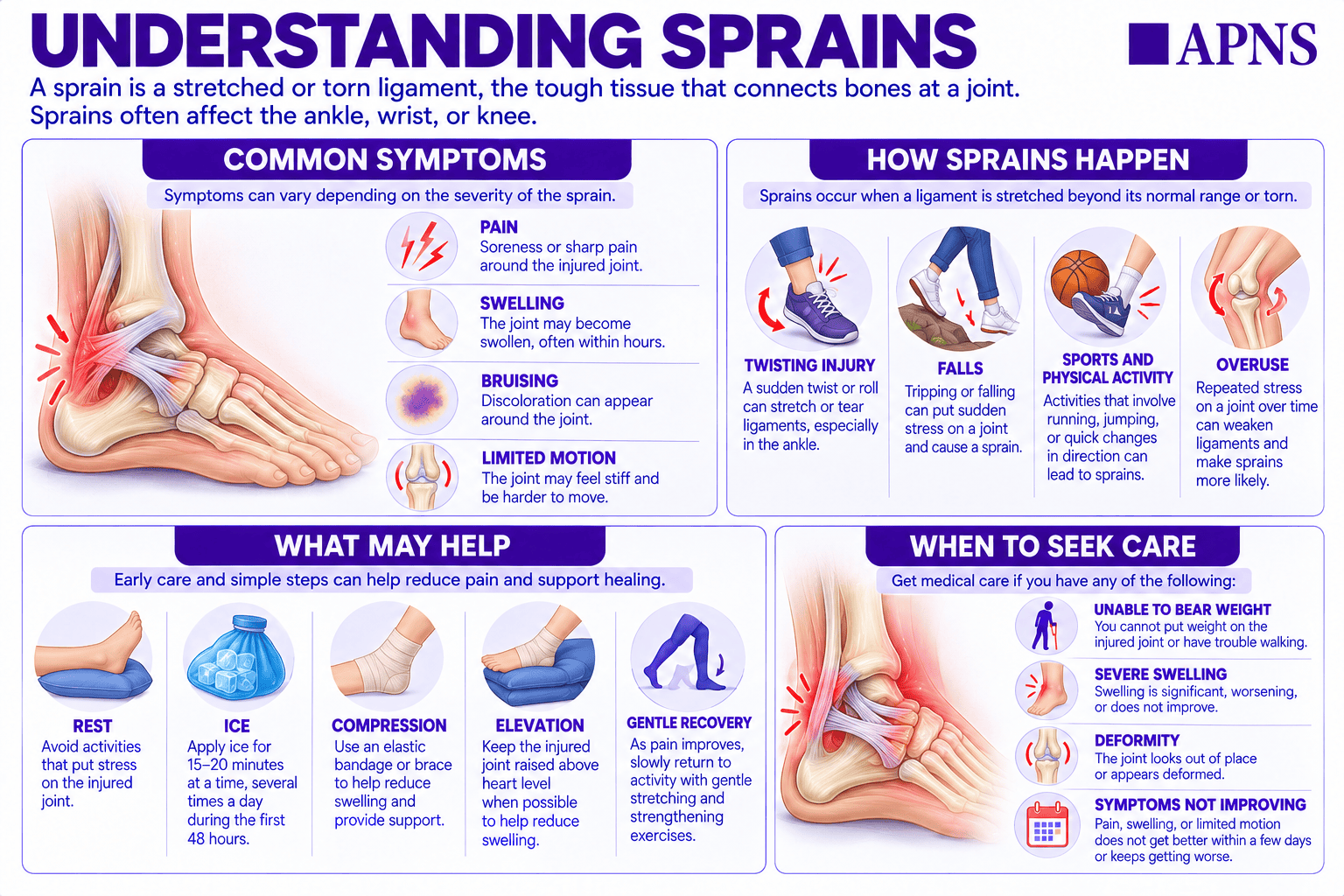
A sprain occurs when a joint is forced beyond its normal range of motion. This stretches or tears the ligaments supporting the joint.
Common causes include:
Sprains are often sudden injuries, although repeated stress may gradually weaken a ligament and contribute to joint instability.
Sports Injuries – National Institute of Arthritis and Musculoskeletal and Skin Diseases
Explains common injuries affecting ligaments, muscles, tendons, bones, and joints.
Factors that may worsen a sprain or delay healing include:
Continuing to exercise immediately after an injury can cause additional damage. However, prolonged complete rest may lead to stiffness and weakness. Activity should be increased gradually as pain and swelling improve.
Not every sprain can be prevented, but the risk can often be reduced.
Helpful prevention measures include:
People with a previous ankle sprain may benefit from balance training, strengthening exercises, supportive footwear, taping, or bracing during higher-risk activities.
The following video content is provided to help you better understand this condition. These resources are intended for educational purposes and should not replace personalized medical advice from your healthcare provider.
Most sprains do not require blood tests.
Laboratory testing may be considered when symptoms suggest another condition, such as infection, gout, inflammatory arthritis, or a medical problem that could affect healing.
Possible tests include:
Blood tests do not show whether a ligament is stretched or torn.
Medical Tests – NIH MedlinePlus
Provides information about laboratory tests used to evaluate inflammation, infection, and related medical conditions.
Imaging may be recommended when a fracture, dislocation, severe ligament injury, or another condition is suspected.
Possible tests include:
An X-ray does not directly show most ligament injuries, but it can help rule out a fracture. MRI is generally reserved for severe, unclear, or persistent injuries or when surgery is being considered.
Explains how X-rays are used to evaluate bones, fractures, and joints.
Provides information about MRI testing and what to expect.
Treatment depends on the injured joint, the severity of the ligament damage, and whether another injury is present.
Treatment options may include:
Initial treatment commonly includes rest, ice, compression, and elevation. Rehabilitation is important because movement, strength, and balance must be restored before returning to demanding activities.
Sprains and Strains – NIH MedlinePlus
Provides an overview of home care, medication, rehabilitation, and medical treatment.
Healthy habits may support recovery and reduce the chance of another sprain.
Helpful changes include:
Warmups, strength exercises, flexibility work, rest, and recovery can reduce the risk of exercise-related injuries.
Medication may help manage pain and swelling but does not repair the ligament by itself.
Possible medications include:
Nonsteroidal anti-inflammatory drugs may not be safe for everyone. They may increase the risk of stomach bleeding, kidney problems, elevated blood pressure, heart problems, and medication interactions.
Acetaminophen can cause severe liver damage if too much is taken. Check combination cold, flu, and pain products because they may also contain acetaminophen.
Ask a healthcare provider or pharmacist before using pain medication if you:
Pain Relievers – NIH MedlinePlus
Provides information about over-the-counter and prescription pain medications and their risks.
Most sprains do not require an invasive procedure.
Possible procedures include:
Surgery is generally reserved for complete tears, persistent instability, associated fractures, or injuries that do not improve with appropriate rehabilitation. Severe sprains sometimes require surgical ligament repair.
Most mild sprains improve with appropriate protection, gradual movement, and rehabilitation. Pain and swelling may improve before strength, balance, and joint stability fully return.
Approximate recovery varies:
Recovery depends on:
Some injuries continue to cause weakness, stiffness, pain, or instability. Repeated ankle sprains, for example, can lead to chronic ankle instability if balance and strength are not restored.
For a mild sprain without deformity, severe pain, or other warning signs:
Ice, compression, elevation, and temporary protection can reduce pain and swelling. Compression should not cause numbness, tingling, increased pain, coldness, or skin discoloration.
Remove or loosen a compression wrap and seek advice if the fingers or toes become:
Do not attempt to force a deformed joint back into place.
A sprain involves a ligament that connects bone to bone. A strain involves a muscle or tendon, which connects muscle to bone.
Some people with mild sprains can gradually place weight on the ankle as pain allows. Do not force weight-bearing when pain is severe or when you cannot walk normally. An evaluation may be needed to rule out a fracture.
Cold packs are commonly used during the early stage to reduce pain and swelling. Heat may be introduced later for stiffness if recommended by a healthcare professional. Never apply ice or intense heat directly to the skin.
The wrap should feel supportive but should not cause numbness, tingling, increased pain, coldness, or discoloration.
No. Some sprains cause significant bruising, while others cause mostly pain, swelling, or instability.
Not always. A popping sensation can occur with a sprain, fracture, tendon injury, or dislocation. Medical evaluation is appropriate when a pop is followed by severe pain, swelling, instability, or inability to use the joint.
An X-ray may be needed when there is severe tenderness, inability to bear weight, significant swelling, deformity, or concern about a fracture.
Avoid activities that cause significant pain during the early stage. Gentle movement and gradual return to activity are often encouraged as symptoms improve. The exact timeline depends on the injury.
Pain relief alone does not mean the ligament has fully healed. Strength, movement, balance, and stability should be restored before returning to sports.
Most sprains heal well. Severe or repeatedly injured ligaments may cause chronic instability, weakness, or pain.

Consider asking:
Many sprains can be managed by a primary care provider or urgent care clinician.
You may be referred to:
Sports Injuries: Diagnosis and Treatment – NIAMS
Explains when an injury requires professional evaluation and how serious sports injuries are treated.
Most sprains heal successfully with proper treatment and rehabilitation.
Mild ligament injuries may heal completely without surgery. Moderate or severe injuries may require longer rehabilitation, bracing, or surgical treatment.
Some people develop long-term problems such as:
Completing strengthening and balance exercises can reduce the risk of another injury.
Call 911 or seek emergency medical care immediately if the injury occurs with:
Seek urgent same-day medical evaluation if:
Severe pain, swelling, bruising, inability to bear weight, or obvious deformity may indicate a fracture, dislocation, complete ligament tear, or another serious injury.
CALL 911
APNS does not provide emergency medical services. If you believe you are experiencing a medical emergency, including (but not limited to) chest pain, difficulty breathing, stroke symptoms, severe allergic reactions, anaphylaxis, uncontrolled bleeding, seizures, loss of consciousness, or any other potentially life-threatening condition, you are instructed to call 911 immediately or go immediately to the nearest emergency department.
Sprains and Strains – NIH MedlinePlus
Patient-friendly information about the differences between sprains and strains, symptoms, treatment, and rehabilitation.
Explains sprain causes, first aid, home care, and warning signs.
Sports Injuries – National Institute of Arthritis and Musculoskeletal and Skin Diseases
Provides information about ligament, tendon, muscle, bone, and joint injuries.
Sports Injuries: Diagnosis and Treatment – NIAMS
Explains injury evaluation, rehabilitation, and symptoms that require professional care.
Sprained Ankle – American Academy of Orthopaedic Surgeons
Orthopedic information about ankle-sprain severity, diagnosis, treatment, exercises, and prevention.
This guide is intended for educational purposes only and should not replace medical advice, diagnosis, imaging, or treatment from your healthcare provider. A suspected sprain may actually be a fracture, dislocation, tendon injury, cartilage injury, complete ligament tear, or another condition requiring different treatment. Do not force a deformed joint back into place or continue sports through severe pain. Consult a healthcare professional before regularly using pain medication or beginning rehabilitation exercises after a serious injury. Seek urgent medical care for severe pain, significant swelling, inability to move or bear weight, deformity, numbness, an open wound, or a hand or foot that becomes cold, pale, or blue. Call 911 immediately for severe trauma, uncontrolled bleeding, bone protruding through the skin, loss of consciousness, breathing difficulty, loss of circulation, or another medical emergency.
At APNS, our providers take the time to understand your condition and your goals. We offer comprehensive telehealth visits at a fixed rate — no membership fees, no insurance required, and no unexpected charges. Whether you’re newly diagnosed or looking for a provider who actually listens, we’re here to help.