

Trichomoniasis, often called trich, is a common sexually transmitted infection (STI) caused by a tiny parasite called Trichomonas vaginalis. It most often infects the vagina, cervix, urethra, or penis. Many people have no symptoms but can still pass it to sexual partners.
Trich is curable with prescription medicine. Untreated infection can last for months or years, cause genital irritation, increase the chance of getting or transmitting HIV, and contribute to pregnancy complications. A positive result does not show exactly when the infection began or which partner had it first.
About Trichomoniasis – Centers for Disease Control and Prevention
https://www.cdc.gov/trichomoniasis/about/index.html
Explains symptoms, spread, diagnosis, treatment, partner care, reinfection, and retesting.
Trichomoniasis – NIH MedlinePlus
https://medlineplus.gov/trichomoniasis.html
Offers patient-friendly information about symptoms, testing, treatment, and prevention.
Trich is one of the most common curable STIs worldwide. Millions of new infections occur each year, but exact numbers are difficult to measure because many people have no symptoms and routine screening is not recommended for everyone.
It is diagnosed more often in people with a vagina and is more common in some communities facing barriers to testing and treatment. Anyone exposed through sexual contact can become infected.
Symptoms may appear 5–28 days after infection, appear much later, come and go, or never develop.
Symptoms overlap with bacterial vaginosis, yeast infection, gonorrhea, chlamydia, urinary infection, and other conditions, so testing matters.
Symptoms and examination alone cannot reliably diagnose trich. A clinician collects a vaginal swab, urine sample, urethral sample, or another validated specimen for laboratory testing.
Tell the clinician about symptoms, recent medicines, pregnancy, HIV status, exposure sites, and whether a partner tested positive. A finding of trich on a Pap test should be confirmed with a sensitive diagnostic test.
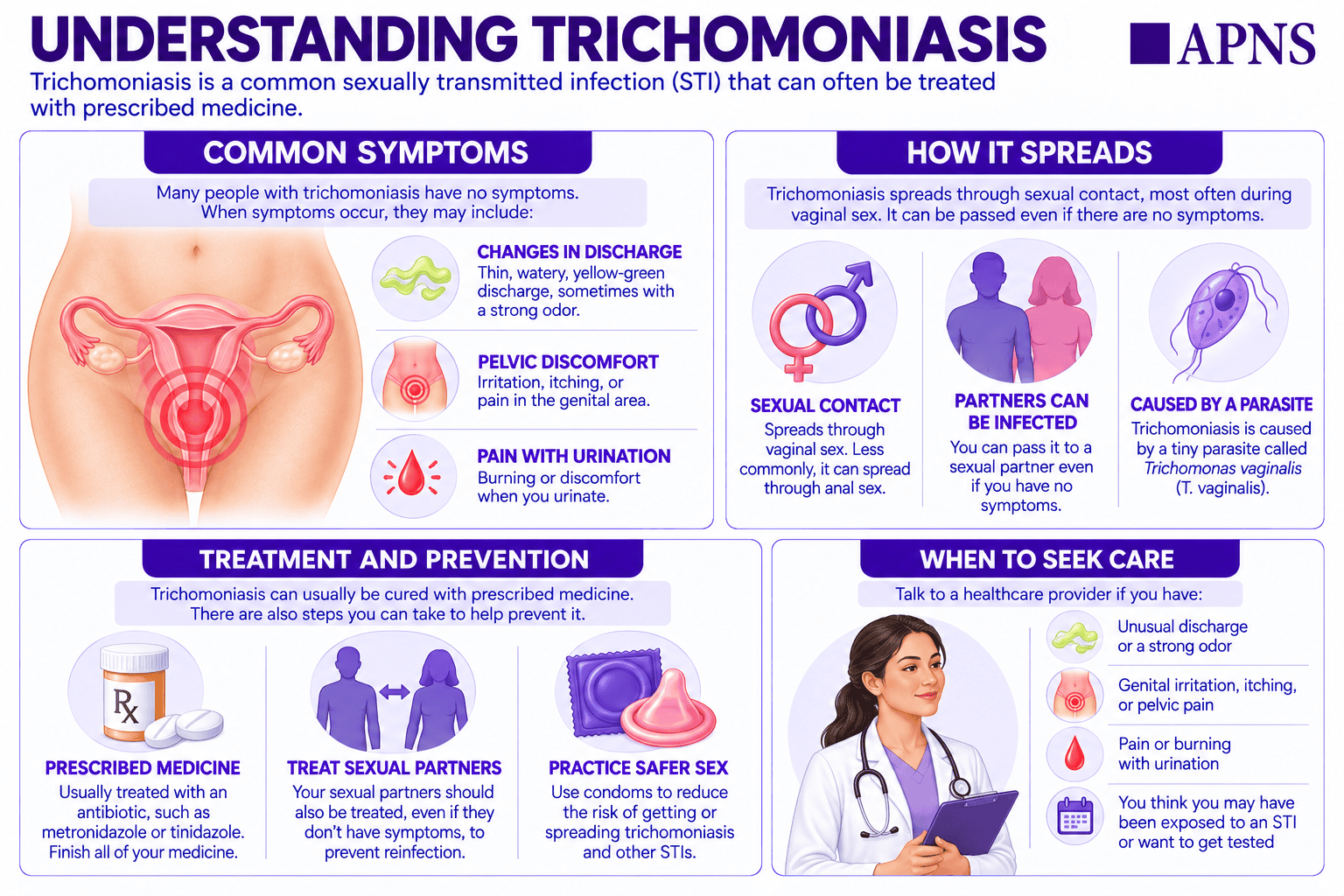
Trich is caused by the T. vaginalis parasite. It spreads mainly during penis-to-vagina or vagina-to-vagina sexual contact and through sharing sex toys that have not been cleaned or covered with a new condom.
The parasite usually does not infect the mouth, hands, or anus. It is not caused by poor hygiene, toilet seats, swimming pools, or casual contact.
About Trichomoniasis – Centers for Disease Control and Prevention
https://www.cdc.gov/trichomoniasis/about/index.html
Explains symptoms, spread, diagnosis, treatment, partner care, reinfection, and retesting.
Reinfection is common—about 1 in 5 people may be infected again within three months, often because a partner was not treated.
How to Prevent STIs – Centers for Disease Control and Prevention
https://www.cdc.gov/sti/prevention/index.html
Explains condoms, testing, partner communication, vaccination, and other STI prevention strategies.
The following video content is provided to help you better understand this condition. These resources are intended for educational purposes and should not replace personalized medical advice from your healthcare provider.
Trichomoniasis – CDC STI Treatment Guidelines
https://www.cdc.gov/std/treatment-guidelines/trichomoniasis.htm
Provides clinical guidance for testing, treatment by anatomy, pregnancy, HIV, recurrence, and resistance.
Imaging is not needed for uncomplicated trich. A pelvic examination may show discharge, irritation, or a spotted ‘strawberry’ cervix, but these findings are not present in everyone.
Persistent pelvic pain, fever, pregnancy concerns, or testicular pain may require examination and additional tests for pelvic inflammatory disease, epididymitis, or another condition.
Trich is treated with an oral nitroimidazole medicine. CDC recommends metronidazole 500 mg twice daily for seven days for women; for men, the recommended regimen is metronidazole 2 g by mouth once.
Tinidazole 2 g by mouth once is an alternative for women and men. Treatment may differ with pregnancy, breastfeeding, HIV, allergy, medication interactions, persistent infection, or suspected resistance.
Common effects include nausea, stomach upset, headache, and a metallic taste. Tell the prescriber about warfarin, lithium, seizure medicines, disulfiram, liver disease, pregnancy, breastfeeding, and all other medicines. Follow the product and clinician’s instructions about alcohol during and after treatment.
No procedure or surgery is used to cure trich. Vaginal rinses, over-the-counter yeast products, boric acid, and home remedies do not replace oral prescription treatment.
A clinician may perform a pelvic or genital examination when symptoms are severe, diagnosis is uncertain, or another infection or complication is suspected.
Correct treatment usually cures trich and symptoms often improve within several days. Finish all medicine even if symptoms disappear.
People with a vagina should be retested about three months after treatment because reinfection is common. Routine retesting data are limited for men, but anyone with ongoing symptoms or a new exposure should return for evaluation.
Yes. Infection can continue without symptoms, so a positive test does not show when it was acquired.
Not necessarily. Because infection may be silent for a long time, timing usually cannot prove when or from whom it came.
The parasite mainly affects the genitals and urethra; oral and rectal infection are uncommon, and routine testing at those sites is not recommended.
No. Trich requires an oral prescription medicine such as metronidazole or tinidazole.
Correct and consistent condom use lowers risk but does not eliminate every possible exposure.
Yes. Current partners should receive presumptive treatment to prevent reinfection.

Yes. Trich is curable with the correct oral prescription medicine. Treatment does not create immunity, so a person can become infected again.
A repeat positive test may reflect reinfection, incomplete treatment, testing too soon, or less commonly drug resistance. Do not use a NAAT earlier than three weeks after finishing treatment for persistent symptoms because leftover genetic material can cause a positive result.
Trich is usually not an emergency. Seek prompt care for persistent symptoms, pregnancy, pelvic pain, testicular pain, fever, or a positive test after treatment.
Seek urgent or emergency care for:
CALL 911
APNS does not provide emergency medical services. If you believe you are experiencing a medical emergency, including (but not limited to) chest pain, difficulty breathing, stroke symptoms, severe allergic reactions, anaphylaxis, uncontrolled bleeding, seizures, loss of consciousness, or any other potentially life-threatening condition, you are instructed to call 911 immediately or go immediately to the nearest emergency department.
About Trichomoniasis – Centers for Disease Control and Prevention
https://www.cdc.gov/trichomoniasis/about/index.html
Explains symptoms, spread, diagnosis, treatment, partner care, reinfection, and retesting.
Trichomoniasis – CDC STI Treatment Guidelines
https://www.cdc.gov/std/treatment-guidelines/trichomoniasis.htm
Provides clinical guidance for testing, treatment by anatomy, pregnancy, HIV, recurrence, and resistance.
Trichomoniasis – NIH MedlinePlus
https://medlineplus.gov/trichomoniasis.html
Offers patient-friendly information about symptoms, testing, treatment, and prevention.
Trichomoniasis – World Health Organization
https://www.who.int/news-room/fact-sheets/detail/trichomoniasis
Reviews global burden, complications, diagnosis, treatment, and prevention.
How to Prevent STIs – Centers for Disease Control and Prevention
https://www.cdc.gov/sti/prevention/index.html
Explains condoms, testing, partner communication, vaccination, and other STI prevention strategies.
Metronidazole Drug Information – NIH MedlinePlus
https://medlineplus.gov/druginfo/meds/a689011.html
Explains how to take metronidazole safely, possible side effects, and medication precautions.
This guide is intended for educational purposes only and should not replace medical advice, STI testing, diagnosis, or treatment from your healthcare provider. Vaginal or penile discharge, odor, itching, burning, and painful urination may have several causes that require different treatment. Trichomoniasis requires prescription oral medicine and treatment of sexual partners. Pregnancy, breastfeeding, HIV, liver disease, medication interactions, allergy, or persistent infection may change management. Seek urgent care for severe pelvic or testicular pain, fever, fainting, a severe allergic reaction, or a serious rash.
At APNS, our providers take the time to understand your condition and your goals. We offer comprehensive telehealth visits at a fixed rate — no membership fees, no insurance required, and no unexpected charges. Whether you’re newly diagnosed or looking for a provider who actually listens, we’re here to help.