

Launching September 2027

Urinary Tract Infection (UTI)

UTI At A Glance

  • A urinary tract infection occurs when germs infect part of the urinary system, including the bladder, urethra, ureters, or kidneys.
  • Most UTIs affect the bladder or urethra and are caused by bacteria entering the urinary tract.
  • Symptoms may include burning with urination, urinary urgency or frequency, pelvic pressure, cloudy or bloody urine, and passing small amounts of urine.
  • Fever, chills, nausea, vomiting, or back and side pain may indicate that the infection has spread to a kidney.
  • Diagnosis commonly includes urinalysis and sometimes a urine culture to identify the bacteria and guide treatment.
  • UTIs are generally treated with antibiotics selected according to symptoms, health history, and test results.

Table of Contents

Table of Contents

What Is UTI?

A urinary tract infection, commonly called a UTI, occurs when germs infect part of the urinary system. The urinary tract includes the kidneys, ureters, bladder, and urethra. Most UTIs affect the bladder or urethra, but an infection can spread to one or both kidneys.

Most UTIs are caused by bacteria entering the urinary tract. Common symptoms include burning during urination, needing to urinate frequently or urgently, lower abdominal discomfort, and cloudy or bloody urine. UTIs are generally treated with antibiotics selected by a healthcare provider.

Learn More

Urinary Tract Infection Basics – Centers for Disease Control and Prevention

Provides an overview of UTI symptoms, risk factors, treatment, and prevention.

Bladder Infection in Adults – National Institute of Diabetes and Digestive and Kidney Diseases

Explains bladder infections, diagnosis, treatment, and prevention

How Common Is UTI?

UTIs are common and can affect people of any age or sex. They occur more frequently in women because the urethra is shorter and closer to areas where bacteria normally live. MedlinePlus reports that women develop UTIs about four times as often as men.

The risk may be higher in people who:

  • Have had previous UTIs
  • Are sexually active
  • Are pregnant
  • Have gone through menopause
  • Have diabetes
  • Cannot empty the bladder completely
  • Have kidney stones or an enlarged prostate
  • Use a urinary catheter
  • Have a spinal cord injury
  • Have a weakened immune system
  • Recently had a urinary procedure

Prolonged urinary-catheter use is an important risk factor for catheter-associated UTIs.

What Symptoms Might You Notice?

Symptoms depend on which part of the urinary tract is affected.

Common bladder or lower urinary tract symptoms include:

  • Pain or burning during urination
  • Needing to urinate more often
  • A sudden, strong urge to urinate
  • Passing only small amounts of urine
  • Lower abdominal or pelvic pressure
  • Pain above the pubic bone
  • Cloudy urine
  • Blood in the urine
  • Strong-smelling urine
  • Difficulty completely emptying the bladder

Symptoms suggesting that the infection may have reached a kidney include:

  • Fever
  • Chills
  • Pain in the back, side, or groin
  • Nausea
  • Vomiting
  • Feeling very weak or ill

A kidney infection can become serious if it is not treated promptly.

Older adults may sometimes have less typical symptoms, but confusion by itself does not always mean that a UTI is present. Other possible causes should also be evaluated.

How Is UTI Diagnosed?

A healthcare provider will review the symptoms, medical history, medications, and risk factors.

The provider may ask:

  • When symptoms began
  • Whether urination is painful
  • How often and urgently you need to urinate
  • Whether blood is visible in the urine
  • Whether fever, chills, nausea, or vomiting are present
  • Whether you have back or side pain
  • Whether vaginal or penile discharge is present
  • Whether you could be pregnant
  • Whether you have had previous UTIs
  • Whether you recently took antibiotics
  • Whether you use a urinary catheter
  • Whether you have kidney stones, prostate problems, or diabetes
  • Whether there is concern for a sexually transmitted infection

The physical examination may include checking temperature, hydration, abdominal tenderness, and tenderness over the kidneys.
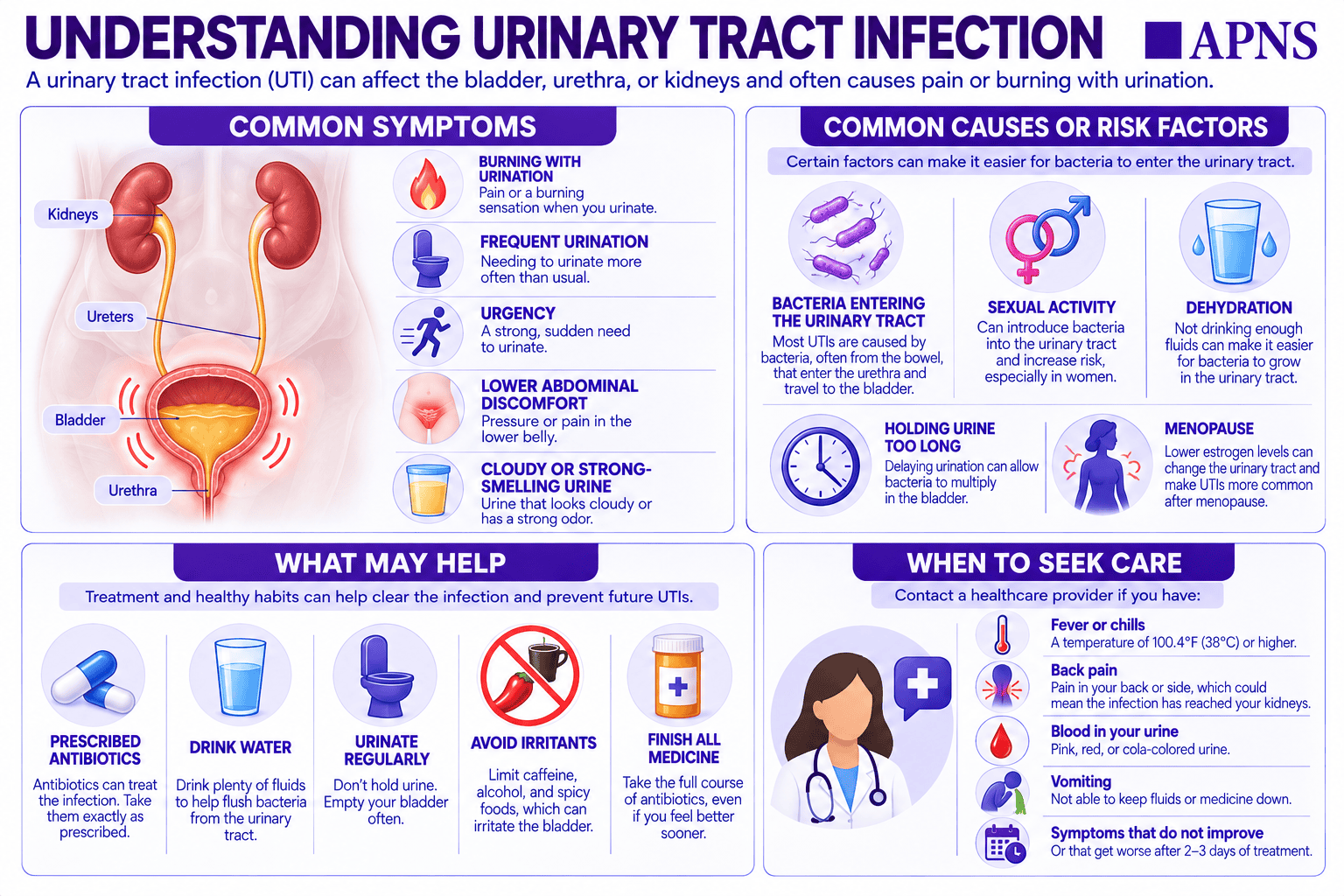
Urinary Tract Infection (UTI) infographic – click to enlarge

What Causes UTI?

Most UTIs occur when bacteria enter through the urethra and multiply in the bladder. Bacteria from the bowel are a common source.

Factors that may contribute include:

  • Sexual activity
  • Changes after menopause
  • Pregnancy
  • Urinary catheters
  • Kidney or bladder stones
  • Enlarged prostate
  • Urinary retention
  • Structural urinary tract problems
  • Recent urinary procedures
  • Poorly controlled diabetes
  • Reduced immune function
  • Difficulty reaching or cleaning the genital area
  • Previous antibiotic exposure

A UTI is not usually considered a sexually transmitted infection. However, sexual activity can move bacteria toward the urethra, and some sexually transmitted infections can cause similar urinary symptoms.

What Can Make UTI Worse?

Factors that may worsen symptoms or increase the risk of complications include:

  • Delaying medical evaluation
  • Not taking antibiotics as prescribed
  • Stopping antibiotics early
  • Using leftover antibiotics
  • Taking an antibiotic that does not treat the responsible bacteria
  • Becoming dehydrated
  • Holding urine for long periods
  • Not emptying the bladder completely
  • Having an untreated urinary blockage
  • Continuing unnecessary catheter use
  • Poorly controlled diabetes
  • Pregnancy
  • Kidney disease
  • A weakened immune system

Untreated bladder infections may spread to the kidneys. Severe kidney infections can occasionally lead to bloodstream infection or sepsis.

Prevention

Not every UTI can be prevented, but helpful measures may include:

  • Drink enough water.
  • Urinate regularly.
  • Avoid holding urine for long periods.
  • Empty the bladder completely.
  • Urinate after sexual activity if this seems helpful for you.
  • Wipe from front to back after using the toilet.
  • Avoid irritating genital sprays, powders, or douches.
  • Manage diabetes.
  • Treat urinary retention or prostate problems.
  • Avoid unnecessary urinary-catheter use.
  • Remove urinary catheters as soon as medically possible.
  • Discuss vaginal estrogen after menopause when appropriate.
  • Discuss preventive medication for frequent recurrent UTIs.
  • Follow safe catheter-care instructions.

Evidence for some commonly recommended practices is limited, and recurrent UTIs are not necessarily caused by poor hygiene or personal behavior. Prevention should be individualized.

Learn More About UTI

The following video content is provided to help you better understand this condition. These resources are intended for educational purposes and should not replace personalized medical advice from your healthcare provider.

Labs

Urine testing is commonly used to help diagnose a UTI.

Possible laboratory tests include:

  • Urinalysis: Checks for white blood cells, blood, bacteria, nitrites, and other findings.
  • Urine Dipstick: Provides a rapid screening test for signs of infection.
  • Urine Microscopy: Examines urine for cells, bacteria, crystals, and other material.
  • Urine Culture: Identifies bacteria and determines which antibiotics may work.
  • Pregnancy Test: May affect testing and antibiotic selection.
  • Complete Blood Count: May be ordered when a severe or kidney infection is suspected.
  • Kidney Function Tests: Evaluate kidney function and dehydration.
  • Blood Cultures: May be needed for fever, severe illness, or suspected bloodstream infection.
  • STI Testing: May be appropriate when symptoms could be caused by chlamydia, gonorrhea, or another infection.

A urine culture may be especially helpful for recurrent infections, pregnancy, infections in men, kidney infections, severe symptoms, recent antibiotic use, or symptoms that do not improve. Diagnosis should consider symptoms as well as urine-test results.

Bacteria in the urine without UTI symptoms usually does not require antibiotics, except in certain situations such as pregnancy or before selected urinary procedures.

Diagnostics

Most uncomplicated bladder infections do not require imaging.

Possible tests for complicated, severe, or repeated infections include:

  • Kidney and Bladder Ultrasound: Checks for stones, blockage, retention, or structural problems.
  • Computed Tomography Scan: May identify kidney stones, abscesses, obstruction, or complications.
  • Post-Void Residual Measurement: Checks how much urine remains after urination.
  • Cystoscopy: Uses a small camera to examine the bladder and urethra.
  • Urodynamic Testing: Evaluates bladder emptying and urinary function.
  • Prostate Evaluation: May be needed in men with urinary retention or recurring infections.

Imaging may be considered when there is severe flank pain, repeated kidney infections, suspected stones, urinary blockage, unusual organisms, or symptoms that do not improve with treatment.

Treatment & Management

Treatment Options

Bacterial UTIs are generally treated with antibiotics. The exact medication and length of treatment depend on the infection location, urine-culture results, allergies, pregnancy status, kidney function, sex, previous infections, and local antibiotic-resistance patterns.

Treatment may include:

  • Oral antibiotics
  • Intravenous antibiotics for severe infection
  • Increased fluid intake when medically appropriate
  • Medication for urinary discomfort
  • Treatment of fever or nausea
  • Removal or replacement of an unnecessary urinary catheter
  • Treatment of kidney stones or urinary blockage
  • Hospital care for severe kidney infection, dehydration, sepsis, or inability to take oral medication

Symptoms often begin improving after antibiotic treatment starts. Contact the healthcare provider if symptoms worsen or do not begin improving as expected.

Lifestyle Changes

Helpful habits include:

  • Drink enough water unless a provider has restricted fluids.
  • Urinate when you feel the need.
  • Avoid regularly holding urine.
  • Take time to empty the bladder completely.
  • Manage diabetes carefully.
  • Avoid unnecessary urinary catheter use.
  • Change out of wet clothing promptly.
  • Wear comfortable, breathable clothing.
  • Avoid products that irritate the genital area.
  • Follow treatment recommendations for urinary retention or prostate problems.
  • Discuss prevention options if infections repeatedly occur.

Water is generally the best fluid for maintaining hydration.

Medications

Possible medications include:

  • Nitrofurantoin: Commonly used for selected bladder infections.
  • Trimethoprim-Sulfamethoxazole: May be used when appropriate and local resistance is acceptable.
  • Fosfomycin: May be used as a single-dose treatment for selected uncomplicated bladder infections.
  • Beta-Lactam Antibiotics: Certain penicillins or cephalosporins may be prescribed.
  • Fluoroquinolone Antibiotics: May be reserved for selected complicated infections or kidney infections because of safety and antibiotic-resistance concerns.
  • Phenazopyridine: May temporarily reduce urinary burning but does not treat the infection.
  • Acetaminophen: May help with pain or fever.
  • Anti-Nausea Medication: May be used when nausea or vomiting occurs.

Important medication guidance:

  • Take antibiotics exactly as prescribed.
  • Do not share antibiotics.
  • Do not take leftover antibiotics.
  • Tell the provider about medication allergies.
  • Tell the provider if pregnancy is possible.
  • Contact the provider for severe diarrhea, rash, breathing difficulty, or other concerning reactions.
  • Phenazopyridine can turn urine orange or reddish and may stain clothing.
  • Urinary pain-relief products do not kill bacteria or replace antibiotics.

The healthcare provider should determine whether antibiotics are needed and which antibiotic is appropriate.

Procedures

Most UTIs do not require a procedure.

Procedures may be necessary when an underlying problem contributes to infection, such as:

  • Removal or replacement of a urinary catheter
  • Drainage of a blocked or infected kidney
  • Placement of a ureteral stent
  • Placement of a nephrostomy tube
  • Treatment or removal of kidney stones
  • Treatment of bladder stones
  • Procedures for an enlarged prostate
  • Drainage of an abscess
  • Surgical correction of selected urinary tract abnormalities

A urinary obstruction combined with infection can become an emergency because infected urine cannot drain normally.

What Should You Expect Long-Term?

Most uncomplicated bladder infections improve completely with appropriate treatment. Symptoms often improve soon after antibiotics are started, although the full course should be taken as directed.

Some people develop repeated UTIs. Recurrent infections may require:

  • Urine cultures
  • Review of possible triggers
  • Evaluation for urinary retention or stones
  • Preventive antibiotic plans
  • Medication taken after sexual activity in selected cases
  • Low-dose preventive antibiotics in selected cases
  • Vaginal estrogen after menopause when appropriate
  • Specialist evaluation

Kidney infections generally require longer or more intensive treatment than simple bladder infections. Delayed treatment increases the risk of complications.

What Can You Do At Home?

Home care should support—but not replace—medical treatment when a bacterial UTI is suspected.

Helpful measures include:

  • Contact a healthcare provider for evaluation.
  • Take prescribed antibiotics exactly as directed.
  • Drink water regularly if fluids are not restricted.
  • Urinate frequently.
  • Avoid holding urine.
  • Use a heating pad on a low setting for lower abdominal discomfort.
  • Do not place a heating pad directly against bare skin.
  • Rest as needed.
  • Avoid alcohol if it worsens symptoms or interacts with medication.
  • Limit caffeine if it increases bladder urgency or discomfort.
  • Avoid scented genital products if they cause irritation.
  • Monitor for fever, vomiting, or back and side pain.

Cranberry products may help prevent some recurrent UTIs, but evidence is mixed. They should not be used as a replacement for antibiotics when an active bacterial infection is present. NIDDK notes that some research suggests cranberry products may help with prevention.

Frequently Asked Questions

Is a UTI the same as a bladder infection?

A bladder infection is one type of UTI. UTIs may also affect the urethra, ureters, or kidneys.

Can a UTI go away without antibiotics?

Some mild symptoms may improve, but a suspected bacterial UTI should be medically assessed. Delaying treatment may allow the infection to spread to the kidneys.

Can I have a UTI without burning?

Yes. Some people mainly experience urgency, frequent urination, lower abdominal pressure, or blood in the urine.

Does strong-smelling urine always mean a UTI?

No. Urine odor may change because of dehydration, foods, vitamins, or medications. Odor alone does not confirm infection.

Is cloudy urine always caused by infection?

No. Cloudiness may result from dehydration, crystals, vaginal discharge, or other causes. Symptoms and testing help determine whether infection is present.

Can sexual activity cause a UTI?

Sexual activity may move bacteria toward the urethra and increase UTI risk, but UTIs are generally not sexually transmitted infections.

Can men develop UTIs?

Yes. UTIs are less common in men, so evaluation may include checking for urinary retention, prostate problems, stones, or another contributing condition.

Are UTIs dangerous during pregnancy?

UTIs during pregnancy require prompt medical care because they are associated with kidney infection and pregnancy complications.

Can I drink cranberry juice instead of taking antibiotics?

No. Cranberry products do not reliably treat an active bacterial infection and should not replace prescribed antibiotics.

Why do my UTIs keep returning?

Possible reasons include reinfection, resistant bacteria, sexual activity, menopause-related changes, urinary retention, stones, catheter use, diabetes, or structural urinary problems.

Can a UTI cause confusion?

A severe infection may contribute to confusion, especially in an older or medically vulnerable person. However, confusion has many possible causes and should not automatically be diagnosed as a UTI without an appropriate assessment.

Questions To Ask Your Provider

Consider asking:

  • Do my symptoms suggest a bladder or kidney infection?
  • Do I need a urine culture?
  • Which antibiotic is appropriate for me?
  • How long should I take the antibiotic?
  • What should I do if I miss a dose?
  • When should my symptoms begin improving?
  • Is phenazopyridine safe for me?
  • Could this be a sexually transmitted infection?
  • Could vaginal irritation or another condition be causing my symptoms?
  • Do I need pregnancy testing?
  • Should I avoid any foods, drinks, or medications?
  • What should I do if the infection returns?
  • Do I need imaging or specialist evaluation?

Which symptoms require urgent medical attention?

Specialist Referrals

Most uncomplicated UTIs can be managed by a primary care, urgent care, or women’s health provider.

You may be referred to:

  • Urologist: Evaluates recurrent infections, urinary retention, stones, prostate problems, structural abnormalities, or blood in the urine.
  • Urogynecologist: Evaluates recurrent UTIs with pelvic-floor or bladder-support problems.
  • Nephrologist: Manages kidney impairment or selected kidney complications.
  • Infectious Disease Specialist: Treats resistant, unusual, or complicated infections.
  • Obstetrician: Manages UTIs during pregnancy.
  • Emergency Medicine Clinician: Treats severe kidney infection, dehydration, sepsis, or urinary obstruction.
  • Pelvic-Floor Physical Therapist: May help when bladder-emptying or pelvic-floor dysfunction contributes to symptoms.

Is UTI Curable?

Yes. Most bacterial UTIs are curable with an appropriate antibiotic.

Repeated infections can usually be managed, but the healthcare provider may need to identify contributing factors such as urinary retention, stones, catheter use, menopause-related changes, diabetes, or structural urinary problems.

Antibiotic-resistant bacteria may require a different medication based on urine-culture results.

Emergency Symptoms / When To Seek Immediate Help

Call 911 or seek emergency medical care immediately for:

  • Severe confusion
  • Difficulty waking
  • Fainting or loss of consciousness
  • Trouble breathing
  • Signs of shock
  • Severe weakness with rapidly worsening illness
  • A severe allergic reaction to medication

Seek urgent same-day medical care for:

  • Fever or shaking chills
  • Pain in the back, side, or groin
  • Persistent nausea or vomiting
  • Inability to keep fluids or medication down
  • Severe abdominal or pelvic pain
  • Little or no urination
  • Inability to urinate
  • Visible blood clots in the urine
  • Rapidly worsening symptoms
  • Symptoms during pregnancy
  • Symptoms in a person with kidney disease
  • Symptoms in a person with a weakened immune system
  • Symptoms in someone with a urinary catheter
  • Symptoms that worsen or do not improve after starting antibiotics

Fever, chills, vomiting, and back or side pain may indicate a kidney infection and require prompt treatment.

CALL 911

APNS does not provide emergency medical services. If you believe you are experiencing a medical emergency, including (but not limited to) chest pain, difficulty breathing, stroke symptoms, severe allergic reactions, anaphylaxis, uncontrolled bleeding, seizures, loss of consciousness, or any other potentially life-threatening condition, you are instructed to call 911 immediately or go immediately to the nearest emergency department.

Official Resources / External Links

Urinary Tract Infection Basics – Centers for Disease Control and Prevention

Provides information about UTI symptoms, risk factors, diagnosis, antibiotics, and prevention.

Bladder Infection in Adults – National Institute of Diabetes and Digestive and Kidney Diseases

Explains bladder-infection symptoms, causes, testing, treatment, and prevention.

Urinary Tract Infections – NIH MedlinePlus

Provides patient-friendly information about UTIs, symptoms, risk factors, diagnosis, and treatment.

Kidney Infection – National Institute of Diabetes and Digestive and Kidney Diseases

Explains kidney-infection symptoms, diagnosis, treatment, and possible complications.

Urinary Tract Infections – American College of Obstetricians and Gynecologists

Provides information about UTIs in women, including treatment, prevention, recurrent infections, and pregnancy considerations.

This guide is intended for educational purposes only and should not replace medical advice, diagnosis, urine testing, or treatment from your healthcare provider. Urinary burning, urgency, frequency, pelvic pain, blood in the urine, or abnormal urine may be caused by a UTI, kidney stone, sexually transmitted infection, vaginal condition, prostate problem, medication, or another condition requiring different treatment. Do not take leftover antibiotics or another person’s medication. Antibiotic selection should consider allergies, pregnancy, kidney function, previous culture results, and local antibiotic resistance. Seek prompt medical care for fever, chills, back or side pain, vomiting, inability to urinate, pregnancy with urinary symptoms, worsening symptoms, or failure to improve after beginning treatment. Call 911 immediately for severe confusion, difficulty breathing, loss of consciousness, signs of shock, or another medical emergency.

Get personalized care for UTI

At APNS, our providers take the time to understand your condition and your goals. We offer comprehensive telehealth visits at a fixed rate — no membership fees, no insurance required, and no unexpected charges. Whether you’re newly diagnosed or looking for a provider who actually listens, we’re here to help.