

A vaginal yeast infection, medically called vulvovaginal candidiasis, is an infection caused by an overgrowth of yeast in the vagina and surrounding vulvar area. The most common cause is a type of fungus called Candida albicans. Small amounts of Candida normally live in the vagina without causing symptoms, but changes in the vaginal environment can allow the yeast to multiply.
A vaginal yeast infection may cause intense itching, burning, irritation, swelling, soreness, and vaginal discharge. It is usually treatable with antifungal medication. Vaginal yeast infections are not generally classified as sexually transmitted infections, although sexual activity can sometimes contribute to irritation or, less commonly, transmission between partners.
Vaginal Yeast Infections – Office on Women’s Health
https://womenshealth.gov/a-z-topics/vaginal-yeast-infections
Provides patient-friendly information about symptoms, risk factors, diagnosis, treatment, and prevention.
Vaginal Yeast Infection – NIH MedlinePlus
https://medlineplus.gov/ency/article/001511.htm
Provides easy-to-understand information about vaginal yeast infections, testing, treatment, and home care.
Vaginal yeast infections are very common. Many people with a vagina experience at least one infection during their lifetime, and some experience repeated infections.
A yeast infection can occur at any age after puberty but is more common during the reproductive years. Pregnancy, antibiotic use, diabetes, and weakened immune function may increase the risk.
Vaginal Yeast Infections – Office on Women’s Health
https://womenshealth.gov/a-z-topics/vaginal-yeast-infections
Provides information about how common vaginal yeast infections are and who is more likely to develop them.
Symptoms may be mild or severe and can resemble bacterial vaginosis, sexually transmitted infections, allergic reactions, and other causes of vaginitis.
Common symptoms may include:
The discharge associated with a yeast infection usually does not have a strong odor. A noticeable fishy or unpleasant odor may suggest bacterial vaginosis, trichomoniasis, or another condition rather than an uncomplicated yeast infection.
Your healthcare provider will ask about your symptoms, previous infections, medications, pregnancy status, sexual history when relevant, and medical conditions such as diabetes.
They may perform:
Because symptoms overlap with bacterial vaginosis, trichomoniasis, sexually transmitted infections, skin disorders, and allergic reactions, testing is recommended when the diagnosis is uncertain.
Testing and Diagnosis for Candidiasis – CDC
https://www.cdc.gov/candidiasis/testing/
Explains why testing may be needed and how vaginal candidiasis is diagnosed.
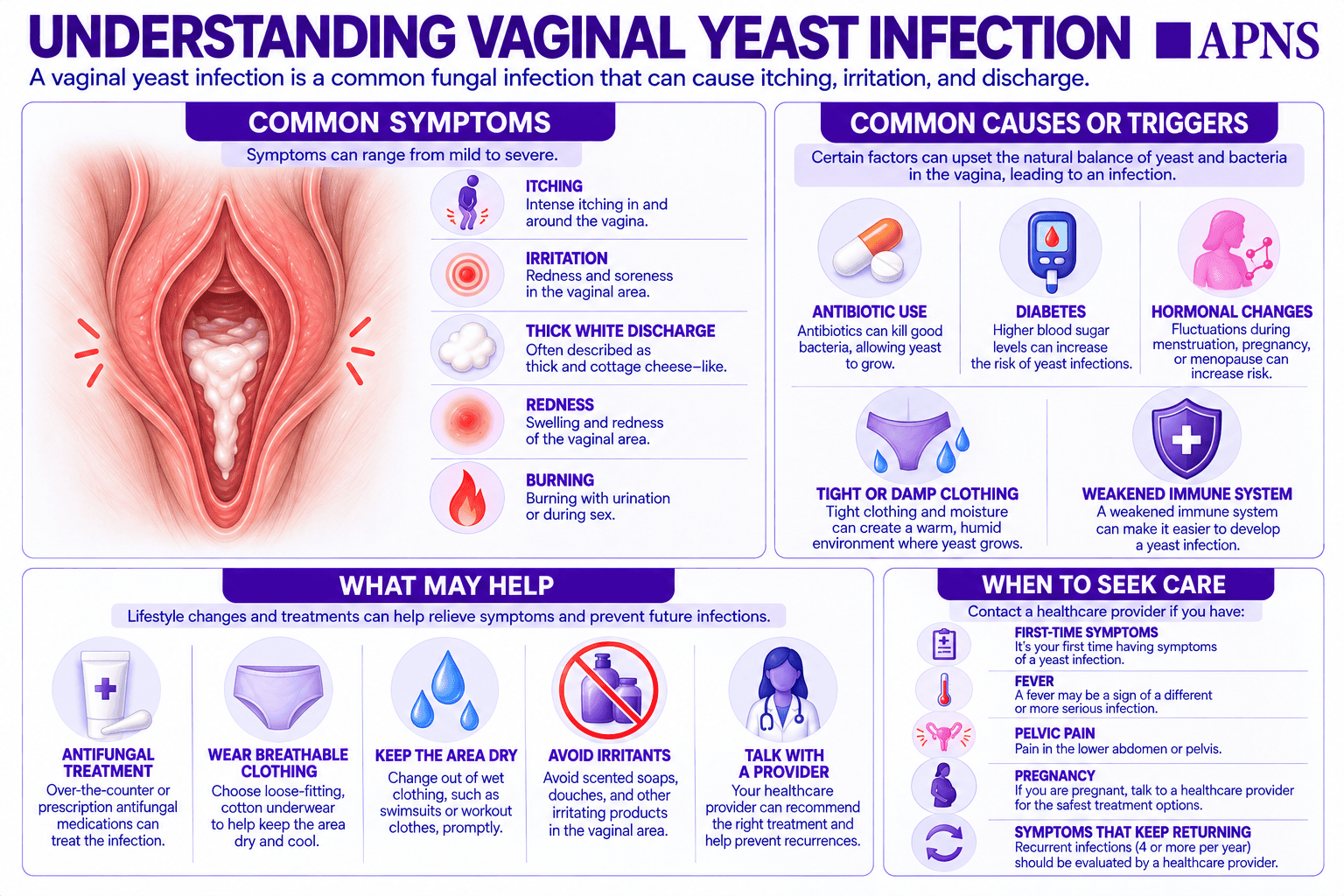
Vaginal yeast infections develop when Candida yeast grows more than usual and disrupts the natural vaginal environment.
Common causes and contributing factors include:
Antibiotics may reduce the healthy bacteria that normally help control Candida growth. Diabetes and conditions or medications that weaken immune function may also make it harder for the body to limit yeast growth.
Risk Factors for Candidiasis – CDC
https://www.cdc.gov/candidiasis/risk-factors/
Explains how medications, health conditions, and immune-system changes can increase the risk of Candida infections.
Several factors may increase irritation, delay recovery, or contribute to repeated infections.
Common factors include:
Douching can disturb the normal vaginal environment and may worsen an existing infection or contribute to bacterial vaginosis and other vaginal problems.
Douching – Office on Women’s Health
https://womenshealth.gov/a-z-topics/douching
Explains why douching is not recommended and how it can affect vaginal health.
Not every vaginal yeast infection can be prevented, but certain habits may reduce the risk.
Helpful prevention tips include:
The CDC recommends using antibiotics and corticosteroids only as prescribed and notes that cotton underwear may help reduce the risk of vaginal candidiasis.
Preventing Candidiasis – CDC
https://www.cdc.gov/candidiasis/prevention/
Provides recommendations for reducing the risk of vaginal and other Candida infections.
The following video content is provided to help you better understand this condition. These resources are intended for educational purposes and should not replace personalized medical advice from your healthcare provider.
Many uncomplicated vaginal yeast infections can be diagnosed through examination and testing of vaginal discharge.
Common laboratory tests may include:
A vaginal yeast test typically involves a pelvic examination and collection of a small sample of vaginal discharge.
Yeast Infection Tests – NIH MedlinePlus
https://medlineplus.gov/lab-tests/yeast-infection-tests/
Explains how vaginal samples are collected and tested for yeast.
Most vaginal yeast infections do not require imaging or invasive diagnostic procedures.
Possible diagnostic evaluations include:
Symptoms alone cannot always reliably distinguish a yeast infection from other vaginal conditions.
Vaginitis – American College of Obstetricians and Gynecologists
https://www.acog.org/womens-health/faqs/vaginitis
Provides information about the evaluation, diagnosis, and treatment of common causes of vaginitis.
Treatment depends on whether the infection is uncomplicated, severe, recurrent, caused by a less common Candida species, or occurring during pregnancy.
Treatment options may include:
Short courses of topical antifungal medication effectively treat many uncomplicated infections. People whose symptoms return, worsen, or fail to improve should be medically evaluated rather than repeatedly treating themselves.
Treatment of Candidiasis – CDC
https://www.cdc.gov/candidiasis/treatment/
Provides information about antifungal creams, oral medication, and treatment for infections that do not improve.
Healthy vulvar and vaginal-care habits may reduce irritation and help prevent repeated symptoms.
Helpful lifestyle changes include:
The vagina cleans itself naturally, and internal cleansing products are not necessary.
Vulvovaginal Health – ACOG
https://www.acog.org/womens-health/faqs/vulvovaginal-health
Provides guidance about vaginal discharge, irritation, hygiene, and maintaining vulvovaginal health.
Antifungal medications are used to treat vaginal yeast infections.
Common medications may include:
Some vaginal antifungal creams and suppositories are oil-based and may weaken latex condoms and diaphragms during treatment. Review the product instructions and ask your pharmacist or healthcare provider about temporary alternative protection.
Pregnant patients should consult a healthcare provider before treatment. CDC guidance recommends topical azole treatment for seven days during pregnancy rather than oral fluconazole.
Miconazole Vaginal – NIH MedlinePlus
https://medlineplus.gov/druginfo/meds/a601203.html
Provides information about vaginal miconazole, proper use, side effects, and precautions.
Clotrimazole Vaginal – NIH MedlinePlus
https://medlineplus.gov/druginfo/meds/a682753.html
Provides information about vaginal clotrimazole and how to use it safely.
Vaginal yeast infections usually do not require surgery or invasive procedures.
Possible office-based evaluations or treatments may include:
Repeated symptoms should not automatically be assumed to be yeast. A healthcare provider may need to rule out bacterial vaginosis, sexually transmitted infections, dermatitis, vulvodynia, or another condition.
Yeast Infection Tests – NIH MedlinePlus
https://medlineplus.gov/lab-tests/yeast-infection-tests/
Explains the examination and sample collection used to diagnose Candida infections.
Most uncomplicated vaginal yeast infections improve after appropriate antifungal treatment. Symptoms such as itching and burning often begin improving within several days, although complete resolution may take longer.
Some people develop recurrent vulvovaginal candidiasis, commonly defined as three or more symptomatic infections within one year. Recurrent infections may require:
Recurrent symptoms may also result from another condition that resembles a yeast infection.
Home care may help reduce discomfort during treatment.
Helpful tips include:
Avoid inserting yogurt, garlic, essential oils, boric acid, or other home remedies unless specifically directed by a qualified healthcare provider. Some products can irritate or injure vaginal tissue, and boric acid is dangerous if swallowed.
Vaginal Yeast Infections – Office on Women’s Health
https://womenshealth.gov/a-z-topics/vaginal-yeast-infections
Provides practical information about treatment, symptom relief, and when to seek medical care.
Usually not. Vaginal yeast infections are generally caused by an overgrowth of Candida already present in the body. Sexual activity may sometimes trigger symptoms, but the infection is not usually classified as sexually transmitted.
Routine treatment of an asymptomatic partner is generally not necessary. A partner who develops genital itching, redness, irritation, or rash should contact a healthcare provider.
An over-the-counter antifungal may be appropriate when you have previously received a confirmed diagnosis and recognize the same symptoms. First-time, severe, recurrent, or uncertain symptoms should be medically evaluated.
Yes. Antibiotics can reduce healthy vaginal bacteria that normally help control Candida growth.
Yes. High blood sugar and poorly controlled diabetes can increase the risk of yeast overgrowth and recurrent infection.
Yes. Some people have watery discharge, mild discharge, or mainly itching and burning.
A strong fishy or unpleasant odor is not typical of an uncomplicated yeast infection and may suggest bacterial vaginosis, trichomoniasis, or another cause.
A mild infection may occasionally improve, but symptoms can continue or worsen. Medical evaluation is recommended when the diagnosis is uncertain.
Probiotics have not been established as a replacement for recommended antifungal treatment. The CDC notes that substantial evidence does not support probiotics or homeopathic products as treatment for vulvovaginal candidiasis.

Consider asking your healthcare provider:
Most vaginal yeast infections are treated by a primary care provider, gynecologist, or other reproductive-health clinician.
You may be referred to:
Vaginitis – ACOG
https://www.acog.org/womens-health/faqs/vaginitis
Provides patient information about yeast infections, bacterial vaginosis, trichomoniasis, diagnosis, and specialist care.
Yes. Most vaginal yeast infections are completely treatable with appropriate antifungal medication.
However, a person can develop another yeast infection later. Recurrent infections may require longer treatment and evaluation for contributing factors.
Treatment may be less straightforward when:
Vaginal yeast infections rarely cause medical emergencies.
Call 911 or seek emergency medical care immediately if you experience:
Seek prompt medical evaluation if you notice:
These symptoms may indicate another vaginal infection, pelvic inflammatory disease, an STI, a medication reaction, or another condition requiring different treatment.
Vaginal Diseases – NIH MedlinePlus
https://medlineplus.gov/vaginaldiseases.html
Provides information about vaginal discharge, pain, infection, bleeding, and when medical evaluation is needed.
CALL 911
APNS does not provide emergency medical services. If you believe you are experiencing a medical emergency, including (but not limited to) chest pain, difficulty breathing, stroke symptoms, severe allergic reactions, anaphylaxis, uncontrolled bleeding, seizures, loss of consciousness, or any other potentially life-threatening condition, you are instructed to call 911 immediately or go immediately to the nearest emergency department.
Vaginal Yeast Infections – Office on Women’s Health
https://womenshealth.gov/a-z-topics/vaginal-yeast-infections
Comprehensive patient information about symptoms, risk factors, treatment, and prevention.
Vaginal Yeast Infection – NIH MedlinePlus
https://medlineplus.gov/ency/article/001511.htm
Easy-to-understand information about causes, testing, treatment, and home care.
Vulvovaginal Candidiasis – CDC
https://www.cdc.gov/std/treatment-guidelines/candidiasis.htm
Detailed clinical guidance about diagnosis and antifungal treatment.
Treatment of Candidiasis – CDC
https://www.cdc.gov/candidiasis/treatment/
Provides information about antifungal treatment and what to do when symptoms return or do not improve.
Vaginitis – American College of Obstetricians and Gynecologists
https://www.acog.org/womens-health/faqs/vaginitis
Provides patient education about yeast infections, bacterial vaginosis, trichomoniasis, diagnosis, and treatment.
This guide is intended for educational purposes only and should not replace medical advice, diagnosis, testing, or treatment from your healthcare provider. Vaginal itching, burning, pain, and discharge may be caused by a yeast infection, bacterial vaginosis, sexually transmitted infection, allergic reaction, skin condition, or another health problem requiring different treatment. Consult a healthcare professional before self-treating if this is your first suspected infection, you are pregnant, symptoms are severe or recurrent, you have diabetes or a weakened immune system, or you are uncertain about the diagnosis. Use antifungal medication exactly as directed and contact your healthcare provider if symptoms worsen, fail to improve, or quickly return. Call 911 immediately for difficulty breathing, swelling of the face or throat, fainting, loss of consciousness, or another medical emergency.
At APNS, our providers take the time to understand your condition and your goals. We offer comprehensive telehealth visits at a fixed rate — no membership fees, no insurance required, and no unexpected charges. Whether you’re newly diagnosed or looking for a provider who actually listens, we’re here to help.