
Emergency Contraception At A Glance
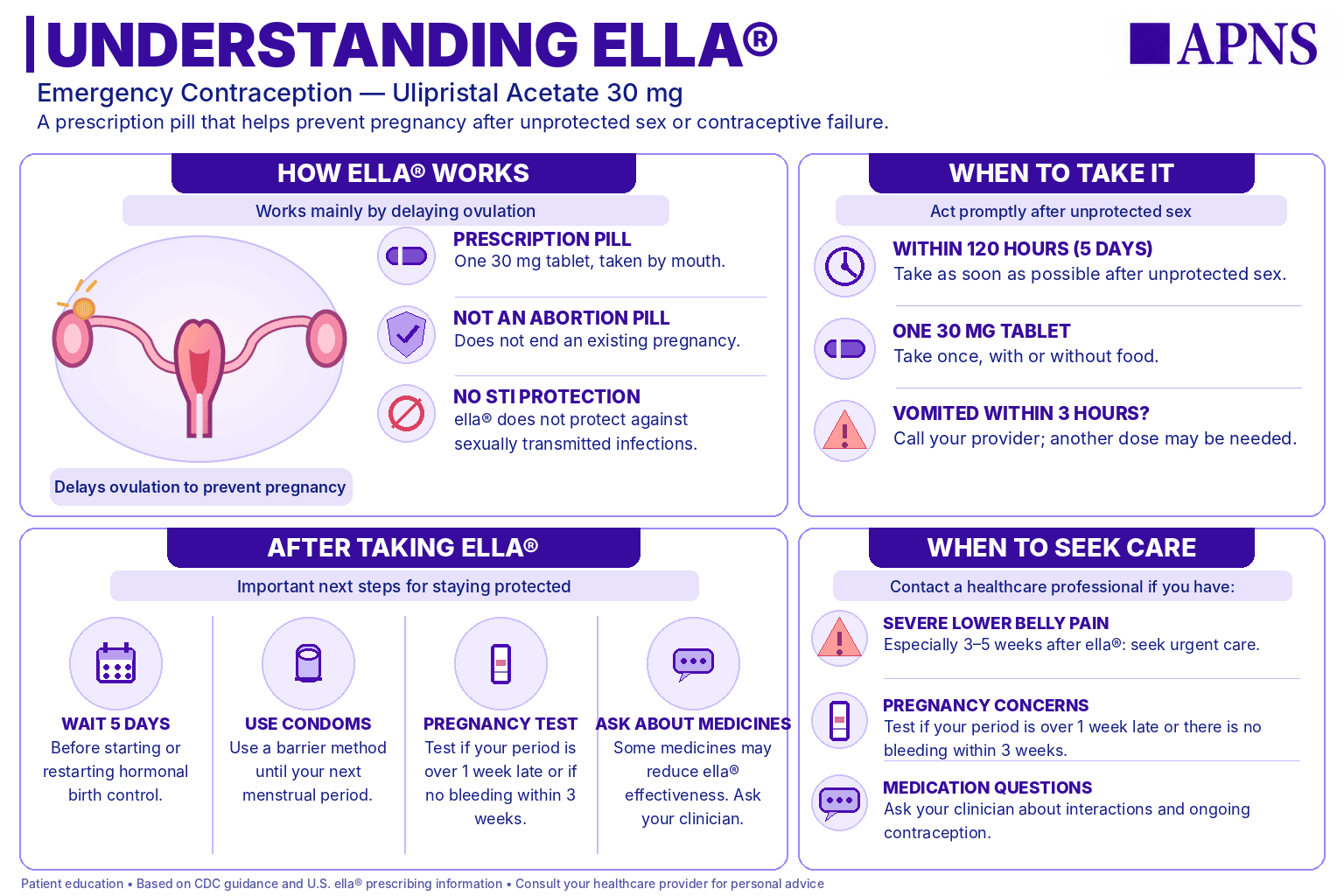
- Ulipristal acetate, sold as ella®, is a prescription emergency contraceptive pill used to lower the chance of pregnancy after unprotected sex or birth-control failure.
- It works mainly by delaying or preventing ovulation so that sperm cannot fertilize an egg.
- It should be taken as soon as possible and can be used within 5 days, or 120 hours, after unprotected sex.
- Ulipristal does not end an established pregnancy and is not the same as medication abortion.
- Common side effects may include headache, nausea, abdominal pain, menstrual cramps, tiredness, dizziness, and temporary changes in the timing of the next period.
- Hormonal birth control generally should not be restarted until at least 5 days after taking ulipristal because it may interfere with the medication’s effect.

Table of Contents
Table of Contents
What Is Emergency Contraception with Ulipristal Acetate?
Ulipristal acetate (brand name ella®) is a prescription emergency contraceptive pill used to lower the chance of pregnancy after unprotected sex or when birth control fails. Examples include a condom breaking, missed birth control pills, or having sex without contraception.
Ulipristal acetate works mainly by delaying or preventing ovulation (the release of an egg from the ovary). It does not end an existing pregnancy and is not the same as medication abortion. It should be taken as soon as possible and can be used within 5 days (120 hours) after unprotected sex.
When Is It Used?
Ulipristal acetate may be considered after:
- Sex without contraception
- A condom breaks, slips, or is used incorrectly
- Birth control pills are missed
- A contraceptive patch or vaginal ring is used incorrectly
- Another birth control method fails
- Sexual assault when pregnancy is possible
Emergency contraceptive pills should be taken as soon as possible within 5 days after unprotected sex.
How Does Ulipristal Acetate Work?
Ulipristal acetate is a selective progesterone receptor modulator. It primarily delays or prevents ovulation so that sperm cannot fertilize an egg.
It does not protect against pregnancy from sex that occurs after the dose is taken. Additional contraception is needed for future sexual activity.
How Is It Taken?
The usual dose is:
- Ulipristal acetate 30 mg by mouth once
- Take it as soon as possible after unprotected sex.
- It can be taken up to 120 hours (5 days) afterward.
- It may be taken with or without food.
Taking emergency contraception sooner is generally preferred. Ulipristal remains an effective oral emergency-contraception option throughout the 5-day window.
Ulipristal (ella) vs. Plan B
Ulipristal acetate and levonorgestrel (such as Plan B One-Step®) are different medications.
Ulipristal acetate (ella):
- Prescription emergency contraceptive
- Works up to 5 days after unprotected sex
- 30 mg single dose
- More effective than levonorgestrel during days 3–5 after unprotected sex
Levonorgestrel (Plan B and generics):
- Available without a prescription
- Works best when taken as soon as possible
- 1.5 mg single dose is commonly used
- Effectiveness may decrease as more time passes
CDC guidance notes that ulipristal and levonorgestrel have similar effectiveness within the first 3 days, but ulipristal has been observed to be more effective during days 3–5.
What If I Am Already Pregnant?
Ulipristal acetate is not an abortion medication and will not terminate an established pregnancy.
It should not be used when there is a known or suspected existing pregnancy. If you may already be pregnant, talk with your healthcare provider about pregnancy testing and your options.
The FDA prescribing information states that ella is contraindicated for use during an existing or suspected pregnancy.
Prevention and Ongoing Birth Control
Emergency contraception is intended for situations when regular contraception was not used or did not work. It is not designed to replace an ongoing birth control method.
Options for ongoing contraception include:
- Birth control pills
- Vaginal ring
- Contraceptive patch
- Birth control injection
- Implant
- Hormonal IUD
- Copper IUD
- Condoms and other barrier methods
Talk with your healthcare provider about which method best fits your health needs and preferences.
Learn More About Ulipristal Acetate
These resources are intended for educational purposes and should not replace personalized medical advice from your healthcare provider.
Common Side Effects
Possible side effects include:
- Headache
- Nausea
- Abdominal or stomach pain
- Menstrual cramps
- Tiredness
- Dizziness
- Changes in your next menstrual period
Your next period may occur earlier or later than expected.
What If I Vomit?
If you vomit shortly after taking ulipristal acetate, contact your healthcare provider or pharmacist.
Another dose may be needed depending on how soon vomiting occurred after taking the medication.
When Will My Next Period Come?
Your next menstrual period may come a few days earlier or later than expected.
If you do not have a period or withdrawal bleed within about 3 weeks, take a pregnancy test. CDC specifically recommends pregnancy testing if bleeding does not occur within 3 weeks after emergency contraceptive pill use.
Starting Birth Control After ella
This is especially important with ulipristal acetate.
Wait at least 5 days after taking ulipristal before starting or restarting hormonal birth control, unless your healthcare provider gives you different instructions based on your individual situation.
Hormonal birth control contains hormones that can interfere with ulipristal’s ability to delay ovulation. CDC therefore recommends starting or resuming hormonal contraception no sooner than 5 days after ulipristal.
Do I Need Condoms After Taking It?
Yes. Ulipristal does not provide ongoing protection against pregnancy.
After waiting 5 days and starting or restarting your regular hormonal contraception, abstain from sex or use a barrier method such as condoms for the next 7 days after restarting contraception, or until your next period, whichever comes first, according to CDC emergency-contraception guidance.
Nonhormonal contraception can be started immediately after ulipristal.
Does It Protect Against STIs?
No.
Emergency contraception does not protect against sexually transmitted infections (STIs), including HIV.
Condoms can help reduce STI transmission. People with possible HIV exposure may also need evaluation for HIV post-exposure prophylaxis (PEP), which is time-sensitive.
Can Body Weight Affect Emergency Contraception?
Body weight and BMI may influence the effectiveness of some oral emergency contraceptives.
CDC notes that levonorgestrel emergency contraception might be less effective than ulipristal among women with obesity. If effectiveness is a concern, talk with your healthcare provider about the best emergency-contraception option for you.
A copper IUD is another highly effective emergency-contraception option.
Other Emergency Contraception Options
Emergency contraception options include:
- Ulipristal acetate (ella®)
- Levonorgestrel (Plan B One-Step® and generics)
- Copper intrauterine device (IUD)
A copper IUD can generally be placed within 5 days after the first episode of unprotected sex and is highly effective emergency contraception. It can then remain in place as ongoing birth control.
Medication Interactions
Some medications and supplements can reduce the effectiveness of ulipristal acetate.
Tell your healthcare provider about all prescription medicines, over-the-counter medications, vitamins, and herbal supplements you take.
Certain medications that strongly increase CYP3A4 enzyme activity can lower ulipristal levels and may make it less effective. Your healthcare provider or pharmacist can check your medications for interactions.
Hormonal contraceptives are also important because progestin-containing contraception used too soon after ulipristal may reduce its ability to delay ovulation.
Pregnancy Testing
A pregnancy test taken immediately after very recent unprotected sex cannot reliably rule out a pregnancy caused by that sexual encounter.
Pregnancy tests detect pregnancy hormones only after enough time has passed. CDC notes that pregnancy tests cannot detect a pregnancy resulting from very recent intercourse.
Take a pregnancy test if you do not have your expected bleeding within about 3 weeks after using emergency contraception.
Frequently Asked Questions
Is ella the abortion pill?
No. Ulipristal acetate is emergency contraception. It primarily works by delaying or preventing ovulation and does not terminate an established pregnancy.
Can I take ella 4 or 5 days after sex?
Yes. It can be taken within 120 hours (5 days) after unprotected sex.
Can I take my regular birth control pill the next day?
Generally, no. CDC recommends waiting at least 5 days after ulipristal before starting or restarting hormonal contraception.
Does ella protect me if I have unprotected sex again tomorrow?
No. It does not provide ongoing contraception for future sexual activity.
Can I use ella more than once?
Talk with your healthcare provider if you need emergency contraception again, particularly within the same menstrual cycle. A regular contraceptive method may provide more reliable ongoing pregnancy prevention.
Do I need a pregnancy test first?
A healthcare provider may recommend one depending on your circumstances, but a test taken immediately after recent intercourse cannot rule out pregnancy from that recent exposure.

When Should I Contact a Healthcare Provider?
Contact a healthcare provider if:
- Your period is significantly delayed
- You have a positive pregnancy test
- You have persistent or concerning abdominal/pelvic pain
- You vomited soon after taking the medication
- You had additional unprotected sex after taking ella
- You are unsure when to restart your birth control
- You take medications that might interact with ella
- You need STI testing or HIV prevention services
Emergency Symptoms / When To Seek Immediate Help
Seek prompt medical evaluation for severe or persistent lower abdominal/pelvic pain, especially if you have a positive pregnancy test or a significantly delayed period.
Although uncommon, abdominal pain with pregnancy can require evaluation for conditions such as an ectopic pregnancy, where a pregnancy develops outside the uterus.
Call 911 or seek emergency care for severe symptoms such as fainting, severe weakness, or other symptoms that feel life-threatening.
CALL 911
APNS does not provide emergency medical services. If you believe you are experiencing a medical emergency, including (but not limited to) chest pain, difficulty breathing, stroke symptoms, severe allergic reactions, anaphylaxis, uncontrolled bleeding, seizures, loss of consciousness, or any other potentially life-threatening condition, you are instructed to call 911 immediately or go immediately to the nearest emergency department.
Official Resources / External Links
Centers for Disease Control and Prevention (CDC) — Emergency Contraception
CDC Emergency Contraception Guidance
CDC — Contraception and Birth Control Methods
CDC Birth Control Methods
FDA — ella (Ulipristal Acetate) Prescribing Information
FDA ella Prescribing Information
This information is for educational purposes only and is not a substitute for professional medical advice, diagnosis, or treatment. Medication recommendations and eligibility can vary based on your health history, other medications, pregnancy risk, and individual circumstances. Always follow the instructions provided by your healthcare professional and pharmacist. If you think you may be experiencing a medical emergency, call 911 or seek emergency medical care.
Get personalized care for Emergency Contraception
At APNS, our providers take the time to understand your condition and your goals. We offer comprehensive telehealth visits at a fixed rate — no membership fees, no insurance required, and no unexpected charges. Whether you’re newly diagnosed or looking for a provider who actually listens, we’re here to help.