

Chlamydia is a common sexually transmitted infection (STI) caused by the bacterium Chlamydia trachomatis. It can infect the cervix, urethra, rectum, and sometimes the throat or eyes. It spreads mainly through vaginal, anal, or oral sex and can pass from a pregnant person to a baby during delivery.
Chlamydia often causes no symptoms, so a person can have and pass it without knowing. It is curable with prescription antibiotics. Early testing and treatment help prevent pelvic inflammatory disease, fertility problems, epididymitis, ongoing pain, and transmission to partners.
About Chlamydia – CDC
https://www.cdc.gov/chlamydia/about/index.html
Provides patient-friendly information about symptoms, transmission, testing, treatment, pregnancy, and prevention.
Chlamydia Infections – NIH MedlinePlus
https://medlineplus.gov/chlamydiainfections.html
Offers clear information about chlamydia symptoms, diagnosis, treatment, complications, and prevention.
Chlamydia is one of the most commonly reported bacterial STIs in the United States. It affects people of all genders and sexual orientations, but reported rates are especially high among younger sexually active adults.
Reported cases do not include every infection because many people have no symptoms and are never tested. Regular screening based on age, anatomy, pregnancy, partners, and sexual exposures helps identify infection early.
About Chlamydia – CDC
https://www.cdc.gov/chlamydia/about/index.html
Provides patient-friendly information about symptoms, transmission, testing, treatment, pregnancy, and prevention.
Getting Tested for STIs – CDC
https://www.cdc.gov/sti/testing/index.html
Explains who should receive STI testing, which body sites may need testing, and how to find care.
Most people have no symptoms. When symptoms occur, they may begin weeks after exposure and can include:
Symptoms alone cannot distinguish chlamydia from gonorrhea, Mgen, trichomoniasis, urinary infection, or other conditions. Laboratory testing is needed.
A provider will ask about symptoms, pregnancy, recent partners, and the types of sexual contact you have had. This information helps decide whether urine, vaginal, cervical, rectal, or throat samples are needed. The conversation should be private and nonjudgmental.
A physical or pelvic examination may be performed when you have pain, discharge, bleeding, testicular swelling, sores, or signs of a complication. Many people can be tested without an internal examination.
About Chlamydia – CDC
https://www.cdc.gov/chlamydia/about/index.html
Provides patient-friendly information about symptoms, transmission, testing, treatment, pregnancy, and prevention.
Getting Tested for STIs – CDC
https://www.cdc.gov/sti/testing/index.html
Explains who should receive STI testing, which body sites may need testing, and how to find care.
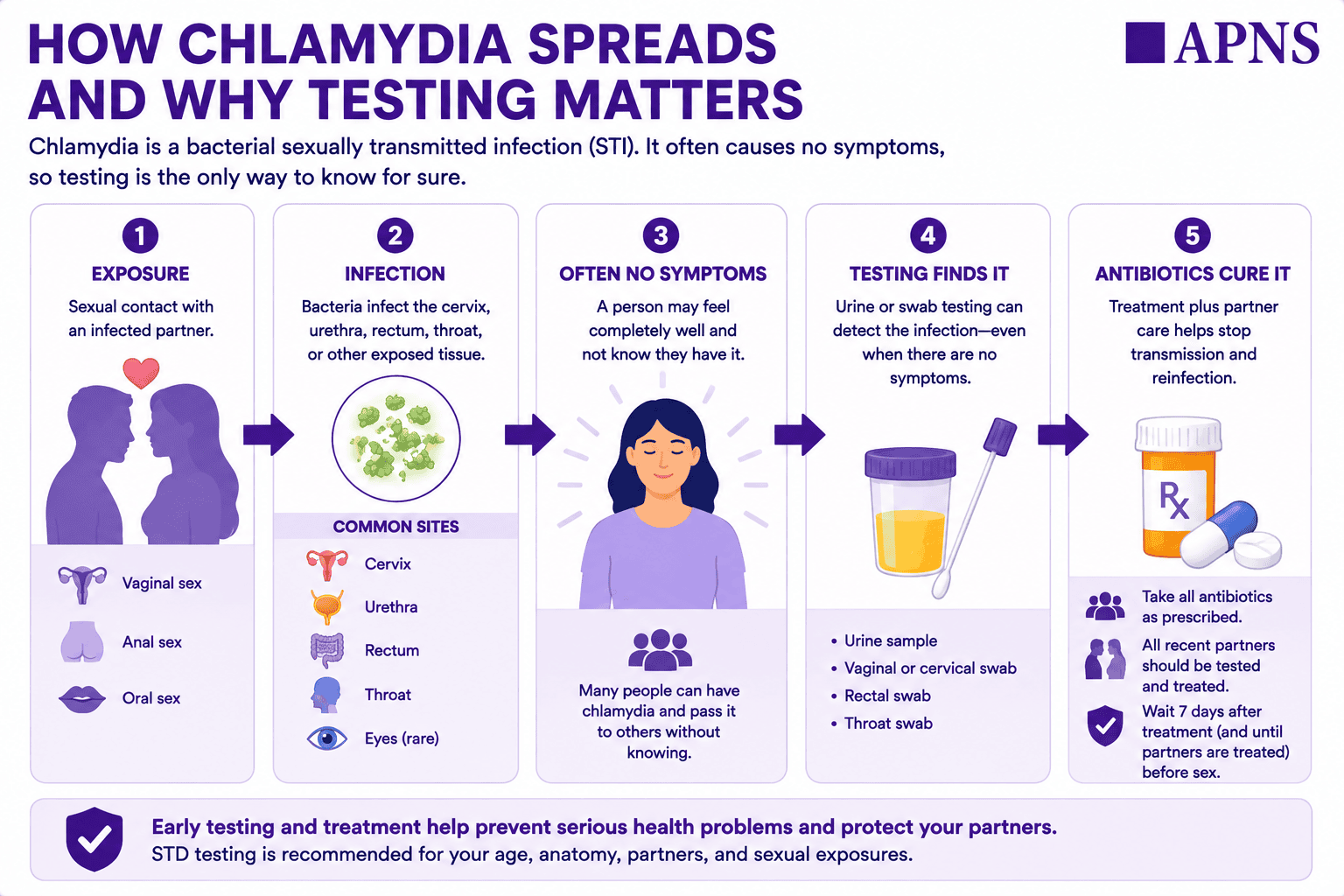
Chlamydia is caused by infection with C. trachomatis. It can spread when infected genital fluids or tissues contact the cervix, urethra, rectum, throat, or eyes during sexual activity, even when there is no ejaculation or visible symptom.
Common routes include:
Chlamydia is not spread by toilet seats, casual touching, hugging, swimming pools, sharing food, or ordinary household contact.
About Chlamydia – CDC
https://www.cdc.gov/chlamydia/about/index.html
Provides patient-friendly information about symptoms, transmission, testing, treatment, pregnancy, and prevention.
Chlamydia may spread or cause complications when treatment is delayed, doses are missed, or sexual contact resumes before treatment and partner care are complete.
Douching does not prevent or cure chlamydia and may increase the chance that an infection moves upward into the reproductive organs.
Chlamydial Infections – CDC STI Treatment Guidelines
https://www.cdc.gov/std/treatment-guidelines/chlamydia.htm
Provides current clinical guidance about testing, recommended treatment, partner care, pregnancy, and follow-up.
You can lower the chance of chlamydia by:
Condoms greatly reduce risk when used correctly, but no method except avoiding sexual contact eliminates risk completely.
Condom Use – CDC
https://www.cdc.gov/condom-use/
Provides guidance on correct condom use to reduce STI and pregnancy risk.
Getting Tested for STIs – CDC
https://www.cdc.gov/sti/testing/index.html
Explains who should receive STI testing, which body sites may need testing, and how to find care.
The following video content is provided to help you better understand this condition. These resources are intended for educational purposes and should not replace personalized medical advice from your healthcare provider.
The preferred test is usually a nucleic acid amplification test (NAAT), which looks for the bacteria’s genetic material.
Ask the clinic whether you should avoid urinating before a urine test. Do not clean inside the vagina or urethra before testing unless instructed.
Sexually Transmitted Infection Tests – NIH MedlinePlus
https://medlineplus.gov/lab-tests/sexually-transmitted-infection-sti-tests/
Explains urine, swab, and blood testing for STIs and what to expect.
Getting Tested for STIs – CDC
https://www.cdc.gov/sti/testing/index.html
Explains who should receive STI testing, which body sites may need testing, and how to find care.
Imaging is not used to diagnose uncomplicated chlamydia. Urine or swab NAAT testing is usually enough.
A normal ultrasound does not rule out mild PID. Treatment may be started based on symptoms and examination because delay can increase complications.
About Pelvic Inflammatory Disease – CDC
https://www.cdc.gov/pid/about/index.html
Explains PID symptoms, complications, prevention, and when to seek care.
Antibiotics cure chlamydia. The recommended medicine depends on the infection site, pregnancy, allergies, age, other medicines, and whether complications such as PID or epididymitis are present.
Do not wait for symptoms to return before completing follow-up. Antibiotics cure the current infection but cannot reverse scarring or other permanent damage that occurred before treatment.
Chlamydial Infections – CDC STI Treatment Guidelines
https://www.cdc.gov/std/treatment-guidelines/chlamydia.htm
Provides current clinical guidance about testing, recommended treatment, partner care, pregnancy, and follow-up.
Antibiotics cure chlamydia. The recommended medicine depends on the infection site, pregnancy, allergies, age, other medicines, and whether complications such as PID or epididymitis are present.
Do not wait for symptoms to return before completing follow-up. Antibiotics cure the current infection but cannot reverse scarring or other permanent damage that occurred before treatment.
Chlamydial Infections – CDC STI Treatment Guidelines
https://www.cdc.gov/std/treatment-guidelines/chlamydia.htm
Provides current clinical guidance about testing, recommended treatment, partner care, pregnancy, and follow-up.
Antibiotics cure chlamydia. The recommended medicine depends on the infection site, pregnancy, allergies, age, other medicines, and whether complications such as PID or epididymitis are present.
Do not wait for symptoms to return before completing follow-up. Antibiotics cure the current infection but cannot reverse scarring or other permanent damage that occurred before treatment.
Chlamydial Infections – CDC STI Treatment Guidelines
https://www.cdc.gov/std/treatment-guidelines/chlamydia.htm
Provides current clinical guidance about testing, recommended treatment, partner care, pregnancy, and follow-up.
Uncomplicated chlamydia does not require a procedure. Testing and antibiotics are usually sufficient.
Ask why any procedure is recommended, what it may show or treat, risks, recovery, and whether it could affect fertility.
About Pelvic Inflammatory Disease – CDC
https://www.cdc.gov/pid/about/index.html
Explains PID symptoms, complications, prevention, and when to seek care.
Most people are fully cured when they take the correct antibiotics and avoid reinfection. Symptoms, if present, should improve, but persistent pain, discharge, bleeding, or urinary symptoms need reevaluation.
Repeat infection is common. CDC recommends retesting about three months after treatment for everyone diagnosed with chlamydia, even if partners were treated. A routine test of cure is not needed for most nonpregnant adults, but pregnancy requires a NAAT test of cure about four weeks after treatment and additional retesting as directed.
Chlamydial Infections – CDC STI Treatment Guidelines
https://www.cdc.gov/std/treatment-guidelines/chlamydia.htm
Provides current clinical guidance about testing, recommended treatment, partner care, pregnancy, and follow-up.
About Chlamydia – CDC
https://www.cdc.gov/chlamydia/about/index.html
Provides patient-friendly information about symptoms, transmission, testing, treatment, pregnancy, and prevention.
Most people are fully cured when they take the correct antibiotics and avoid reinfection. Symptoms, if present, should improve, but persistent pain, discharge, bleeding, or urinary symptoms need reevaluation.
Repeat infection is common. CDC recommends retesting about three months after treatment for everyone diagnosed with chlamydia, even if partners were treated. A routine test of cure is not needed for most nonpregnant adults, but pregnancy requires a NAAT test of cure about four weeks after treatment and additional retesting as directed.
Chlamydial Infections – CDC STI Treatment Guidelines
https://www.cdc.gov/std/treatment-guidelines/chlamydia.htm
Provides current clinical guidance about testing, recommended treatment, partner care, pregnancy, and follow-up.
About Chlamydia – CDC
https://www.cdc.gov/chlamydia/about/index.html
Provides patient-friendly information about symptoms, transmission, testing, treatment, pregnancy, and prevention.
Yes. Most infections cause no symptoms, which is why screening and testing after exposure are important.
Symptoms may disappear while infection remains. Treatment is needed to cure it and reduce complications and transmission.
No. Chlamydia is not spread through toilet seats or ordinary household contact.
Yes. Chlamydia can infect the throat, although throat infection is less common and often has no symptoms.
Wait seven days after single-dose treatment or until a seven-day regimen is completed, and until partners have been treated. Symptoms should also be resolved.
Reinfection is common. Retesting finds a new infection early even if you believe partners were treated.
Untreated infection can cause PID and tubal scarring or epididymitis. Many treated infections do not cause infertility, especially when found early.
No. Chlamydia may remain silent for a long time, so a test usually cannot determine when transmission occurred or identify a specific partner.

Consider asking:
Most uncomplicated infections can be managed in primary care, urgent care, or a sexual-health clinic. Referral may be made to:
Local health departments can often provide confidential testing, treatment, partner services, and prevention support.
Partner Services – CDC STI Treatment Guidelines
https://www.cdc.gov/std/treatment-guidelines/clinical-partnerServices.htm
Explains confidential partner notification, evaluation, treatment, and public-health services.
Yes. Chlamydia is a bacterial infection and can be cured with the correct antibiotics. A cure does not create immunity, so you can get chlamydia again from an untreated or new infected partner.
Treatment stops the active infection but cannot reverse permanent scarring or damage that may have already occurred. Early care and partner treatment lower this risk.
About Chlamydia – CDC
https://www.cdc.gov/chlamydia/about/index.html
Provides patient-friendly information about symptoms, transmission, testing, treatment, pregnancy, and prevention.
Chlamydia Infections – NIH MedlinePlus
https://medlineplus.gov/chlamydiainfections.html
Offers clear information about chlamydia symptoms, diagnosis, treatment, complications, and prevention.
Seek urgent or emergency care for:
Sudden testicular pain can be torsion, and pelvic pain during pregnancy can be ectopic pregnancy. Both are time-sensitive emergencies and should not be assumed to be chlamydia.
About Pelvic Inflammatory Disease – CDC
https://www.cdc.gov/pid/about/index.html
Explains PID symptoms, complications, prevention, and when to seek care.
CALL 911
APNS does not provide emergency medical services. If you believe you are experiencing a medical emergency, including (but not limited to) chest pain, difficulty breathing, stroke symptoms, severe allergic reactions, anaphylaxis, uncontrolled bleeding, seizures, loss of consciousness, or any other potentially life-threatening condition, you are instructed to call 911 immediately or go immediately to the nearest emergency department.
About Chlamydia – CDC
https://www.cdc.gov/chlamydia/about/index.html
Provides patient-friendly information about symptoms, transmission, testing, treatment, pregnancy, and prevention.
Chlamydial Infections – CDC STI Treatment Guidelines
https://www.cdc.gov/std/treatment-guidelines/chlamydia.htm
Provides current clinical guidance about testing, recommended treatment, partner care, pregnancy, and follow-up.
Getting Tested for STIs – CDC
https://www.cdc.gov/sti/testing/index.html
Explains who should receive STI testing, which body sites may need testing, and how to find care.
Chlamydia Infections – NIH MedlinePlus
https://medlineplus.gov/chlamydiainfections.html
Offers clear information about chlamydia symptoms, diagnosis, treatment, complications, and prevention.
Sexually Transmitted Infection Tests – NIH MedlinePlus
https://medlineplus.gov/lab-tests/sexually-transmitted-infection-sti-tests/
Explains urine, swab, and blood testing for STIs and what to expect.
Partner Services – CDC STI Treatment Guidelines
https://www.cdc.gov/std/treatment-guidelines/clinical-partnerServices.htm
Explains confidential partner notification, evaluation, treatment, and public-health services.
This guide is intended for educational purposes only and should not replace medical advice, diagnosis, laboratory testing, or treatment from a healthcare provider. Chlamydia often causes no symptoms and requires prescription antibiotics. Avoid sexual contact until treatment and partner-care requirements are complete. Seek urgent care for severe pelvic or abdominal pain, sudden testicular pain, pregnancy with pain or bleeding, fever with worsening symptoms, serious eye symptoms, or a severe medication reaction.
At APNS, our providers take the time to understand your condition and your goals. We offer comprehensive telehealth visits at a fixed rate — no membership fees, no insurance required, and no unexpected charges. Whether you’re newly diagnosed or looking for a provider who actually listens, we’re here to help.