

Erectile dysfunction (ED) means repeatedly having difficulty getting or keeping an erection firm enough for satisfying sexual activity. An occasional erection problem can happen with stress, fatigue, illness, or alcohol use and does not necessarily mean you have ED.
Ongoing ED is not a routine or unavoidable part of aging. It can affect confidence, intimacy, and quality of life, and it may be an early sign of blood-vessel disease, diabetes, nerve problems, medication effects, or another treatable condition. Effective treatments are available, and discussing ED with a healthcare provider is an important part of routine health care.
Erectile Dysfunction – National Institute of Diabetes and Digestive and Kidney Diseases (NIDDK)
https://www.niddk.nih.gov/health-information/urologic-diseases/erectile-dysfunction
Provides a complete overview of erectile dysfunction symptoms, causes, diagnosis, treatment, and prevention.
Erectile Dysfunction – NIH MedlinePlus
https://medlineplus.gov/erectiledysfunction.html
Offers easy-to-understand information about ED, related health conditions, tests, and treatments.
ED is the most commonly reported sexual problem among people with a penis. It becomes more common with age and with conditions such as diabetes, high blood pressure, heart disease, obesity, and prostate disease, but it can occur at any adult age.
Many people do not seek care because they feel embarrassed, so estimates vary. ED is common, but frequent or worsening symptoms deserve medical evaluation rather than being dismissed as normal aging.
Erectile Dysfunction – Urology Care Foundation
https://www.urologyhealth.org/urology-a-z/e/erectile-dysfunction-%28ed%29
Provides patient-focused information about ED symptoms, evaluation, and treatment choices.
What Symptoms Might You Notice?
Symptoms may occur every time or only in certain situations.
You may notice:
ED is different from low sexual desire, premature ejaculation, and infertility, although these concerns can occur together.
Symptoms and Causes of Erectile Dysfunction – NIDDK
https://www.niddk.nih.gov/health-information/urologic-diseases/erectile-dysfunction/symptoms-causes
Explains physical, medication-related, lifestyle, and emotional factors that may cause ED.
A healthcare provider will ask about your erections, sexual desire, ejaculation, medical conditions, medicines, substance use, mood, and relationship concerns. They may ask whether erections occur during sleep or masturbation and whether symptoms began suddenly or gradually.
The physical examination may include blood pressure, heart and blood-vessel assessment, and examination of the penis, testicles, and nerve responses. Because ED may signal cardiovascular disease, your provider may also assess your risk for diabetes, high cholesterol, and heart disease.
Diagnosis of Erectile Dysfunction – NIDDK
https://www.niddk.nih.gov/health-information/urologic-diseases/erectile-dysfunction/diagnosis
Describes the health history, physical examination, laboratory tests, and specialized testing used to evaluate ED.
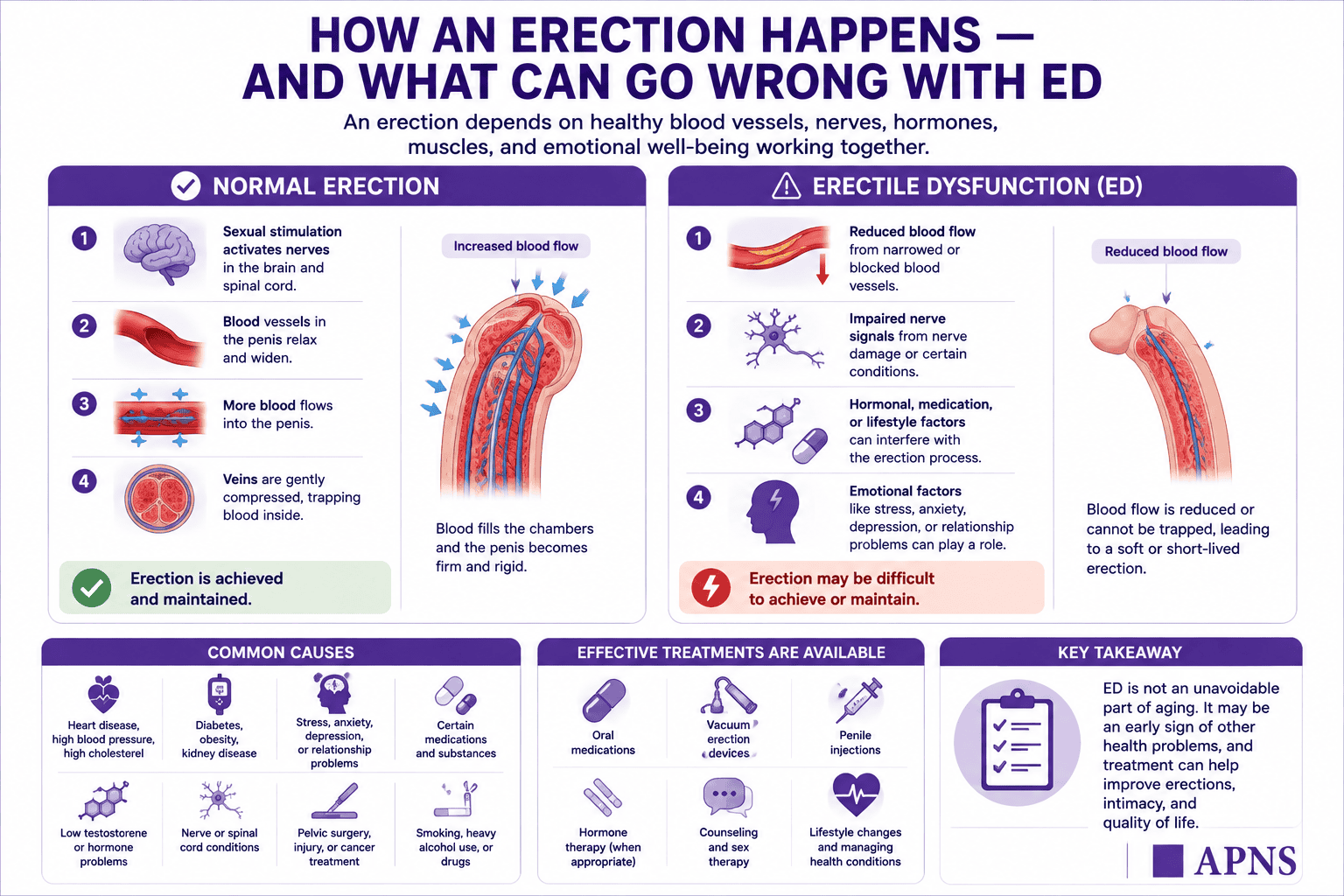
An erection depends on healthy blood vessels, nerves, hormones, muscles, and emotional well-being. A problem affecting any part of this process can contribute to ED, and many people have more than one cause.
Possible causes include:
Symptoms and Causes of Erectile Dysfunction – NIDDK
https://www.niddk.nih.gov/health-information/urologic-diseases/erectile-dysfunction/symptoms-causes
Explains physical, medication-related, lifestyle, and emotional factors that may cause ED.
ED may worsen when an underlying health problem is not controlled or when worry about sexual performance creates a cycle of anxiety.
Common worsening factors include:
Not every case can be prevented, especially when ED follows surgery, injury, or a neurologic condition. Protecting heart, blood-vessel, nerve, and mental health can lower risk.
Eating, Diet, and Nutrition for Erectile Dysfunction – NIDDK
Explains how a heart-healthy eating pattern may lower ED risk or improve symptoms.
The following video content is provided to help you better understand this condition. These resources are intended for educational purposes and should not replace personalized medical advice from your healthcare provider.
Laboratory testing helps identify treatable conditions and is tailored to your symptoms and health history.
Possible tests include:
Hemoglobin A1C Test – NIH MedlinePlus
https://medlineplus.gov/lab-tests/hemoglobin-a1c-hba1c-test/
Explains the blood test used to screen for and monitor diabetes.
Testosterone Levels Test – NIH MedlinePlus
https://medlineplus.gov/lab-tests/testosterone-levels-test/
Explains when testosterone testing may be appropriate and what results can mean.
Most people do not need extensive testing. A provider may use a short questionnaire, such as the International Index of Erectile Function, to measure symptoms and treatment response.
Specialized testing may be used when the cause is unclear, symptoms follow an injury, or surgery is being considered.
Diagnosis of Erectile Dysfunction – NIDDK
https://www.niddk.nih.gov/health-information/urologic-diseases/erectile-dysfunction/diagnosis
Describes the health history, physical examination, laboratory tests, and specialized testing used to evaluate ED.
Treatment addresses contributing health conditions and then focuses on improving erections. The best choice depends on your goals, heart health, medicines, preferences, and whether you have a partner you want involved in decisions.
Treatment options include:
Treatment for Erectile Dysfunction – NIDDK
https://www.niddk.nih.gov/health-information/urologic-diseases/erectile-dysfunction/treatment
Reviews lifestyle changes, counseling, medicines, vacuum devices, injections, and surgery used to treat ED.
Habits that protect the heart and blood vessels can also improve erectile health and treatment response.
Helpful changes include:
Eating, Diet, and Nutrition for Erectile Dysfunction – NIDDK
Explains how a heart-healthy eating pattern may lower ED risk or improve symptoms.
Oral PDE5 inhibitors improve blood flow to the penis and require sexual stimulation to work. They do not automatically create desire or an erection.
Never combine a PDE5 inhibitor with nitrate medicines such as nitroglycerin or isosorbide because blood pressure can fall dangerously low. Tell your provider about alpha blockers, heart disease, and every medicine or supplement you take. Avoid unregulated online products and supplements marketed as “natural Viagra.”
Treatment for Erectile Dysfunction – NIDDK
https://www.niddk.nih.gov/health-information/urologic-diseases/erectile-dysfunction/treatment
Reviews lifestyle changes, counseling, medicines, vacuum devices, injections, and surgery used to treat ED.
Procedures may be considered when pills are unsafe, cause side effects, or do not work well enough.
Treatment for Erectile Dysfunction – NIDDK
https://www.niddk.nih.gov/health-information/urologic-diseases/erectile-dysfunction/treatment
Reviews lifestyle changes, counseling, medicines, vacuum devices, injections, and surgery used to treat ED.
The outlook is often good because many effective treatments are available. Improvement may come from treating an underlying condition, changing a medication with medical guidance, using ED-specific treatment, or combining approaches.
ED can change over time as health, stress, relationships, and medicines change. Follow-up is important to monitor heart and metabolic health, review side effects, and adjust treatment.
Track when symptoms occur, including morning erections, medication changes, stress, and alcohol use, so you can describe the pattern accurately. Do not judge treatment after one rushed or stressful attempt; ask your provider how and when to use it correctly.
At home, you can:
Erectile Dysfunction – NIH MedlinePlus
https://medlineplus.gov/erectiledysfunction.html
Offers easy-to-understand information about ED, related health conditions, tests, and treatments.
No. Risk increases with age, but persistent ED is not inevitable and should be evaluated.
No. Blood flow, nerves, hormones, medicines, stress, and many health conditions can affect erections even when attraction and desire are present.
Yes. ED can appear before other symptoms of blood-vessel disease, so cardiovascular risk assessment is important.
No. Combining PDE5 inhibitors with nitrates can cause a dangerous drop in blood pressure.
No. They improve the physical erection response but do not directly increase desire.
Safety and ingredients may be uncertain, and some products contain hidden prescription drugs. Discuss any product with your provider first.

Consider asking:
You may be referred to:
Erectile Dysfunction – Urology Care Foundation
https://www.urologyhealth.org/urology-a-z/e/erectile-dysfunction-%28ed%29
Provides patient-focused information about ED symptoms, evaluation, and treatment choices.
Some cases improve greatly or resolve when a contributing cause—such as medication effects, smoking, uncontrolled diabetes, low testosterone, anxiety, or relationship stress—is addressed. Other cases are long-term but can usually be managed effectively.
A “cure” is not guaranteed, but most people can find a treatment or combination of treatments that improves erections and sexual quality of life.
ED itself is not usually an emergency. Contact your healthcare provider for persistent or worsening symptoms, penile pain or curvature, medication side effects, or sudden ED with other health changes.
Call 911 or seek emergency medical care immediately for:
If chest pain occurs after taking an ED medicine, call 911 and tell emergency personnel which medicine you took and when. Do not take nitroglycerin unless emergency clinicians specifically direct you.
Treatment for Erectile Dysfunction – NIDDK
https://www.niddk.nih.gov/health-information/urologic-diseases/erectile-dysfunction/treatment
Reviews lifestyle changes, counseling, medicines, vacuum devices, injections, and surgery used to treat ED.
CALL 911
APNS does not provide emergency medical services. If you believe you are experiencing a medical emergency, including (but not limited to) chest pain, difficulty breathing, stroke symptoms, severe allergic reactions, anaphylaxis, uncontrolled bleeding, seizures, loss of consciousness, or any other potentially life-threatening condition, you are instructed to call 911 immediately or go immediately to the nearest emergency department.
Erectile Dysfunction – National Institute of Diabetes and Digestive and Kidney Diseases (NIDDK)
https://www.niddk.nih.gov/health-information/urologic-diseases/erectile-dysfunction
Provides a complete overview of erectile dysfunction symptoms, causes, diagnosis, treatment, and prevention.
Symptoms and Causes of Erectile Dysfunction – NIDDK
https://www.niddk.nih.gov/health-information/urologic-diseases/erectile-dysfunction/symptoms-causes
Explains physical, medication-related, lifestyle, and emotional factors that may cause ED.
Diagnosis of Erectile Dysfunction – NIDDK
https://www.niddk.nih.gov/health-information/urologic-diseases/erectile-dysfunction/diagnosis
Describes the health history, physical examination, laboratory tests, and specialized testing used to evaluate ED.
Treatment for Erectile Dysfunction – NIDDK
https://www.niddk.nih.gov/health-information/urologic-diseases/erectile-dysfunction/treatment
Reviews lifestyle changes, counseling, medicines, vacuum devices, injections, and surgery used to treat ED.
Erectile Dysfunction – NIH MedlinePlus
https://medlineplus.gov/erectiledysfunction.html
Offers easy-to-understand information about ED, related health conditions, tests, and treatments.
Erectile Dysfunction – Urology Care Foundation
https://www.urologyhealth.org/urology-a-z/e/erectile-dysfunction-%28ed%29
Provides patient-focused information about ED symptoms, evaluation, and treatment choices.
Erectile Dysfunction Guideline – American Urological Association
https://www.auanet.org/guidelines-and-quality/guidelines/erectile-dysfunction-(ed)-guideline
Summarizes evidence-based evaluation and treatment recommendations used by urology professionals.
This guide is intended for educational purposes only and should not replace medical advice, diagnosis, or treatment from your healthcare provider or urologist. Erectile dysfunction may be an early sign of heart disease, diabetes, nerve problems, medication effects, or another condition that needs evaluation. Never combine erectile dysfunction medicines with nitrate medicines, use another person’s prescription, or stop a prescribed medication without guidance. Call 911 immediately for chest pain, severe breathing difficulty, fainting, stroke symptoms, a severe allergic reaction, sudden vision or hearing loss, an erection lasting four hours or longer, or another medical emergency.
At APNS, our providers take the time to understand your condition and your goals. We offer comprehensive telehealth visits at a fixed rate — no membership fees, no insurance required, and no unexpected charges. Whether you’re newly diagnosed or looking for a provider who actually listens, we’re here to help.