

Genital herpes is a sexually transmitted infection (STI) caused by herpes simplex virus type 1 (HSV-1) or type 2 (HSV-2). It can affect the genitals, anus, rectum, buttocks, thighs, or nearby skin. HSV-1 commonly causes oral cold sores but can spread to the genitals through oral sex; HSV-2 more often causes recurring genital infection.
After infection, the virus stays inactive in nearby nerves and may reactivate later. Some people have painful outbreaks, while others have mild symptoms or none. There is no cure, but antiviral medicines can shorten outbreaks, reduce recurrences, and lower—though not eliminate—the chance of transmission.
About Genital Herpes – CDC
https://www.cdc.gov/herpes/about/index.html
Provides patient-friendly information about symptoms, transmission, treatment, pregnancy, and prevention.
Genital Herpes – NIH MedlinePlus
https://medlineplus.gov/genitalherpes.html
Offers clear information about genital herpes symptoms, tests, medicines, self-care, and prevention.
Genital herpes is a sexually transmitted infection (STI) caused by herpes simplex virus type 1 (HSV-1) or type 2 (HSV-2). It can affect the genitals, anus, rectum, buttocks, thighs, or nearby skin. HSV-1 commonly causes oral cold sores but can spread to the genitals through oral sex; HSV-2 more often causes recurring genital infection.
After infection, the virus stays inactive in nearby nerves and may reactivate later. Some people have painful outbreaks, while others have mild symptoms or none. There is no cure, but antiviral medicines can shorten outbreaks, reduce recurrences, and lower—though not eliminate—the chance of transmission.
About Genital Herpes – CDC
https://www.cdc.gov/herpes/about/index.html
Provides patient-friendly information about symptoms, transmission, treatment, pregnancy, and prevention.
Genital Herpes – NIH MedlinePlus
https://medlineplus.gov/genitalherpes.html
Offers clear information about genital herpes symptoms, tests, medicines, self-care, and prevention.
Many people have no symptoms. A first noticeable outbreak may cause:
Later outbreaks are often shorter and milder and may appear in a similar area. Symptoms alone cannot reliably distinguish herpes from syphilis, chancroid, shingles, allergic reactions, trauma, or other skin conditions.
A provider will ask about symptoms, timing, previous outbreaks, partners, oral and genital contact, pregnancy, immune conditions, and medicines. They will examine sores and nearby skin and may check lymph nodes or other affected areas.
When a fresh blister or sore is present, a swab is the best way to confirm herpes and determine HSV-1 versus HSV-2. Visual diagnosis alone can be wrong, and a negative swab from an older or healing sore does not fully rule out infection.
Genital Herpes – CDC STI Treatment Guidelines
https://www.cdc.gov/std/treatment-guidelines/herpes.htm
Provides clinical guidance about diagnosis, antiviral treatment, suppression, counseling, HIV, and pregnancy.
Herpes (HSV) Test – NIH MedlinePlus
https://medlineplus.gov/lab-tests/herpes-hsv-test/
Explains sore-swab and blood testing, preparation, and how results may be interpreted.
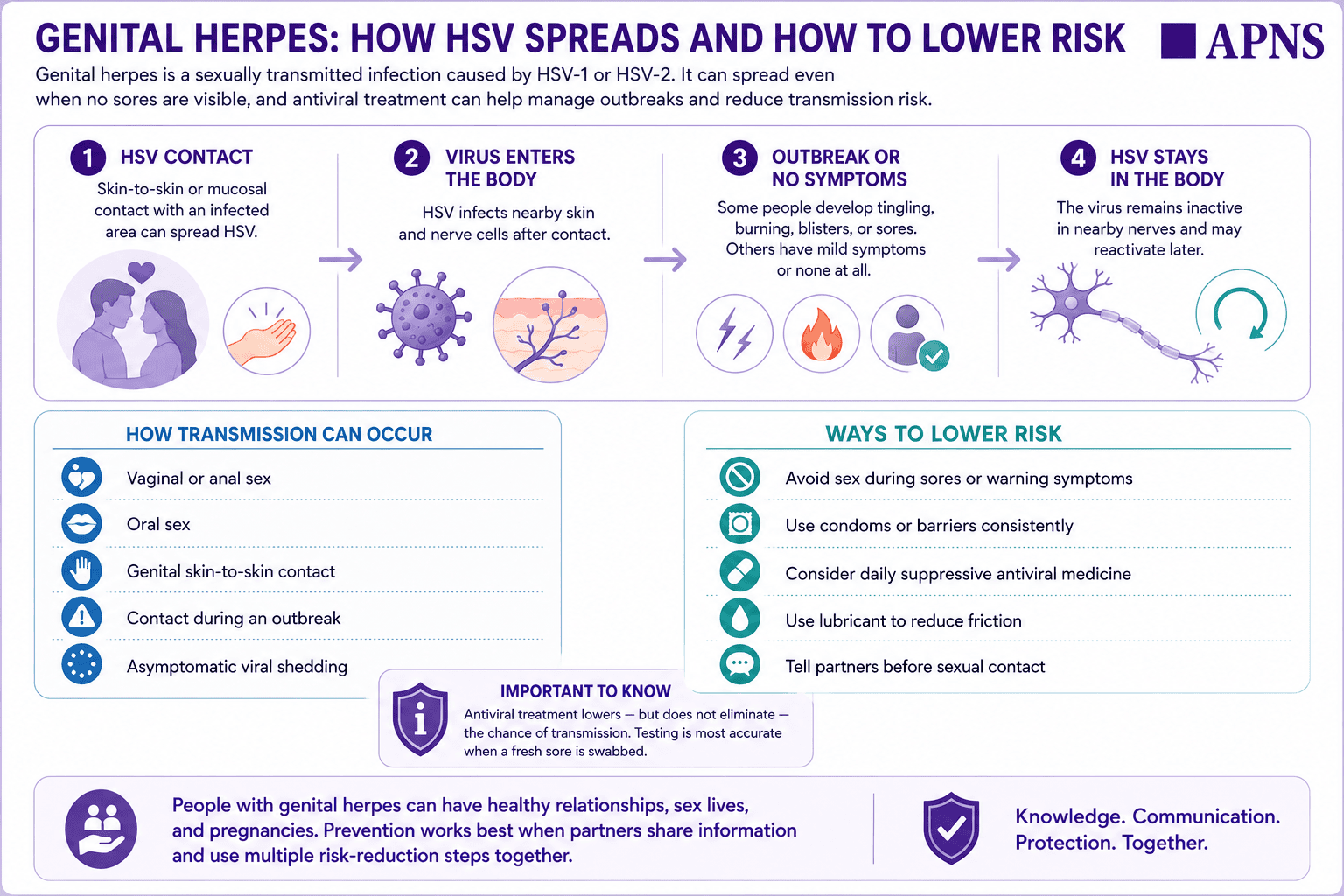
Genital herpes spreads through skin-to-skin or mucosal contact with an infected area. Transmission can occur from sores, saliva, genital fluids, or skin that looks normal because HSV may shed without symptoms.
Herpes is not spread by toilet seats, bedding, swimming pools, towels used in normal household settings, or casual contact such as hugging.
About Genital Herpes – CDC
https://www.cdc.gov/herpes/about/index.html
Provides patient-friendly information about symptoms, transmission, treatment, pregnancy, and prevention.
Genital herpes spreads through skin-to-skin or mucosal contact with an infected area. Transmission can occur from sores, saliva, genital fluids, or skin that looks normal because HSV may shed without symptoms.
Herpes is not spread by toilet seats, bedding, swimming pools, towels used in normal household settings, or casual contact such as hugging.
About Genital Herpes – CDC
https://www.cdc.gov/herpes/about/index.html
Provides patient-friendly information about symptoms, transmission, treatment, pregnancy, and prevention.
No method removes all risk, but you can lower it by:
There is no approved vaccine that prevents genital herpes. Suppressive therapy lowers but does not eliminate transmission.
About Genital Herpes – CDC
https://www.cdc.gov/herpes/about/index.html
Provides patient-friendly information about symptoms, transmission, treatment, pregnancy, and prevention.
Condom Use – CDC
https://www.cdc.gov/condom-use/
Provides instructions for correct condom use and explains how condoms reduce STI risk.
The following video content is provided to help you better understand this condition. These resources are intended for educational purposes and should not replace personalized medical advice from your healthcare provider.
Laboratory options include:
Blood antibodies take time to develop, so early testing may be negative. IgM herpes tests are not recommended because they are not type-specific and can be misleading.
Screening for Genital Herpes – CDC
https://www.cdc.gov/herpes/testing/index.html
Explains when herpes testing is useful and why routine blood screening is not recommended for everyone.
Herpes (HSV) Test – NIH MedlinePlus
https://medlineplus.gov/lab-tests/herpes-hsv-test/
Explains sore-swab and blood testing, preparation, and how results may be interpreted.
HIV Testing – CDC
https://www.cdc.gov/hiv/testing/index.html
Explains HIV testing options and how to find testing.
Imaging is not needed for uncomplicated genital herpes. Diagnosis is based on examination and lesion or blood testing when appropriate.
A biopsy is rarely needed, but a dermatologist may sample an unusual or persistent lesion when another condition is suspected.
Genital Herpes – CDC STI Treatment Guidelines
https://www.cdc.gov/std/treatment-guidelines/herpes.htm
Provides clinical guidance about diagnosis, antiviral treatment, suppression, counseling, HIV, and pregnancy.
Antiviral medicine is recommended for every first clinical episode because symptoms may become prolonged or severe. Recurrent outbreaks can be managed with episodic or daily suppressive treatment.
Treatment does not remove HSV from the body. Discuss how often outbreaks occur, how much they affect you, partner transmission concerns, pregnancy, kidney health, and cost when choosing a plan.
Genital Herpes – CDC STI Treatment Guidelines
https://www.cdc.gov/std/treatment-guidelines/herpes.htm
Provides clinical guidance about diagnosis, antiviral treatment, suppression, counseling, HIV, and pregnancy.
Daily habits can reduce irritation and help protect partners.
Condoms reduce risk but cannot cover all skin that may shed virus. Combining barriers, avoiding sex during symptoms, and suppressive medicine provides greater protection than any single step.
Condom Use – CDC
https://www.cdc.gov/condom-use/
Provides instructions for correct condom use and explains how condoms reduce STI risk.
Three oral antivirals have proven benefit for genital herpes:
Common side effects may include headache, nausea, or stomach upset. Dose adjustments may be needed with kidney disease, dehydration, older age, or certain medicines. Antivirals work best when started early and should be taken exactly as prescribed.
Topical antiviral creams provide little benefit for genital herpes and are discouraged in CDC guidance. Antibiotics, antifungal products, and over-the-counter cold-sore creams do not treat genital HSV unless another condition is also present.
Genital Herpes – CDC STI Treatment Guidelines
https://www.cdc.gov/std/treatment-guidelines/herpes.htm
Provides clinical guidance about diagnosis, antiviral treatment, suppression, counseling, HIV, and pregnancy.
Uncomplicated genital herpes does not require a procedure. Swab testing and oral medicine are usually sufficient.
Ask why a procedure is needed, what to expect, risks, recovery, and how it will change treatment.
Pregnancy and Herpes – NIH MedlinePlus
https://medlineplus.gov/ency/article/001368.htm
Explains pregnancy risks, antiviral prevention near delivery, and delivery planning.
HSV remains in the body for life. Recurrences often become less frequent and less severe over time, but the pattern is different for each person. Genital HSV-1 generally recurs and sheds less often than genital HSV-2.
Daily suppression substantially reduces recurrences for many people and can lower transmission risk. The need for suppression can be reviewed periodically because outbreak frequency and personal priorities change.
Genital Herpes – CDC STI Treatment Guidelines
https://www.cdc.gov/std/treatment-guidelines/herpes.htm
Provides clinical guidance about diagnosis, antiviral treatment, suppression, counseling, HIV, and pregnancy.
About Genital Herpes – CDC
https://www.cdc.gov/herpes/about/index.html
Provides patient-friendly information about symptoms, transmission, treatment, pregnancy, and prevention.
During an outbreak:
Emotional reactions are common. Reliable information, partner communication, peer support, and counseling can help reduce shame and anxiety.
Genital Herpes Self-Care – NIH MedlinePlus
https://medlineplus.gov/ency/patientinstructions/000653.htm
Provides practical steps to relieve discomfort and help sores heal.
Yes. Asymptomatic viral shedding can occur. Risk is highest during sores or warning symptoms but is not zero between outbreaks.
A cold sore usually means oral HSV. Oral HSV-1 can spread to a partner’s genitals through oral sex.
Usually not. Symptoms may appear long after infection, and blood testing cannot determine when transmission occurred or identify a partner.
No. Condoms reduce risk but may not cover every area that sheds virus.
No. CDC does not recommend routine screening for everyone because blood tests have limitations and false positives can occur.
It does not usually cause infertility. Pregnancy and delivery require special planning because newborn infection can be serious.
No. HSV, HPV, and HIV are different viruses with different tests, health effects, prevention, and treatment.
Talking before sexual contact allows partners to make informed choices and use prevention strategies together.

Consider asking:
Most cases can be managed in primary care, sexual-health care, or gynecology. Referral may be made to:
Genital Herpes – CDC STI Treatment Guidelines
https://www.cdc.gov/std/treatment-guidelines/herpes.htm
Provides clinical guidance about diagnosis, antiviral treatment, suppression, counseling, HIV, and pregnancy.
No. There is currently no cure that removes HSV from the body. The virus remains inactive in nerve cells between outbreaks and can reactivate later.
Antiviral medicine can shorten outbreaks, reduce pain, lower the number of recurrences, and reduce transmission risk. Many people have healthy relationships, sex lives, pregnancies, and births while living with genital herpes.
About Genital Herpes – CDC
https://www.cdc.gov/herpes/about/index.html
Provides patient-friendly information about symptoms, transmission, treatment, pregnancy, and prevention.
Genital Herpes – NIH MedlinePlus
https://medlineplus.gov/genitalherpes.html
Offers clear information about genital herpes symptoms, tests, medicines, self-care, and prevention.
Seek urgent or emergency care for:
Herpes involving the brain, spinal fluid, eyes, or a newborn can be life-threatening or cause permanent injury. Do not wait for a routine appointment.
Genital Herpes – CDC STI Treatment Guidelines
https://www.cdc.gov/std/treatment-guidelines/herpes.htm
Provides clinical guidance about diagnosis, antiviral treatment, suppression, counseling, HIV, and pregnancy.
CALL 911
APNS does not provide emergency medical services. If you believe you are experiencing a medical emergency, including (but not limited to) chest pain, difficulty breathing, stroke symptoms, severe allergic reactions, anaphylaxis, uncontrolled bleeding, seizures, loss of consciousness, or any other potentially life-threatening condition, you are instructed to call 911 immediately or go immediately to the nearest emergency department.
About Genital Herpes – CDC
https://www.cdc.gov/herpes/about/index.html
Provides patient-friendly information about symptoms, transmission, treatment, pregnancy, and prevention.
Genital Herpes – CDC STI Treatment Guidelines
https://www.cdc.gov/std/treatment-guidelines/herpes.htm
Provides clinical guidance about diagnosis, antiviral treatment, suppression, counseling, HIV, and pregnancy.
Screening for Genital Herpes – CDC
https://www.cdc.gov/herpes/testing/index.html
Explains when herpes testing is useful and why routine blood screening is not recommended for everyone.
Genital Herpes – NIH MedlinePlus
https://medlineplus.gov/genitalherpes.html
Offers clear information about genital herpes symptoms, tests, medicines, self-care, and prevention.
Herpes (HSV) Test – NIH MedlinePlus
https://medlineplus.gov/lab-tests/herpes-hsv-test/
Explains sore-swab and blood testing, preparation, and how results may be interpreted.
Genital Herpes Self-Care – NIH MedlinePlus
https://medlineplus.gov/ency/patientinstructions/000653.htm
Provides practical steps to relieve discomfort and help sores heal.
Pregnancy and Herpes – NIH MedlinePlus
https://medlineplus.gov/ency/article/001368.htm
Explains pregnancy risks, antiviral prevention near delivery, and delivery planning.
This guide is intended for educational purposes only and should not replace medical advice, diagnosis, testing, or treatment from a healthcare provider. Genital sores have several possible causes, and testing is most accurate when a fresh lesion is swabbed promptly. Avoid sexual contact during sores or warning symptoms. Seek urgent care for inability to urinate, severe or rapidly spreading symptoms, neurologic or eye symptoms, pregnancy with a new outbreak or symptoms near labor, possible newborn exposure, or a serious medication reaction.
At APNS, our providers take the time to understand your condition and your goals. We offer comprehensive telehealth visits at a fixed rate — no membership fees, no insurance required, and no unexpected charges. Whether you’re newly diagnosed or looking for a provider who actually listens, we’re here to help.