

Genital warts are soft bumps caused by certain types of human papillomavirus (HPV), a very common infection spread through intimate skin-to-skin contact. Warts may appear on or around the penis, scrotum, vulva, vagina, cervix, anus, groin, or upper thighs. They may be flat or raised, single or clustered, and sometimes look like cauliflower.
The HPV types that usually cause genital warts—most often types 6 and 11—are different from the high-risk types that can cause cancer. Genital warts are not cancer. Treatment can remove visible warts, but it does not instantly remove HPV from the body, so warts can return.
About Genital HPV Infection – CDC
https://www.cdc.gov/sti/about/about-genital-hpv-infection.html
Explains HPV transmission, genital warts, cancer risk, testing, treatment, and prevention.
Genital Warts – NIH MedlinePlus
https://medlineplus.gov/genitalwarts.html
Offers patient-friendly information about symptoms, diagnosis, treatment, and prevention.
HPV is the most common sexually transmitted infection. Nearly everyone who is not vaccinated is exposed to HPV at some point, and most people never develop symptoms.
About 9 in 10 HPV infections become undetectable on their own within two years. Only some infected people develop genital warts, and warts may appear months or years after exposure.
About Genital HPV Infection – CDC
https://www.cdc.gov/sti/about/about-genital-hpv-infection.html
Explains HPV transmission, genital warts, cancer risk, testing, treatment, and prevention.
Many people have no symptoms. Genital warts may cause:
Not every genital bump is a wart. Skin tags, ingrown hairs, molluscum, herpes, syphilis, normal glands, and some cancers can look similar. A healthcare provider can examine the area.
A clinician usually diagnoses genital warts by looking at the skin. They may ask about symptoms, sexual exposure, prior warts, HPV vaccination, pregnancy, immune conditions, and cervical screening history.
A biopsy may be needed if a growth is dark, hard, fixed, bleeding, ulcerated, unusual, worsening, or not responding to treatment. It may also be used when the diagnosis is uncertain or the immune system is weakened.
Anogenital Warts – CDC STI Treatment Guidelines
https://www.cdc.gov/std/treatment-guidelines/anogenital-warts.htm
Provides clinical guidance on diagnosis, treatment choices, follow-up, partners, and pregnancy.
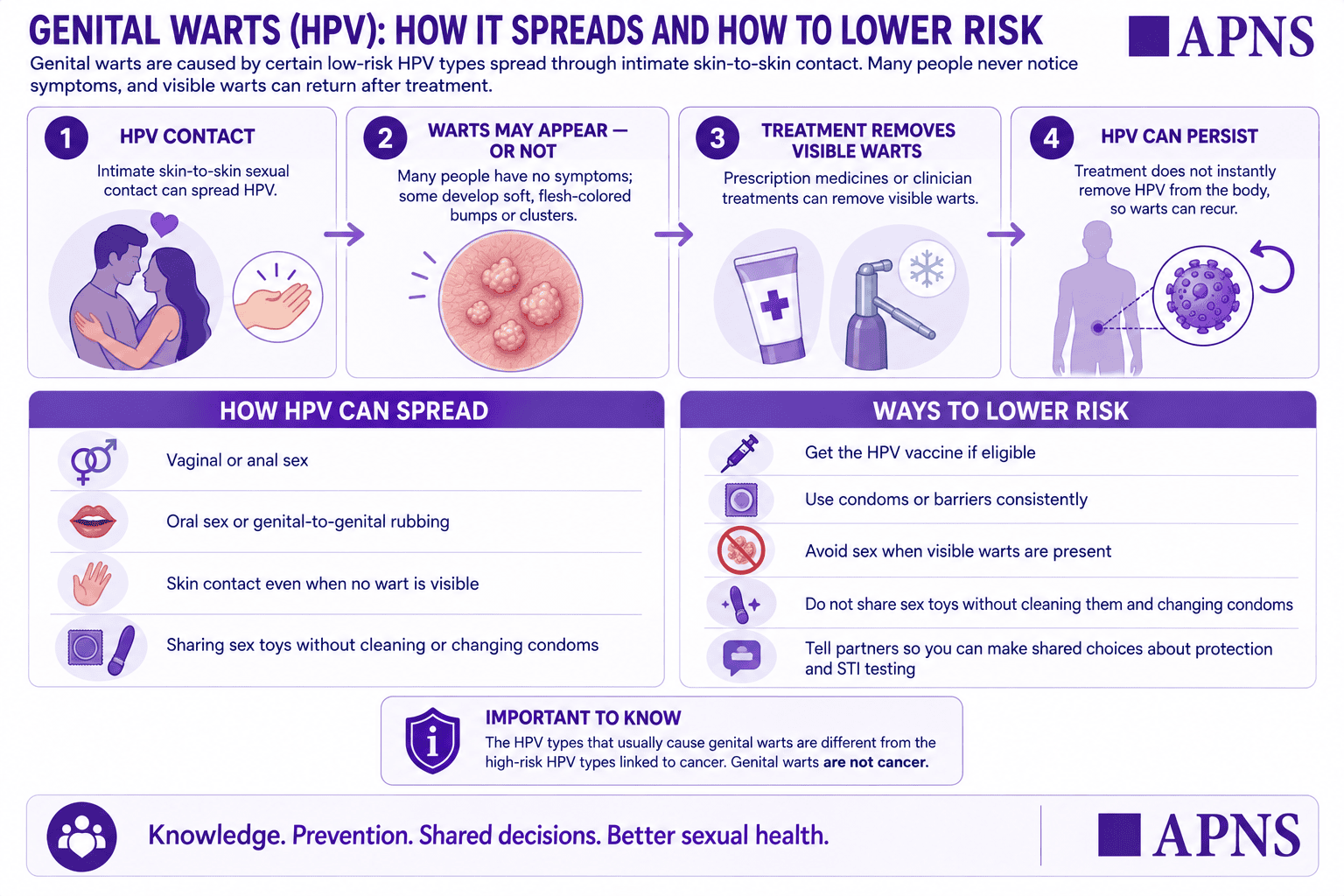
Genital warts are caused by low-risk HPV types passed through close sexual skin contact. Penetration or ejaculation is not required.
HPV is not a sign of poor hygiene. It is not usually spread by toilet seats, swimming pools, or casual contact such as hugging. Because HPV can remain quiet for a long time, a diagnosis usually cannot show when it was acquired or from whom.
About Genital HPV Infection – CDC
https://www.cdc.gov/sti/about/about-genital-hpv-infection.html
Explains HPV transmission, genital warts, cancer risk, testing, treatment, and prevention.
Warts may grow, spread, or recur even without a clear trigger. Factors that may make them harder to control include:
Pregnancy can make warts larger or easier to bleed. Tell your clinician if you are pregnant or could be pregnant before using any wart medicine.
Anogenital Warts – CDC STI Treatment Guidelines
https://www.cdc.gov/std/treatment-guidelines/anogenital-warts.htm
Provides clinical guidance on diagnosis, treatment choices, follow-up, partners, and pregnancy.
You can lower the chance of HPV and related disease by:
HPV vaccine is not recommended during pregnancy, but accidental vaccination is not a reason for alarm. Remaining doses are delayed until after pregnancy. Breastfeeding is generally compatible with vaccination; ask your clinician about your situation.
HPV Vaccination – CDC
https://www.cdc.gov/hpv/vaccines/index.html
Explains who should receive HPV vaccine and how vaccination prevents new infections and cancers.
HPV Vaccine Safety – CDC
https://www.cdc.gov/vaccine-safety/vaccines/hpv.html
Summarizes HPV vaccine safety monitoring, expected side effects, and pregnancy guidance.
Cervical Cancer Causes, Risk Factors, and Prevention – NCI
https://www.cancer.gov/types/cervical/causes-risk-prevention
Provides evidence-based information about cervical HPV, screening, vaccination, and prevention.
The following video content is provided to help you better understand this condition. These resources are intended for educational purposes and should not replace personalized medical advice from your healthcare provider.
There is no blood or urine test that diagnoses genital warts. Tests may include:
There is no recommended routine HPV test to determine a person’s overall ‘HPV status’ for the penis, scrotum, anus, throat, or mouth. Partners do not need HPV testing solely because one partner has genital warts.
Human Papillomavirus (HPV) Test – NIH MedlinePlus
https://medlineplus.gov/lab-tests/human-papillomavirus-hpv-test/
Explains how HPV tests are used in cervical cancer screening and what results mean.
HPV Infection – CDC STI Treatment Guidelines
https://www.cdc.gov/std/treatment-guidelines/hpv.htm
Explains counseling, cervical screening, HPV vaccination, and management of HPV-related conditions.
Imaging is not usually needed. Depending on wart location, a clinician may use:
Acetic acid or ‘vinegar’ testing is not recommended as a routine screening test because it can incorrectly label normal skin as abnormal.
Anogenital Warts – CDC STI Treatment Guidelines
https://www.cdc.gov/std/treatment-guidelines/anogenital-warts.htm
Provides clinical guidance on diagnosis, treatment choices, follow-up, partners, and pregnancy.
Treatment is optional for some small, uncomplicated warts because they may disappear on their own. Others remain or grow. Treatment may be chosen for discomfort, bleeding, appearance, spread, or personal preference.
No single treatment is best for everyone. Choice depends on wart size, number, location, pregnancy, cost, side effects, clinician experience, and your preferences. More than one treatment may be needed.
Anogenital Warts – CDC STI Treatment Guidelines
https://www.cdc.gov/std/treatment-guidelines/anogenital-warts.htm
Provides clinical guidance on diagnosis, treatment choices, follow-up, partners, and pregnancy.
These steps may reduce irritation and support overall health:
There is no proven diet, vitamin, or supplement that removes genital HPV. Avoid products advertised as an HPV cure.
Prescription medicines for external genital or anal warts include:
Do not use drugstore salicylic-acid wart removers meant for hands or feet on genital tissue. Avoid podofilox, podophyllin, and sinecatechins during pregnancy; imiquimod is generally avoided until more safety data are available. Ask your obstetric clinician before any treatment.
Anogenital Warts – CDC STI Treatment Guidelines
https://www.cdc.gov/std/treatment-guidelines/anogenital-warts.htm
Provides clinical guidance on diagnosis, treatment choices, follow-up, partners, and pregnancy.
A procedure may be preferred for large, numerous, internal, resistant, or rapidly growing warts.
Procedures can cause pain, bleeding, infection, pigment changes, or scarring. Removing warts does not guarantee HPV is gone, so recurrence remains possible.
Anogenital Warts – CDC STI Treatment Guidelines
https://www.cdc.gov/std/treatment-guidelines/anogenital-warts.htm
Provides clinical guidance on diagnosis, treatment choices, follow-up, partners, and pregnancy.
Warts may disappear, remain unchanged, or grow. Treatment removes visible lesions but does not directly cure the infection. Recurrence is common, especially during the first three months after treatment.
Most immune systems eventually suppress or clear HPV. The low-risk types that cause most genital warts do not cause cancer, but a person can carry more than one HPV type. Continue age-appropriate cervical screening even after vaccination or wart treatment.
About Genital HPV Infection – CDC
https://www.cdc.gov/sti/about/about-genital-hpv-infection.html
Explains HPV transmission, genital warts, cancer risk, testing, treatment, and prevention.
HPV and Cancer – National Cancer Institute
https://www.cancer.gov/about-cancer/causes-prevention/risk/infectious-agents/hpv-and-cancer
Explains high-risk HPV, HPV-related cancers, prevention, screening, and treatment of abnormal cells.
If your clinician prescribes home treatment:
If you choose observation, check the area periodically and seek evaluation for bleeding, ulceration, rapid growth, color change, or a hard fixed lump.
Genital Warts – NIH MedlinePlus
https://medlineplus.gov/genitalwarts.html
Offers patient-friendly information about symptoms, diagnosis, treatment, and prevention.
The HPV types that cause most genital warts do not cause cancer. High-risk HPV types can cause cancer, and a person may have more than one type.
Usually not. HPV can be silent for months or years, partners often share it, and a diagnosis does not prove recent infidelity.
Routine HPV testing of partners is not recommended. Partners may benefit from an examination, HPV vaccination, and testing for other STIs.
No. Condoms lower risk but do not cover every area that can carry HPV.
No. It prevents new infections from vaccine-covered types. It can still protect against types you have not acquired.
Yes. Recurrence is common, especially in the first few months, because treatment removes warts rather than the virus itself.
External genital warts alone do not require more frequent cervical screening. Follow the screening schedule recommended for your age and history.
Yes. HPV may be passed when skin looks normal, although the exact duration of contagiousness after warts resolve is unknown.

Consider asking:
Most external genital warts can be managed in primary care, sexual-health care, gynecology, or dermatology. Referral may be made to:
Anogenital Warts – CDC STI Treatment Guidelines
https://www.cdc.gov/std/treatment-guidelines/anogenital-warts.htm
Provides clinical guidance on diagnosis, treatment choices, follow-up, partners, and pregnancy.
Visible genital warts are treatable, and many go away. However, no medicine or procedure can immediately remove HPV from every infected cell. The immune system makes most infections undetectable over time.
Warts can recur after successful treatment. The HPV vaccine prevents new infections from covered types but does not treat current HPV or existing warts.
About Genital HPV Infection – CDC
https://www.cdc.gov/sti/about/about-genital-hpv-infection.html
Explains HPV transmission, genital warts, cancer risk, testing, treatment, and prevention.
HPV Vaccination – CDC
https://www.cdc.gov/hpv/vaccines/index.html
Explains who should receive HPV vaccine and how vaccination prevents new infections and cancers.
Genital warts rarely cause an emergency. Seek urgent medical care for:
Call emergency services for trouble breathing, fainting, or uncontrolled bleeding. Other concerning changes need prompt evaluation because another condition, including cancer, can sometimes resemble a wart.
CALL 911
APNS does not provide emergency medical services. If you believe you are experiencing a medical emergency, including (but not limited to) chest pain, difficulty breathing, stroke symptoms, severe allergic reactions, anaphylaxis, uncontrolled bleeding, seizures, loss of consciousness, or any other potentially life-threatening condition, you are instructed to call 911 immediately or go immediately to the nearest emergency department.
About Genital HPV Infection – CDC
https://www.cdc.gov/sti/about/about-genital-hpv-infection.html
Explains HPV transmission, genital warts, cancer risk, testing, treatment, and prevention.
Anogenital Warts – CDC STI Treatment Guidelines
https://www.cdc.gov/std/treatment-guidelines/anogenital-warts.htm
Provides clinical guidance on diagnosis, treatment choices, follow-up, partners, and pregnancy.
HPV Infection – CDC STI Treatment Guidelines
https://www.cdc.gov/std/treatment-guidelines/hpv.htm
Explains counseling, cervical screening, HPV vaccination, and management of HPV-related conditions.
HPV Vaccination – CDC
https://www.cdc.gov/hpv/vaccines/index.html
Explains who should receive HPV vaccine and how vaccination prevents new infections and cancers.
HPV Vaccine Safety – CDC
https://www.cdc.gov/vaccine-safety/vaccines/hpv.html
Summarizes HPV vaccine safety monitoring, expected side effects, and pregnancy guidance.
Genital Warts – NIH MedlinePlus
https://medlineplus.gov/genitalwarts.html
Offers patient-friendly information about symptoms, diagnosis, treatment, and prevention.
Human Papillomavirus (HPV) Test – NIH MedlinePlus
https://medlineplus.gov/lab-tests/human-papillomavirus-hpv-test/
Explains how HPV tests are used in cervical cancer screening and what results mean.
HPV and Cancer – National Cancer Institute
https://www.cancer.gov/about-cancer/causes-prevention/risk/infectious-agents/hpv-and-cancer
Explains high-risk HPV, HPV-related cancers, prevention, screening, and treatment of abnormal cells.
Cervical Cancer Causes, Risk Factors, and Prevention – NCI
https://www.cancer.gov/types/cervical/causes-risk-prevention
Provides evidence-based information about cervical HPV, screening, vaccination, and prevention.
This guide is for education only and does not replace medical advice, examination, diagnosis, or treatment from a healthcare professional. Not every genital growth is an HPV wart. Do not use over-the-counter hand-and-foot wart products on genital tissue, and ask a clinician before treatment if you are pregnant or could be pregnant. Seek prompt care for trouble urinating or passing stool, heavy bleeding, severe pain or infection, rapid or unusual growth, or a serious medication reaction.
At APNS, our providers take the time to understand your condition and your goals. We offer comprehensive telehealth visits at a fixed rate — no membership fees, no insurance required, and no unexpected charges. Whether you’re newly diagnosed or looking for a provider who actually listens, we’re here to help.