

Graves’ disease is an autoimmune disorder and the most common cause of hyperthyroidism (overactive thyroid). In Graves’ disease, the body’s immune system mistakenly produces antibodies that stimulate the thyroid gland to make too much thyroid hormone.
Excess thyroid hormone causes the body’s metabolism to speed up, leading to symptoms such as weight loss, rapid heartbeat, anxiety, tremors, and heat intolerance. Some people also develop Graves’ eye disease (Graves’ ophthalmopathy), which can cause eye irritation, bulging eyes, double vision, or vision changes.
Although there is no cure for Graves’ disease, it can usually be managed successfully with medications, radioactive iodine therapy, or surgery.
Graves’ Disease – NIH MedlinePlus
https://medlineplus.gov/gravesdisease.html
Provides easy-to-understand information about Graves’ disease, including symptoms, diagnosis, treatment, and long-term management.
Graves’ Disease – American Thyroid Association
https://www.thyroid.org/graves-disease/
Explains what Graves’ disease is, common symptoms, causes, diagnosis, and treatment options.
Graves’ disease is the most common cause of hyperthyroidism in the United States. It affects millions of people worldwide and is much more common in women than men. Although it can occur at any age, it is most often diagnosed between the ages of 20 and 50.
American Thyroid Association – Graves’ Disease
https://www.thyroid.org/graves-disease/
Provides information about who is most likely to develop Graves’ disease and common risk factors.
Symptoms may develop gradually or appear more suddenly.
Common symptoms may include:
Some people may also develop Graves’ eye disease, which can cause:
Your healthcare provider will review your symptoms, perform a physical examination, and order blood tests to evaluate thyroid hormone levels. Additional testing helps confirm Graves’ disease and determine the cause of hyperthyroidism.
Graves’ Disease – NIH MedlinePlus
https://medlineplus.gov/gravesdisease.html
Explains how Graves’ disease is diagnosed and monitored.
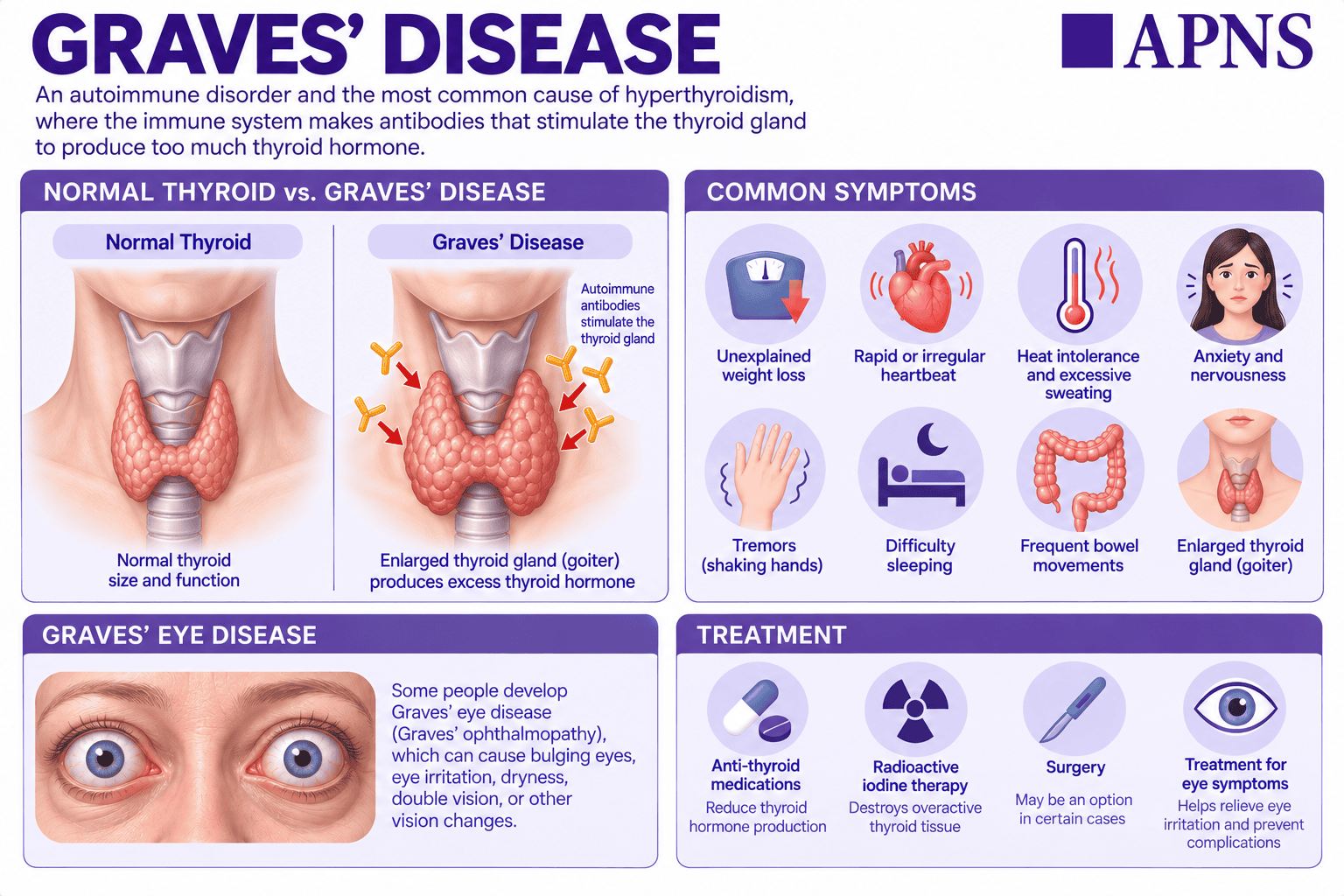
Graves’ disease develops when the immune system produces antibodies called thyroid-stimulating immunoglobulins (TSI) that stimulate the thyroid gland to produce excessive amounts of thyroid hormone.
Common risk factors include:
Graves’ Disease – NIH MedlinePlus
https://medlineplus.gov/gravesdisease.html
Learn about the causes and risk factors associated with Graves’ disease.
Several factors may worsen symptoms or interfere with treatment.
Common factors include:
American Thyroid Association
https://www.thyroid.org/
Provides practical guidance on managing Graves’ disease and reducing complications.
Graves’ disease cannot currently be prevented because it is an autoimmune disease. However, early diagnosis and treatment can reduce the risk of serious complications.
Helpful prevention tips include:
American Thyroid Association
https://www.thyroid.org/
Provides practical information about Graves’ disease, medication management, and long-term care.
The following video content is provided to help you better understand this condition. These resources are intended for educational purposes and should not replace personalized medical advice from your healthcare provider.
Laboratory testing is essential for diagnosing and monitoring Graves’ disease.
Common laboratory tests may include:
TSH Test – NIH MedlinePlus
https://medlineplus.gov/lab-tests/tsh-thyroid-stimulating-hormone-test/
Explains how thyroid blood tests help diagnose Graves’ disease.
Additional testing may help determine the cause of hyperthyroidism and evaluate thyroid structure.
Common diagnostic tests include:
American Thyroid Association – Thyroid Function Tests
https://www.thyroid.org/thyroid-function-tests/
Provides information about thyroid blood tests, imaging studies, and diagnostic testing.
Treatment focuses on lowering thyroid hormone levels, relieving symptoms, and preventing long-term complications.
Treatment options may include:
Graves’ Disease – American Thyroid Association
https://www.thyroid.org/graves-disease/
Provides information about treatment options and long-term management of Graves’ disease.
Healthy lifestyle habits can help support your treatment plan and improve overall well-being.
Helpful lifestyle changes include:
American Thyroid Association
https://www.thyroid.org/
Provides practical guidance for living well with Graves’ disease.
Several medications are available to treat Graves’ disease and control symptoms.
Common medications include:
Methimazole – NIH MedlinePlus
https://medlineplus.gov/druginfo/meds/a682464.html
Provides information about methimazole, proper use, side effects, and monitoring.
Teprotumumab – American Thyroid Association
https://www.thyroid.org/
Provides information about newer treatment options for Graves’ eye disease.
Some people with Graves’ disease require procedures to treat hyperthyroidism or evaluate complications. The type of procedure depends on the severity of the disease, your age, overall health, and whether medications successfully control your thyroid hormone levels.
Common procedures may include:
American Thyroid Association – Graves’ Disease
https://www.thyroid.org/graves-disease/
Learn about radioactive iodine therapy, thyroid surgery, and treatment options for Graves’ disease.
Most people with Graves’ disease respond well to treatment and are able to live healthy, active lives. Some individuals achieve long-term remission with anti-thyroid medications, while others require radioactive iodine therapy or thyroid surgery.
Many people who undergo radioactive iodine therapy or thyroid surgery eventually develop hypothyroidism and require lifelong thyroid hormone replacement. Regular follow-up appointments and blood tests help ensure thyroid hormone levels remain within a healthy range.
Daily self-care can help improve symptoms and reduce the risk of complications.
Helpful tips include:
American Thyroid Association
https://www.thyroid.org/
Provides practical guidance for living well with Graves’ disease and managing Graves’ eye disease.
Graves’ disease is an autoimmune disorder that causes hyperthyroidism. Hyperthyroidism refers to the condition of having too much thyroid hormone and can have several different causes.
Some people only require anti-thyroid medications for a period of time and then go into remission. Others eventually need lifelong thyroid hormone replacement after radioactive iodine therapy or surgery.
Yes. Graves’ eye disease may cause bulging eyes, eye irritation, dryness, double vision, light sensitivity, or vision changes. Not everyone with Graves’ disease develops eye involvement.
Yes. Smoking significantly increases the risk of developing Graves’ eye disease and can worsen existing eye symptoms. Quitting smoking is strongly recommended.
Your healthcare provider will determine how often your thyroid function should be monitored. Blood tests are commonly repeated after starting or adjusting treatment and then periodically once your thyroid hormone levels are stable.

Consider asking your healthcare provider:
Many people with Graves’ disease receive care from a team of healthcare professionals.
You may be referred to:
American Thyroid Association
https://www.thyroid.org/
Provides patient education about Graves’ disease, specialty care, and treatment options.
Some people achieve long-term remission after treatment with anti-thyroid medications. Others receive definitive treatment with radioactive iodine therapy or thyroid surgery.
Although these treatments effectively control hyperthyroidism, many people develop hypothyroidism afterward and require lifelong thyroid hormone replacement. With appropriate treatment and regular monitoring, most people live healthy, active lives.
Call 911 or seek emergency medical care immediately if you experience:
These symptoms may be signs of thyroid storm, a rare but life-threatening complication of severe hyperthyroidism.
Seek prompt medical evaluation if you notice:
Graves’ Disease – NIH MedlinePlus
https://medlineplus.gov/gravesdisease.html
Learn about Graves’ disease, possible complications, and when emergency medical care is needed.
CALL 911
APNS does not provide emergency medical services. If you believe you are experiencing a medical emergency, including (but not limited to) chest pain, difficulty breathing, stroke symptoms, severe allergic reactions, anaphylaxis, uncontrolled bleeding, seizures, loss of consciousness, or any other potentially life-threatening condition, you are instructed to call 911 immediately or go immediately to the nearest emergency department.
Graves’ Disease – NIH MedlinePlus
https://medlineplus.gov/gravesdisease.html
Easy-to-understand information about Graves’ disease, including symptoms, diagnosis, treatment, and long-term management.
American Thyroid Association – Graves’ Disease
https://www.thyroid.org/graves-disease/
Comprehensive patient education about Graves’ disease, Graves’ eye disease, medications, radioactive iodine therapy, surgery, and follow-up care.
National Institute of Diabetes and Digestive and Kidney Diseases (NIDDK)
https://www.niddk.nih.gov/health-information/endocrine-diseases
Reliable information about thyroid disease and other endocrine disorders.
Hormone Health Network
https://www.hormone.org/
Evidence-based patient education about thyroid disorders, Graves’ disease, autoimmune thyroid disease, and endocrine health.
This guide is intended for educational purposes only and should not replace medical advice, diagnosis, or treatment from your healthcare provider. Always follow the recommendations of your healthcare team regarding your individual health needs. Contact your healthcare provider if your symptoms worsen, new symptoms develop, or your treatment is no longer controlling your Graves’ disease. Call 911 immediately if you experience chest pain, difficulty breathing, severe confusion, loss of consciousness, sudden vision loss, or symptoms of thyroid storm or another medical emergency.
At APNS, our providers take the time to understand your condition and your goals. We offer comprehensive telehealth visits at a fixed rate — no membership fees, no insurance required, and no unexpected charges. Whether you’re newly diagnosed or looking for a provider who actually listens, we’re here to help.