

Hormone replacement therapy (HRT), also called menopausal hormone therapy (MHT), uses estrogen—with or without a progestogen—to treat bothersome symptoms caused by lower hormone levels during perimenopause and menopause. It is the most effective treatment for hot flashes and night sweats and can also help vaginal dryness, painful sex, and bone loss.
HRT is not one medicine or one dose. It may be taken throughout the body as a pill, patch, gel, spray, or systemic ring, or used locally in the vagina as a cream, tablet, insert, or low-dose ring. This guide focuses on menopausal HRT; testosterone therapy, thyroid replacement, and gender-affirming hormone therapy require different evaluation and monitoring.
Hormone Replacement Therapies for Menopausal Symptoms – FDA
https://www.fda.gov/consumers/consumer-updates/hormone-replacement-therapies-can-help-women-bothersome-menopausal-symptoms
Explains current FDA information about HRT types, benefits, risks, and updated medicine labeling.
Hormone Therapy for Menopause – ACOG
https://www.acog.org/womens-health/faqs/hormone-therapy-for-menopause
Explains systemic and local therapy, expected benefits, possible risks, and who may need another option.
Menopause usually occurs between ages 45 and 55, and many people experience symptoms for several years. Some symptoms are mild, while others disrupt sleep, work, relationships, or daily life.
HRT use varies because symptoms, health history, preferences, access, and understanding of risks differ. Current guidance supports an individual decision rather than one rule for every patient.
Hormone Replacement Therapies for Menopausal Symptoms – FDA
https://www.fda.gov/consumers/consumer-updates/hormone-replacement-therapies-can-help-women-bothersome-menopausal-symptoms
Explains current FDA information about HRT types, benefits, risks, and updated medicine labeling.
What Is Menopause? – National Institute on Aging
https://www.nia.nih.gov/health/menopause/what-menopause
Explains the menopause transition, common symptoms, health changes, and treatment options.
HRT may help with:
HRT is not proven to prevent normal aging, wrinkles, memory loss, or Alzheimer’s disease, and it should not be started solely to prevent a heart attack or stroke. Other causes should be considered when symptoms do not fit menopause.
Menopause – FDA
https://www.fda.gov/consumers/womens-health-topics/menopause
Reviews menopause symptoms, hormone and nonhormone treatments, safety, and questions to discuss with a clinician.
Sex and Menopause: Treatment for Symptoms – National Institute on Aging
https://www.nia.nih.gov/health/menopause/sex-and-menopause-treatment-symptoms
Reviews vaginal dryness, painful sex, local estrogen, moisturizers, lubricants, and other options.
A clinician reviews menstrual changes, symptoms, pregnancy possibility, uterus and ovary history, medicines, and personal and family history of cancer, blood clots, stroke, heart disease, liver disease, migraine, and osteoporosis.
For most healthy people age 45 or older with typical symptoms, diagnosis is based on history rather than a single hormone level. Examination or testing may be needed for unusual symptoms, early menopause, unexplained bleeding, or another possible condition.
The Menopause Years – ACOG
https://www.acog.org/womens-health/faqs/the-menopause-years
Provides patient education about perimenopause, menopause symptoms, evaluation, and treatment choices.
Hormone Therapy for Menopause – ACOG
https://www.acog.org/womens-health/faqs/hormone-therapy-for-menopause
Explains systemic and local therapy, expected benefits, possible risks, and who may need another option.
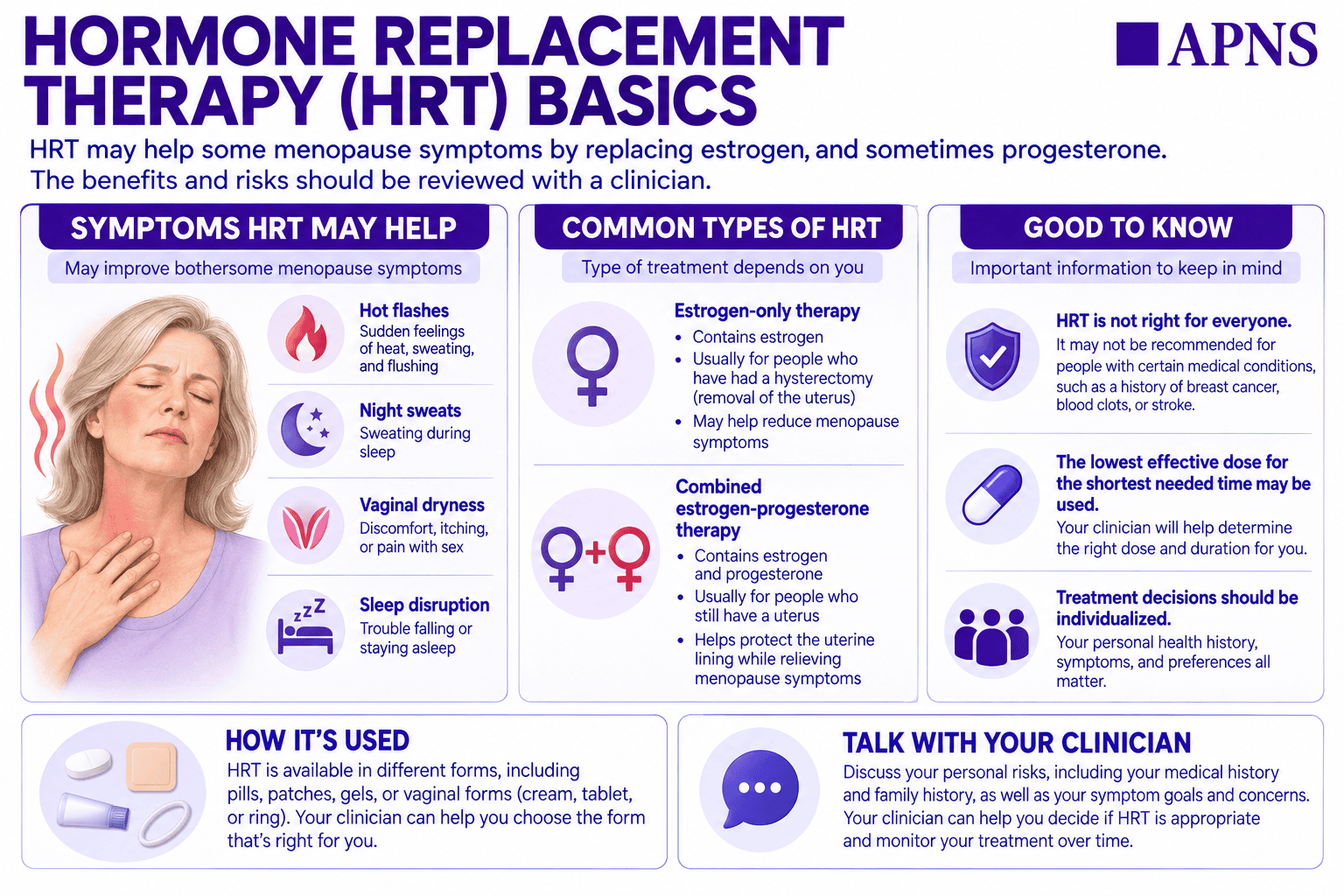
During perimenopause and menopause, the ovaries make less estrogen and progesterone. Lower and changing hormone levels can affect temperature control, sleep, vaginal and urinary tissues, and bone strength.
Not everyone needs HRT. Treatment is considered when symptoms are bothersome or when early loss of estrogen creates a specific health concern.
The Menopause Years – ACOG
https://www.acog.org/womens-health/faqs/the-menopause-years
Provides patient education about perimenopause, menopause symptoms, evaluation, and treatment choices.
Symptoms vary and may change over time. Common triggers include:
Unexpected bleeding, new severe symptoms, or symptoms that continue despite treatment should not be assumed to be menopause. Contact a healthcare professional for evaluation.
Hot Flashes: What Can I Do? – National Institute on Aging
https://www.nia.nih.gov/health/menopause/hot-flashes-what-can-i-do
Offers practical strategies and an overview of hormone and nonhormone treatments for hot flashes.
HRT is a treatment, not a general anti-aging medicine. Safer use includes:
The FDA updated boxed-warning language for several menopausal HRT products in 2026. This does not mean HRT has no risks; breast, cardiovascular, clot, uterine, gallbladder, and other risks still require an individual discussion and review of the specific product label.
Hormone Replacement Therapies for Menopausal Symptoms – FDA
https://www.fda.gov/consumers/consumer-updates/hormone-replacement-therapies-can-help-women-bothersome-menopausal-symptoms
Explains current FDA information about HRT types, benefits, risks, and updated medicine labeling.
FDA-Approved Menopausal Hormone Therapy Labeling Changes – FDA
https://www.fda.gov/news-events/press-announcements/fda-approves-labeling-changes-menopausal-hormone-therapy-products
Summarizes the FDA’s 2026 updates to boxed-warning language while preserving individualized risk counseling.
Routine hormone testing is often unnecessary because levels change during perimenopause. Depending on the situation, testing may include:
Saliva and urine hormone tests used to create custom compounded doses are not proven to make HRT safer or more effective.
Hormone Therapy for Menopause – ACOG
https://www.acog.org/womens-health/faqs/hormone-therapy-for-menopause
Explains systemic and local therapy, expected benefits, possible risks, and who may need another option.
Menopause – FDA
https://www.fda.gov/consumers/womens-health-topics/menopause
Reviews menopause symptoms, hormone and nonhormone treatments, safety, and questions to discuss with a clinician.
Testing is tailored to age, symptoms, and health history. It may include:
A routine pelvic exam or mammogram is not a test that proves someone can or cannot use HRT. The clinician combines findings with the full risk-and-benefit discussion.
Osteoporosis – National Institute on Aging
https://www.nia.nih.gov/health/osteoporosis/osteoporosis
Explains bone loss, fracture prevention, screening, exercise, nutrition, and treatment.
The Menopause Years – ACOG
https://www.acog.org/womens-health/faqs/the-menopause-years
Provides patient education about perimenopause, menopause symptoms, evaluation, and treatment choices.
The best option depends on which symptoms need treatment and whether the uterus is present.
HRT should be individualized by type, dose, route, and schedule. FDA-approved products are preferred over custom-compounded products unless a specific medical need cannot be met by an approved option.
Hormone Replacement Therapies for Menopausal Symptoms – FDA
https://www.fda.gov/consumers/consumer-updates/hormone-replacement-therapies-can-help-women-bothersome-menopausal-symptoms
Explains current FDA information about HRT types, benefits, risks, and updated medicine labeling.
Menopause – FDA
https://www.fda.gov/consumers/womens-health-topics/menopause
Reviews menopause symptoms, hormone and nonhormone treatments, safety, and questions to discuss with a clinician.
Healthy habits support symptom control and long-term heart and bone health:
Lifestyle changes can help but may not be enough for moderate or severe symptoms. Needing medicine is not a failure.
Hot Flashes: What Can I Do? – National Institute on Aging
https://www.nia.nih.gov/health/menopause/hot-flashes-what-can-i-do
Offers practical strategies and an overview of hormone and nonhormone treatments for hot flashes.
Osteoporosis – National Institute on Aging
https://www.nia.nih.gov/health/osteoporosis/osteoporosis
Explains bone loss, fracture prevention, screening, exercise, nutrition, and treatment.
Menopausal HRT may include:
Patches and other skin routes may have different clot and metabolic effects than pills. Side effects can include breast tenderness, spotting, bloating, headache, nausea, mood change, or skin irritation. Do not change the dose or stop abruptly without discussing symptoms and alternatives.
Hormone Replacement Therapies for Menopausal Symptoms – FDA
https://www.fda.gov/consumers/consumer-updates/hormone-replacement-therapies-can-help-women-bothersome-menopausal-symptoms
Explains current FDA information about HRT types, benefits, risks, and updated medicine labeling.
Hormone Therapy for Menopause – ACOG
https://www.acog.org/womens-health/faqs/hormone-therapy-for-menopause
Explains systemic and local therapy, expected benefits, possible risks, and who may need another option.
HRT does not usually require a procedure. Related procedures may be used to evaluate symptoms or monitor health:
A hysterectomy is not performed simply so someone can take estrogen without progestogen. Any procedure should have a separate medical reason.
Hot flashes often improve within weeks, while vaginal and urinary tissue symptoms may take longer. Dose or product adjustments are common early in treatment.
Benefits and risks change with age, time since menopause, route, dose, duration, and health history. Review treatment at least yearly and sooner for new bleeding, breast changes, migraines, blood pressure changes, surgery, immobility, or a new diagnosis. There is no automatic stop date that fits everyone.
Hormone Therapy for Menopause – ACOG
https://www.acog.org/womens-health/faqs/hormone-therapy-for-menopause
Explains systemic and local therapy, expected benefits, possible risks, and who may need another option.
Hormone Replacement Therapies for Menopausal Symptoms – FDA
https://www.fda.gov/consumers/consumer-updates/hormone-replacement-therapies-can-help-women-bothersome-menopausal-symptoms
Explains current FDA information about HRT types, benefits, risks, and updated medicine labeling.
Use HRT exactly as prescribed:
Seek advice if symptoms do not improve, side effects are difficult, a patch repeatedly falls off, or bleeding is new, heavy, or persistent.
It can be appropriate for many healthy people with bothersome menopause symptoms, especially when started near menopause. Safety depends on the individual, the product, route, dose, and health history.
Usually yes when using systemic estrogen. Progesterone or a progestin lowers the risk of overgrowth and cancer of the uterine lining.
No. Low-dose vaginal estrogen mainly treats local vaginal and urinary symptoms and produces much lower body-wide exposure.
Menopause and aging can change body composition, but HRT is not proven to cause major weight gain. It is also not a weight-loss treatment.
No evidence shows they are safer or more effective than FDA-approved products. FDA-approved options include hormones chemically identical to those the body makes.
HRT should not be started solely to prevent heart attack, stroke, memory loss, or Alzheimer’s disease.
Yes, pregnancy may still be possible during perimenopause. HRT is not birth control.
No automatic age applies to everyone. Continued use requires an individualized review of symptoms, benefits, risks, and alternatives.

Consider asking:
Primary care or gynecology can manage most HRT. Referral may be made to:
Hormone Therapy for Menopause – ACOG
https://www.acog.org/womens-health/faqs/hormone-therapy-for-menopause
Explains systemic and local therapy, expected benefits, possible risks, and who may need another option.
HRT does not cure menopause, which is a normal life stage. It replaces some of the hormones that decline and can control symptoms and protect bone while treatment continues.
Some symptoms improve naturally over time; vaginal and urinary tissue changes may continue or worsen without treatment. If HRT is stopped, symptoms may or may not return. A clinician can help taper or change treatment when appropriate.
What Is Menopause? – National Institute on Aging
https://www.nia.nih.gov/health/menopause/what-menopause
Explains the menopause transition, common symptoms, health changes, and treatment options.
Sex and Menopause: Treatment for Symptoms – National Institute on Aging
https://www.nia.nih.gov/health/menopause/sex-and-menopause-treatment-symptoms
Reviews vaginal dryness, painful sex, local estrogen, moisturizers, lubricants, and other options.
Call emergency services or seek urgent care for:
Contact a clinician promptly—not just at the next routine visit—for any bleeding after menopause, a new breast lump, persistent abnormal bleeding, new migraine symptoms, or a major change in health history.
Menopause – FDA
https://www.fda.gov/consumers/womens-health-topics/menopause
Reviews menopause symptoms, hormone and nonhormone treatments, safety, and questions to discuss with a clinician.
CALL 911
APNS does not provide emergency medical services. If you believe you are experiencing a medical emergency, including (but not limited to) chest pain, difficulty breathing, stroke symptoms, severe allergic reactions, anaphylaxis, uncontrolled bleeding, seizures, loss of consciousness, or any other potentially life-threatening condition, you are instructed to call 911 immediately or go immediately to the nearest emergency department.
Hormone Replacement Therapies for Menopausal Symptoms – FDA
https://www.fda.gov/consumers/consumer-updates/hormone-replacement-therapies-can-help-women-bothersome-menopausal-symptoms
Explains current FDA information about HRT types, benefits, risks, and updated medicine labeling.
Menopause – FDA
https://www.fda.gov/consumers/womens-health-topics/menopause
Reviews menopause symptoms, hormone and nonhormone treatments, safety, and questions to discuss with a clinician.
Hormone Therapy for Menopause – ACOG
https://www.acog.org/womens-health/faqs/hormone-therapy-for-menopause
Explains systemic and local therapy, expected benefits, possible risks, and who may need another option.
The Menopause Years – ACOG
https://www.acog.org/womens-health/faqs/the-menopause-years
Provides patient education about perimenopause, menopause symptoms, evaluation, and treatment choices.
What Is Menopause? – National Institute on Aging
https://www.nia.nih.gov/health/menopause/what-menopause
Explains the menopause transition, common symptoms, health changes, and treatment options.
Hot Flashes: What Can I Do? – National Institute on Aging
https://www.nia.nih.gov/health/menopause/hot-flashes-what-can-i-do
Offers practical strategies and an overview of hormone and nonhormone treatments for hot flashes.
Sex and Menopause: Treatment for Symptoms – National Institute on Aging
https://www.nia.nih.gov/health/menopause/sex-and-menopause-treatment-symptoms
Reviews vaginal dryness, painful sex, local estrogen, moisturizers, lubricants, and other options.
Hormone Replacement Therapy – NIH MedlinePlus
https://medlineplus.gov/hormonereplacementtherapy.html
Links to reliable information about menopausal hormone therapy, medicines, benefits, and safety.
Osteoporosis – National Institute on Aging
https://www.nia.nih.gov/health/osteoporosis/osteoporosis
Explains bone loss, fracture prevention, screening, exercise, nutrition, and treatment.
FDA-Approved Menopausal Hormone Therapy Labeling Changes – FDA
https://www.fda.gov/news-events/press-announcements/fda-approves-labeling-changes-menopausal-hormone-therapy-products
Summarizes the FDA’s 2026 updates to boxed-warning language while preserving individualized risk counseling.
This guide is for education only and does not replace individualized medical advice, examination, diagnosis, or treatment. Menopausal HRT has important benefits and possible risks that depend on your symptoms, age, time since menopause, uterus status, medicine type, route, dose, and health history. Seek emergency care for symptoms of a blood clot, heart attack, stroke, severe bleeding, liver injury, or serious allergic reaction, and promptly report any bleeding after menopause.
At APNS, our providers take the time to understand your condition and your goals. We offer comprehensive telehealth visits at a fixed rate — no membership fees, no insurance required, and no unexpected charges. Whether you’re newly diagnosed or looking for a provider who actually listens, we’re here to help.