

Hypertension, also called high blood pressure, is a condition in which the force of blood pushing against the walls of your arteries is consistently too high. Your heart must work harder to pump blood throughout your body, which can place extra strain on your heart and blood vessels over time. Blood pressure is measured using two numbers: systolic pressure (the top number), which measures the pressure when your heart beats, and diastolic pressure (the bottom number), which measures the pressure when your heart relaxes between beats.
Hypertension often develops slowly and usually does not cause symptoms, which is why it is sometimes called the “silent killer.” Without treatment, high blood pressure can increase your risk of heart attack, stroke, heart failure, kidney disease, vision loss, and other serious health problems. The good news is that hypertension can often be successfully managed through healthy lifestyle changes, medications, and regular medical care.
High Blood Pressure – NIH MedlinePlus
https://medlineplus.gov/highbloodpressure.html
Provides easy-to-understand information about high blood pressure, including symptoms, diagnosis, treatment, and prevention.
High Blood Pressure – National Heart, Lung, and Blood Institute (NHLBI)
https://www.nhlbi.nih.gov/health/high-blood-pressure
Explains what high blood pressure is, why it develops, and how it can be treated.
High blood pressure is one of the most common chronic health conditions in the United States. Nearly half of all U.S. adults have hypertension, and many people do not know they have it because it often causes no symptoms. Regular blood pressure checks are important for early detection and treatment.
High Blood Pressure Facts – Centers for Disease Control and Prevention (CDC)
https://www.cdc.gov/high-blood-pressure/
Provides current statistics and information about hypertension in the United States.
Most people with hypertension have no symptoms, even when blood pressure is very high. This is why regular blood pressure screenings are so important.
If blood pressure becomes severely elevated, symptoms may include:
Your healthcare provider diagnoses hypertension by measuring your blood pressure using a blood pressure cuff. Because blood pressure naturally changes throughout the day, your provider may recommend checking it during several visits or monitoring it at home before making a diagnosis.
Your provider will also review your medical history, perform a physical examination, and evaluate your risk factors to determine the best treatment plan.
Measuring Blood Pressure – American Heart Association
https://www.heart.org/en/health-topics/high-blood-pressure/understanding-blood-pressure-readings
Explains how blood pressure is measured and what your numbers mean.
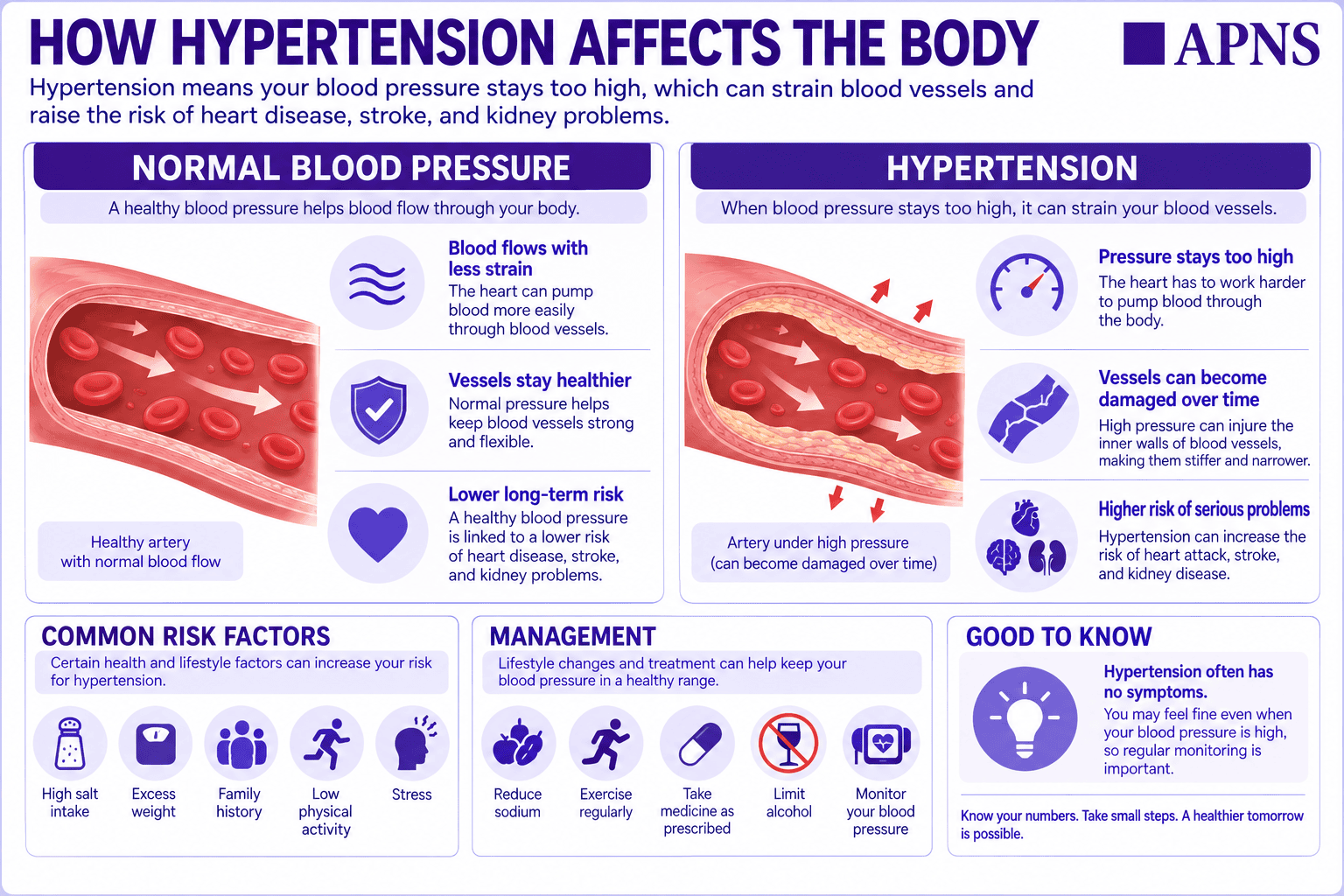
For most people, there is no single identifiable cause of hypertension. This is called primary (essential) hypertension and usually develops gradually over many years. Some people develop secondary hypertension, which is caused by another medical condition or certain medications.
Common risk factors include:
Causes and Risk Factors for High Blood Pressure – NHLBI
https://www.nhlbi.nih.gov/health/high-blood-pressure
Learn about common causes, risk factors, and conditions that may contribute to high blood pressure.
Several lifestyle habits and medical conditions can make blood pressure more difficult to control.
Common factors include:
Managing High Blood Pressure – American Heart Association
https://www.heart.org/en/health-topics/high-blood-pressure
Provides practical information about healthy habits that help lower blood pressure.
Healthy lifestyle habits can help prevent high blood pressure or reduce your risk of developing complications.
Helpful prevention tips include:
Prevent High Blood Pressure – Centers for Disease Control and Prevention (CDC)
https://www.cdc.gov/high-blood-pressure/prevention/
Provides practical tips for preventing high blood pressure and improving heart health.
Laboratory tests help identify possible causes of high blood pressure and evaluate how well your heart, kidneys, and other organs are functioning.
Common laboratory tests may include:
Blood Pressure Tests – NIH MedlinePlus
https://medlineplus.gov/highbloodpressure.html
Provides information about testing commonly performed during a hypertension evaluation.
Additional testing may be recommended to evaluate your heart, kidneys, or blood vessels and to look for complications caused by high blood pressure.
Common diagnostic tests include:
High Blood Pressure – National Heart, Lung, and Blood Institute (NHLBI)
https://www.nhlbi.nih.gov/health/high-blood-pressure
Learn about additional testing used to evaluate hypertension and monitor for complications.
The goal of treatment is to lower your blood pressure and reduce your risk of heart attack, stroke, kidney disease, and other complications. Treatment often includes healthy lifestyle changes, and many people also benefit from medication.
Treatment options may include:
High Blood Pressure Treatment – American Heart Association
https://www.heart.org/en/health-topics/high-blood-pressure
Provides information about lifestyle changes, medications, and treatment goals for high blood pressure.
Healthy lifestyle habits are one of the most effective ways to lower blood pressure and improve your overall health. Even small improvements can make a meaningful difference.
Helpful lifestyle changes include:
DASH Eating Plan – National Heart, Lung, and Blood Institute (NHLBI)
https://www.nhlbi.nih.gov/education/dash-eating-plan
Learn about the DASH eating plan, a heart-healthy way of eating that can help lower blood pressure.
Healthy Living With High Blood Pressure – American Heart Association
https://www.heart.org/en/health-topics/high-blood-pressure
Provides practical tips for nutrition, exercise, and healthy lifestyle habits that support blood pressure control.
Many people with hypertension take medications to help lower their blood pressure and reduce the risk of serious complications. Your healthcare provider will recommend the medication or combination of medications that is best for your individual health needs.
Common medications include:
High Blood Pressure Medicines – American Heart Association
https://www.heart.org/en/health-topics/high-blood-pressure/changes-you-can-make-to-manage-high-blood-pressure/medications-for-high-blood-pressure
Explains the different types of blood pressure medications, how they work, and common side effects.
Most people with high blood pressure do not need a medical procedure to treat hypertension. Treatment usually focuses on healthy lifestyle changes and medications. However, procedures may be recommended if an underlying condition is causing high blood pressure or if complications develop.
Possible procedures may include:
High Blood Pressure – National Heart, Lung, and Blood Institute (NHLBI)
https://www.nhlbi.nih.gov/health/high-blood-pressure
Learn about the causes of hypertension, treatment options, and when additional procedures may be recommended.
Hypertension is usually a lifelong condition, but it can often be successfully managed. Keeping your blood pressure within your target range can greatly reduce your risk of heart attack, stroke, kidney disease, vision loss, and other complications.
Regular follow-up appointments and healthy lifestyle habits are important for long-term blood pressure control. Your healthcare provider may adjust your treatment plan over time based on your blood pressure readings and overall health.
Taking an active role in your care is one of the best ways to manage high blood pressure and protect your heart and blood vessels.
Helpful tips include:
Healthy Living With High Blood Pressure – American Heart Association
https://www.heart.org/en/health-topics/high-blood-pressure
Provides practical guidance for managing blood pressure through healthy lifestyle habits.
For most adults, a normal blood pressure is less than 120/80 mm Hg. Your healthcare provider can help determine your personal blood pressure goal.
Some people can lower their blood pressure through healthy lifestyle changes, especially during the early stages of hypertension. Others may also need medication to reach a healthy blood pressure.
Stress can temporarily raise blood pressure and may contribute to unhealthy habits that increase long-term cardiovascular risk. Managing stress is an important part of overall heart health.
Yes. Regular physical activity is recommended for most people with hypertension. Talk with your healthcare provider before starting a new exercise program.
Your healthcare provider will recommend how often to check your blood pressure based on your health and treatment plan. Some people benefit from regular home monitoring.

Consider asking your healthcare provider:
Many people with hypertension receive care from their primary care provider. Depending on your medical history and blood pressure control, your provider may recommend seeing a specialist.
You may be referred to:
American Heart Association – High Blood Pressure
https://www.heart.org/en/health-topics/high-blood-pressure
Provides information about hypertension, heart health, and specialty care.
Most cases of hypertension cannot be permanently cured. However, many people successfully control their blood pressure through healthy lifestyle changes, medications, or both.
If high blood pressure is caused by another medical condition, treating that condition may improve or even resolve the hypertension.
Call 911 or seek emergency medical care immediately if you experience:
These symptoms may be signs of a hypertensive crisis, heart attack, or stroke and require immediate medical attention.
Hypertensive Crisis – American Heart Association
https://www.heart.org/en/health-topics/high-blood-pressure
Learn the warning signs of dangerously high blood pressure and when emergency medical care is needed.
CALL 911
APNS does not provide emergency medical services. If you believe you are experiencing a medical emergency, including (but not limited to) chest pain, difficulty breathing, stroke symptoms, severe allergic reactions, anaphylaxis, uncontrolled bleeding, seizures, loss of consciousness, or any other potentially life-threatening condition, you are instructed to call 911 immediately or go immediately to the nearest emergency department.
High Blood Pressure – NIH MedlinePlus
https://medlineplus.gov/highbloodpressure.html
Easy-to-understand information about high blood pressure, including symptoms, diagnosis, treatment, and prevention.
National Heart, Lung, and Blood Institute (NHLBI) – High Blood Pressure
https://www.nhlbi.nih.gov/health/high-blood-pressure
Comprehensive information about causes, diagnosis, treatment, medications, and healthy living.
Centers for Disease Control and Prevention (CDC) – High Blood Pressure
https://www.cdc.gov/high-blood-pressure/
Evidence-based information about blood pressure, heart health, and prevention.
American Heart Association – High Blood Pressure
https://www.heart.org/en/health-topics/high-blood-pressure
Provides reliable patient education about hypertension, healthy living, medications, and cardiovascular health.
This guide is intended for educational purposes only and should not replace medical advice, diagnosis, or treatment from your healthcare provider. Always follow the recommendations of your healthcare team regarding your individual health needs. Contact your healthcare provider if your blood pressure remains above your target range or you have concerns about your treatment plan. Call 911 immediately if you experience symptoms of a hypertensive crisis, heart attack, stroke, or another medical emergency.
At APNS, our providers take the time to understand your condition and your goals. We offer comprehensive telehealth visits at a fixed rate — no membership fees, no insurance required, and no unexpected charges. Whether you’re newly diagnosed or looking for a provider who actually listens, we’re here to help.