
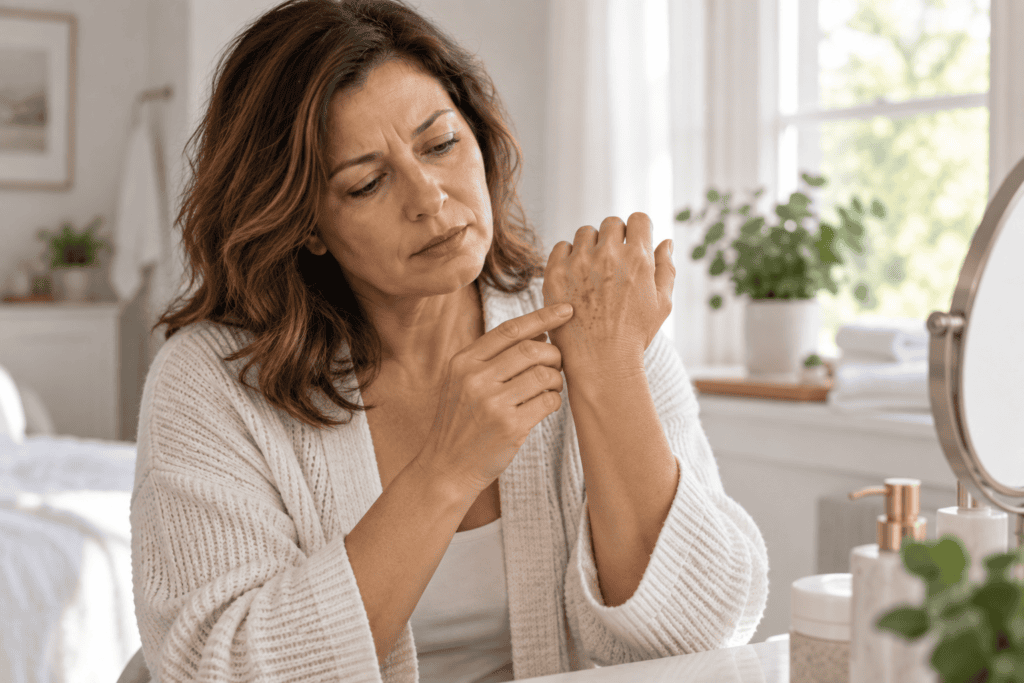
Lentigines are flat, sharply defined spots caused by an increased number or activity of pigment-producing cells. One spot is called a lentigo. They are usually tan, brown, dark brown, or black and do not disappear during seasons with less sun.
Solar lentigines—often called sun spots, age spots, or liver spots—develop after years of ultraviolet exposure and are benign. “Liver spot” is only a nickname; these spots do not indicate liver disease. A clinician should confirm the diagnosis before cosmetic treatment because some skin cancers look similar.
What Can Get Rid of Age Spots? – American Academy of Dermatology
https://www.aad.org/public/cosmetic/age-spots-marks/get-rid-spots
Explains diagnosis before treatment, creams, lasers, freezing, peels, and sun protection.
Aging Spots: Should You Be Concerned? – NIH MedlinePlus
https://medlineplus.gov/ency/article/002086.htm
Describes typical solar lentigines and warning signs that may indicate skin cancer.
Solar lentigines are very common after age 40–50, but they may appear earlier with extensive sun or tanning exposure. They affect all skin tones.
Lentigo simplex can occur without sun exposure and may begin earlier in life. Numerous lentigines beginning in childhood or appearing in unusual patterns can rarely be associated with an inherited syndrome.
Liver Spots – NIH MedlinePlus
https://medlineplus.gov/ency/article/001141.htm
Explains appearance, sun-related causes, examination, biopsy, and treatment of age spots.
Noonan Syndrome With Multiple Lentigines – MedlinePlus Genetics
https://medlineplus.gov/genetics/condition/noonan-syndrome-with-multiple-lentigines/
Explains a rare inherited syndrome in which many lentigines begin in childhood with other health findings.
A lentigo that becomes raised, lumpy, scaly, painful, itchy, bleeding, multicolored, or rapidly changing needs examination rather than cosmetic treatment.
Aging Spots: Should You Be Concerned? – NIH MedlinePlus
https://medlineplus.gov/ency/article/002086.htm
Describes typical solar lentigines and warning signs that may indicate skin cancer.
Moles and Melanoma Warning Signs – National Cancer Institute
https://www.cancer.gov/types/skin/moles-fact-sheet
Explains ABCDE changes, unusual pigmented lesions, melanoma diagnosis, and skin protection.
A clinician examines the number, color, shape, border, texture, location, and history of each concerning spot. They ask about sun exposure, tanning, changes, symptoms, family history, medicines, and prior skin cancer.
Solar lentigines must be distinguished from freckles, moles, seborrheic keratoses, pigmented actinic keratoses, post-inflammatory pigment, lentigo maligna, and melanoma. An atypical or changing spot should be evaluated before it is frozen, lasered, or lightened.
What Can Get Rid of Age Spots? – American Academy of Dermatology
https://www.aad.org/public/cosmetic/age-spots-marks/get-rid-spots
Explains diagnosis before treatment, creams, lasers, freezing, peels, and sun protection.
Skin Cancer Screening – NIH MedlinePlus
https://medlineplus.gov/lab-tests/skin-cancer-screening/
Reviews self-exams, risk factors, suspicious spots, professional examination, and biopsy.
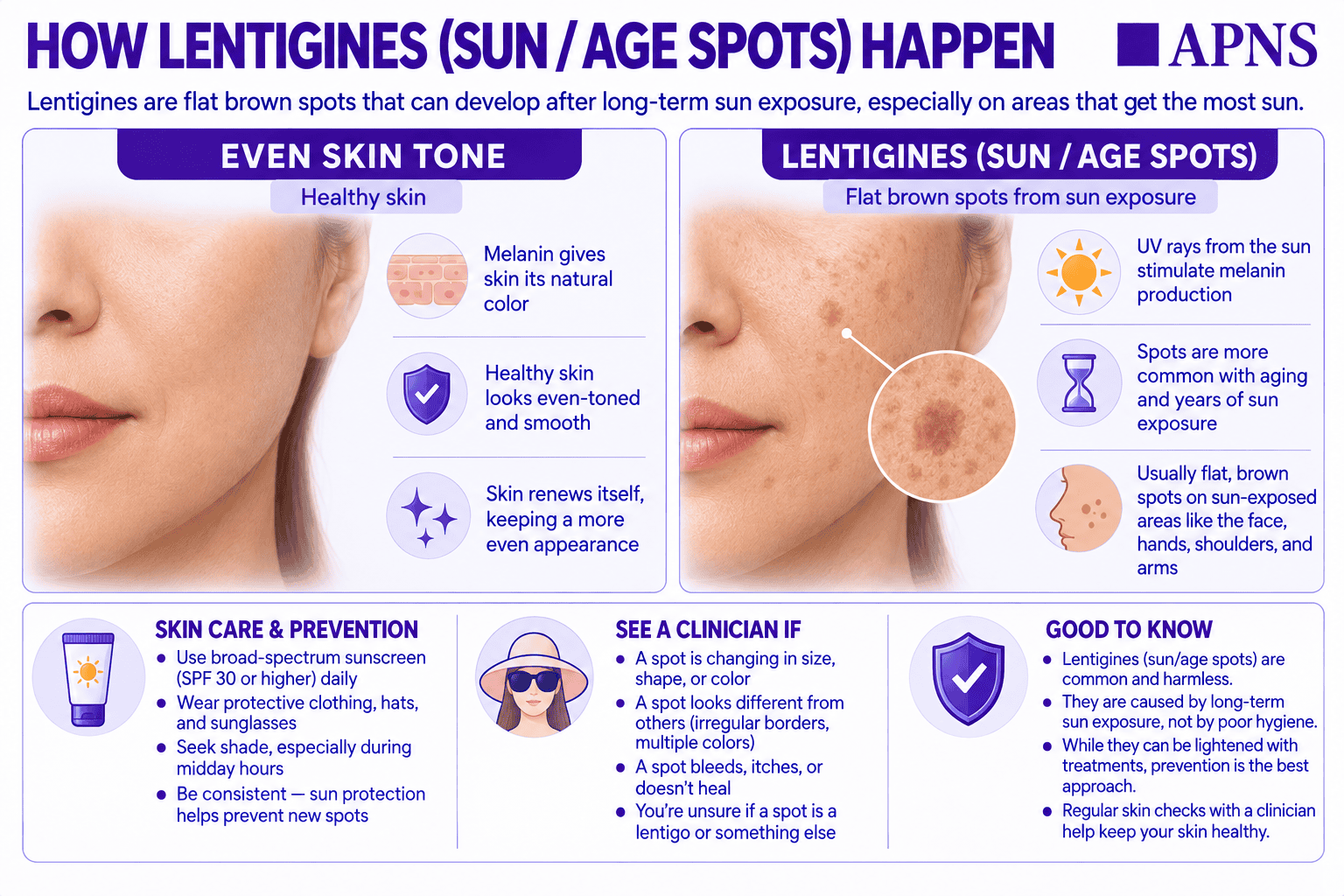
Solar lentigines reflect accumulated skin damage. They are not caused by poor hygiene, liver disease, or something contagious.
Procedures may leave lighter or darker marks, especially in deeper skin tones, when the treatment or settings are not carefully selected.
Sun protection reduces new solar lentigines and skin-cancer risk, but it may not prevent lentigo simplex or rare inherited forms.
What Can Get Rid of Age Spots? – American Academy of Dermatology
https://www.aad.org/public/cosmetic/age-spots-marks/get-rid-spots
Explains diagnosis before treatment, creams, lasers, freezing, peels, and sun protection.
Skin Cancer Screening – NIH MedlinePlus
https://medlineplus.gov/lab-tests/skin-cancer-screening/
Reviews self-exams, risk factors, suspicious spots, professional examination, and biopsy.
The following video content is provided to help you better understand this condition. These resources are intended for educational purposes and should not replace personalized medical advice from your healthcare provider.
Typical solar lentigines need no blood or urine tests. Laboratory testing is guided by other symptoms or a suspected rare syndrome, medicine reaction, or toxic product exposure.
Routine liver tests are not needed simply because solar lentigines are called “liver spots.”
Biopsy is appropriate when melanoma, lentigo maligna, pigmented actinic keratosis, or another cancer cannot be excluded. Do not use a bleaching product to delay evaluation.
Moles and Melanoma Warning Signs – National Cancer Institute
https://www.cancer.gov/types/skin/moles-fact-sheet
Explains ABCDE changes, unusual pigmented lesions, melanoma diagnosis, and skin protection.
Skin Cancer Screening – NIH MedlinePlus
https://medlineplus.gov/lab-tests/skin-cancer-screening/
Reviews self-exams, risk factors, suspicious spots, professional examination, and biopsy.
Confirmed benign lentigines do not require treatment. Cosmetic options differ in speed, cost, recovery, recurrence, and risk of color change.
Procedures often work faster than creams but can cause blistering, crusting, scars, or lasting light or dark areas.
What Can Get Rid of Age Spots? – American Academy of Dermatology
https://www.aad.org/public/cosmetic/age-spots-marks/get-rid-spots
Explains diagnosis before treatment, creams, lasers, freezing, peels, and sun protection.
Sun protection cannot erase every existing spot, but it reduces new lentigines, prevents darkening, and protects against skin cancer.
No cream should be used on a suspicious lesion before diagnosis. Retinoids and some lightening medicines are avoided during pregnancy; discuss pregnancy and breastfeeding safety first.
Only a trained clinician should select a procedure after confirming the diagnosis. Strong at-home peels, home freezing, and unlicensed lasers can cause burns, infection, scars, and delayed cancer diagnosis.
What Can Get Rid of Age Spots? – American Academy of Dermatology
https://www.aad.org/public/cosmetic/age-spots-marks/get-rid-spots
Explains diagnosis before treatment, creams, lasers, freezing, peels, and sun protection.
Benign solar lentigines do not become dangerous simply because they are lentigines, but new skin cancers may arise nearby on sun-damaged skin. Continue monitoring all spots.
Treatment can fade or remove selected spots, but recurrence and new lesions are common without ongoing sun protection. Temporary redness, crusting, or color change may follow procedures.
Do not cut, scrape, freeze, burn, or apply mole-removal products to a spot at home. A scarred or partially treated lesion can become harder to diagnose.
Lentigines themselves are not emergencies. Arrange prompt examination for:
Call emergency services for breathing difficulty, collapse, or a severe allergic reaction. Contact Poison Control at 1-800-222-1222 in the United States for suspected toxic skin-product exposure.
Aging Spots: Should You Be Concerned? – NIH MedlinePlus
https://medlineplus.gov/ency/article/002086.htm
Describes typical solar lentigines and warning signs that may indicate skin cancer.
Skin Cancer Screening – NIH MedlinePlus
https://medlineplus.gov/lab-tests/skin-cancer-screening/
Reviews self-exams, risk factors, suspicious spots, professional examination, and biopsy.

Are lentigines liver disease?
No. “Liver spot” is an old nickname for solar lentigines and does not mean the liver is abnormal.
Are lentigines freckles?
They are different. Freckles often darken and fade with seasons, while lentigines tend to remain visible.
Are solar lentigines cancer?
No, but skin cancer can resemble an age spot. New or changing lesions need examination.
Can age spots become melanoma?
A confirmed solar lentigo is benign, but an atypical area or new melanoma may develop within sun-damaged skin and look similar.
Will creams remove them permanently?
They may fade spots gradually, but recurrence or new spots can occur, especially with UV exposure.
Is laser always best?
No. It can work quickly but may cause burns or pigment changes. The best method depends on diagnosis and skin tone.
Can I freeze a spot at home?
No. Home treatment can scar the skin and delay diagnosis of a cancer mimic.
What does ABCDE mean?
Asymmetry, irregular Border, uneven Color, changing Diameter, and Evolving. Any evolving spot deserves assessment.
Moles and Melanoma Warning Signs – National Cancer Institute
https://www.cancer.gov/types/skin/moles-fact-sheet
Explains ABCDE changes, unusual pigmented lesions, melanoma diagnosis, and skin protection.
What Can Get Rid of Age Spots? – American Academy of Dermatology
https://www.aad.org/public/cosmetic/age-spots-marks/get-rid-spots
Explains diagnosis before treatment, creams, lasers, freezing, peels, and sun protection.
Lentigines themselves are not emergencies. Arrange prompt examination for:
Call emergency services for breathing difficulty, collapse, or a severe allergic reaction. Contact Poison Control at 1-800-222-1222 in the United States for suspected toxic skin-product exposure.
Aging Spots: Should You Be Concerned? – NIH MedlinePlus
https://medlineplus.gov/ency/article/002086.htm
Describes typical solar lentigines and warning signs that may indicate skin cancer.
Skin Cancer Screening – NIH MedlinePlus
https://medlineplus.gov/lab-tests/skin-cancer-screening/
Reviews self-exams, risk factors, suspicious spots, professional examination, and biopsy.
CALL 911
APNS does not provide emergency medical services. If you believe you are experiencing a medical emergency, including (but not limited to) chest pain, difficulty breathing, stroke symptoms, severe allergic reactions, anaphylaxis, uncontrolled bleeding, seizures, loss of consciousness, or any other potentially life-threatening condition, you are instructed to call 911 immediately or go immediately to the nearest emergency department.
What Can Get Rid of Age Spots? – American Academy of Dermatology
https://www.aad.org/public/cosmetic/age-spots-marks/get-rid-spots
Explains diagnosis before treatment, creams, lasers, freezing, peels, and sun protection.
Aging Spots: Should You Be Concerned? – NIH MedlinePlus
https://medlineplus.gov/ency/article/002086.htm
Describes typical solar lentigines and warning signs that may indicate skin cancer.
This guide is educational and does not replace medical care. Have new, changing, bleeding, raised, painful, or unusual spots examined before treatment. Never remove a questionable lesion at home.
At APNS, our providers take the time to understand your condition and your goals. We offer comprehensive telehealth visits at a fixed rate — no membership fees, no insurance required, and no unexpected charges. Whether you’re newly diagnosed or looking for a provider who actually listens, we’re here to help.