

Head lice are tiny, wingless insects that live on the scalp and feed on small amounts of blood from the scalp. An infestation of head lice is called pediculosis capitis. Head lice are very common, especially among school-aged children, but they can affect people of any age.
Lice do not spread disease, are not caused by poor hygiene, and can affect anyone regardless of how often they wash their hair. They spread primarily through direct head-to-head contact. Lice cannot jump, fly, or hop—they crawl from one person’s hair to another. (cdc.gov)
Head lice lay eggs called nits, which attach firmly to the hair shaft close to the scalp. Nits hatch into young lice (nymphs), which mature into adult lice over approximately 1–2 weeks.
Head Lice – Centers for Disease Control and Prevention (CDC)
https://www.cdc.gov/lice/about/head-lice.html
Provides easy-to-understand information about head lice, symptoms, treatment, and prevention.
Head Lice – NIH MedlinePlus
https://medlineplus.gov/headlice.html
Provides patient education about head lice, diagnosis, treatment, and prevention.
Head lice are among the most common childhood infestations worldwide. Millions of cases occur each year, particularly among children 3 to 11 years old. Adults may also develop head lice, especially parents, caregivers, teachers, and healthcare workers who have close contact with children. (cdc.gov)
Although common in schools and daycare settings, anyone can become infested through close personal contact.
Head Lice – CDC
https://www.cdc.gov/lice/about/head-lice.html
Provides information about who commonly develops head lice and how they spread.
Some people have no symptoms, especially early in an infestation.
Common symptoms may include:
A healthcare provider usually diagnoses head lice by examining the scalp and hair.
Diagnosis is confirmed by finding:
Finding nits alone does not always mean an active infestation is present because empty eggshells may remain after treatment.
Head Lice Diagnosis – CDC
https://www.cdc.gov/lice/treatment/head-lice.html
Explains how healthcare providers diagnose active head lice infestations.
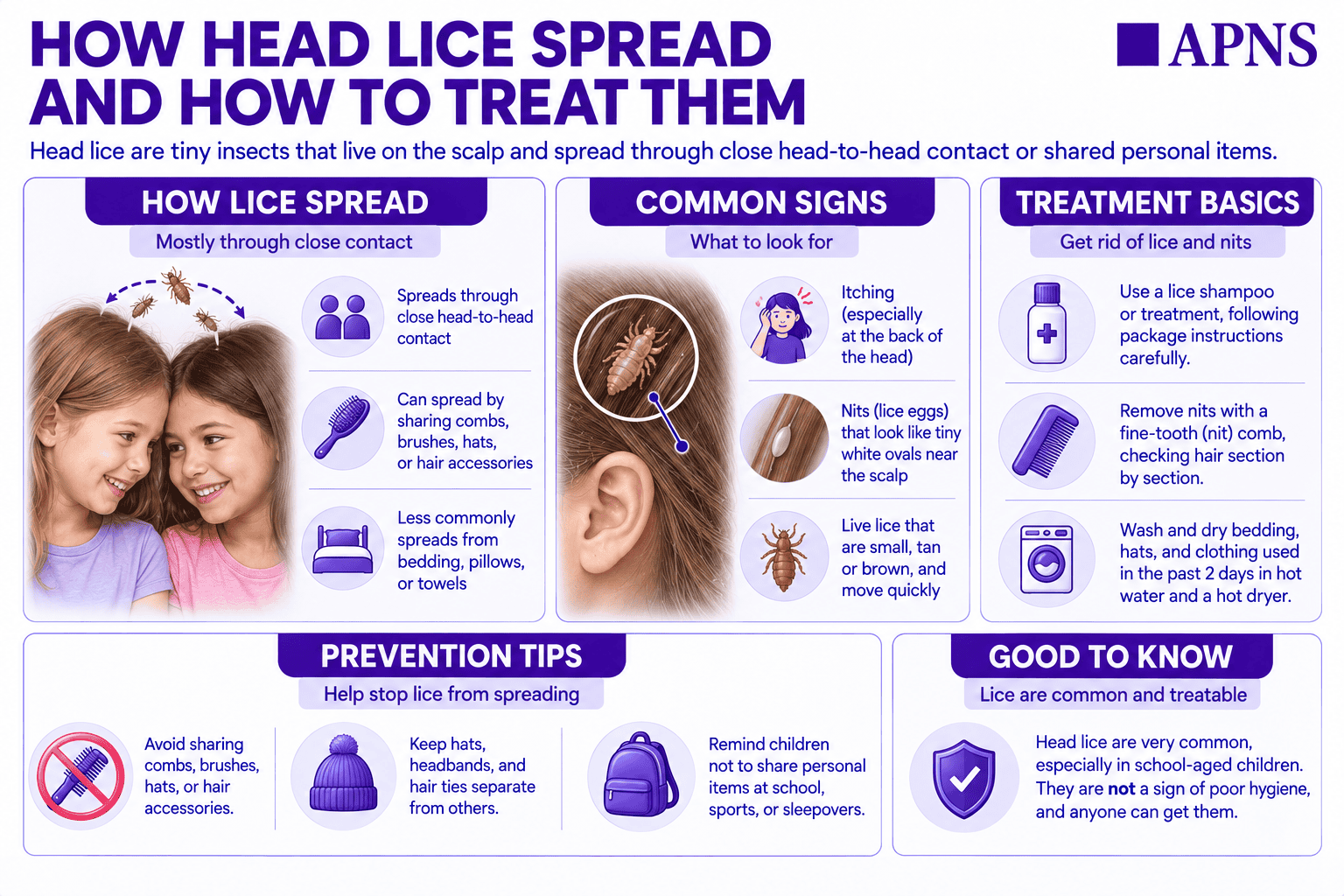
What Causes Lice?
Head lice spread through close personal contact.
Common ways lice spread include:
Less commonly, lice may spread by sharing:
Lice do not spread because someone has poor hygiene, dirty hair, or a dirty home.
How Head Lice Spread – CDC
https://www.cdc.gov/lice/about/head-lice.html
Explains how lice spread and common misconceptions about transmission.
Several factors may allow an infestation to continue.
Common factors include:
Treatment for Head Lice – CDC
https://www.cdc.gov/lice/treatment/head-lice.html
Provides recommendations for successful treatment and preventing reinfestation.
Helpful prevention tips include:
Head Lice Prevention – CDC
https://www.cdc.gov/lice/prevention/head-lice.html
Provides recommendations for preventing head lice and reducing spread.
The following video content is provided to help you better understand this condition. These resources are intended for educational purposes and should not replace personalized medical advice from your healthcare provider.
Head lice usually do not require laboratory testing.
Laboratory testing is rarely necessary because lice are identified through direct examination of the hair and scalp.
Occasionally, microscopic examination may help confirm uncertain findings.
Head Lice – NIH MedlinePlus
https://medlineplus.gov/headlice.html
Provides information about diagnosing head lice without laboratory testing.
Most people do not require diagnostic testing beyond a physical examination.
Possible evaluations include:
Head Lice – CDC
https://www.cdc.gov/lice/about/head-lice.html
Provides information about identifying lice and nits.
Treatment focuses on killing live lice and preventing newly hatched lice from surviving.
Treatment options may include:
A second treatment is often recommended 7–10 days after the first treatment, depending on the medication used.
Treatment for Head Lice – CDC
https://www.cdc.gov/lice/treatment/head-lice.html
Provides detailed instructions for treating head lice safely and effectively.
Helpful habits include:
Head Lice Prevention – CDC
https://www.cdc.gov/lice/prevention/head-lice.html
Provides recommendations for reducing the spread of head lice.
Common medications include:
Always follow the medication instructions carefully. Some treatments kill live lice but not eggs, making repeat treatment necessary.
Head Lice Treatment – CDC
https://www.cdc.gov/lice/treatment/head-lice.html
Provides medication recommendations and instructions for repeat treatment when needed.
Most people do not require medical procedures.
Common management techniques include:
Head Lice – NIH MedlinePlus
https://medlineplus.gov/headlice.html
Provides information about lice removal and follow-up care.
Most head lice infestations are successfully treated with appropriate medication and follow-up care.
Itching may continue for several days or weeks after the lice have been eliminated because the skin remains irritated. Reinfestation can occur if another exposure happens.
Helpful home care includes:
Treating Head Lice at Home – CDC
https://www.cdc.gov/lice/treatment/head-lice.html
Provides practical recommendations for home treatment and preventing reinfestation.
No. Lice crawl but cannot jump, hop, or fly.
No. Dogs, cats, and other pets do not spread human head lice.
No. Head lice affect clean and dirty hair equally.
No. They can usually be cleaned according to CDC recommendations.
Many schools allow children to return after appropriate treatment begins. School policies may vary.
It is generally unnecessary. Proper treatment is usually effective without shaving.

Consider asking:
Most cases are treated by a primary care provider or pediatrician.
You may be referred to:
Head Lice – CDC
https://www.cdc.gov/lice/
Provides additional educational resources for patients and families.
Yes. Head lice are completely treatable.
Successful treatment usually requires:
Lice do not live long away from the human scalp, making complete elimination achievable with proper treatment.
Head lice rarely cause medical emergencies.
Seek prompt medical evaluation if you develop:
Call 911 immediately if you develop:
Head Lice – CDC
https://www.cdc.gov/lice/
Provides guidance about treatment complications and when to seek medical care.
CALL 911
APNS does not provide emergency medical services. If you believe you are experiencing a medical emergency, including (but not limited to) chest pain, difficulty breathing, stroke symptoms, severe allergic reactions, anaphylaxis, uncontrolled bleeding, seizures, loss of consciousness, or any other potentially life-threatening condition, you are instructed to call 911 immediately or go immediately to the nearest emergency department.
Head Lice – CDC
https://www.cdc.gov/lice/
Comprehensive information about head lice, treatment, prevention, and common questions.
Head Lice – NIH MedlinePlus
https://medlineplus.gov/headlice.html
Easy-to-understand information about symptoms, diagnosis, treatment, and prevention.
American Academy of Pediatrics – HealthyChildren.org
https://www.healthychildren.org
Provides trusted information for parents about head lice, treatment, and school recommendations.
This guide is intended for educational purposes only and should not replace medical advice, diagnosis, or treatment from your healthcare provider. Always follow the instructions provided with lice treatment products and the recommendations of your healthcare team. Contact your healthcare provider if symptoms worsen, treatment is unsuccessful, or signs of infection develop. Call 911 immediately if you experience difficulty breathing, swelling of the face or throat, or another medical emergency after using a lice treatment.
At APNS, our providers take the time to understand your condition and your goals. We offer comprehensive telehealth visits at a fixed rate — no membership fees, no insurance required, and no unexpected charges. Whether you’re newly diagnosed or looking for a provider who actually listens, we’re here to help.