
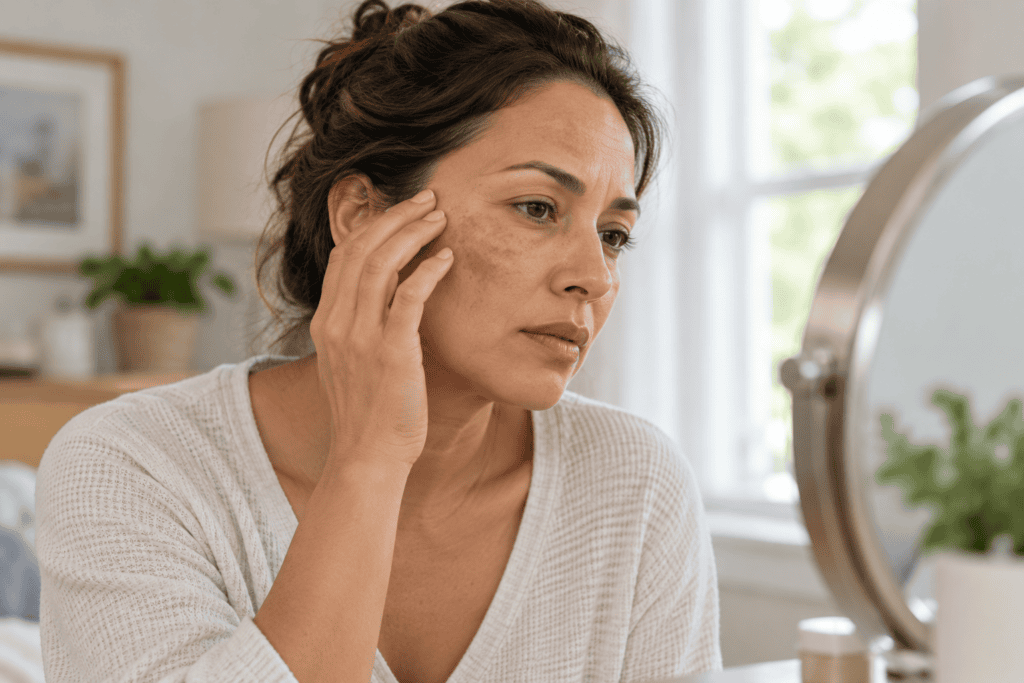
Melasma is a common skin condition that causes flat, darker patches or spots to develop on the skin. It most often affects areas of the face that receive sunlight, including the cheeks, forehead, nose, upper lip, and chin. The patches may appear light brown, dark brown, gray-brown, or darker than the surrounding skin.
Melasma is a type of hyperpigmentation, meaning the affected skin produces more pigment, called melanin. It is not contagious, harmful, or a form of skin cancer. However, it may affect confidence, emotional well-being, and quality of life.
Melasma is sometimes called the “mask of pregnancy” because hormonal changes during pregnancy can trigger it. Although treatment can lighten the discoloration, melasma often returns and may require long-term sun protection and skin care.
Melasma – NIH MedlinePlus
https://medlineplus.gov/ency/article/000836.htm
Provides easy-to-understand information about melasma, including symptoms, causes, diagnosis, treatment, and prevention.
Melasma – American Academy of Dermatology
https://www.aad.org/public/diseases/a-z/melasma-overview
Provides dermatologist-reviewed information about melasma and available treatment options.
Melasma is a common pigmentation disorder, but its frequency varies considerably among different populations and geographic areas. It occurs more often in women, particularly during the reproductive years, and is more noticeable in people with medium to darker skin tones.
People with Asian, Hispanic or Latino, Middle Eastern, Mediterranean, African, or South Asian backgrounds may be more likely to develop melasma. Men can also develop the condition, although it is diagnosed less frequently in men than in women.
Melasma: Overview – American Academy of Dermatology
https://www.aad.org/public/diseases/a-z/melasma-overview
Provides information about who develops melasma and why treatment may be helpful.
Melasma usually causes changes in skin color without pain, itching, or other physical discomfort.
Common symptoms may include:
Common facial patterns include:
Melasma does not usually cause changes in skin texture. A raised, painful, bleeding, crusting, or rapidly changing skin lesion may have another cause and should be evaluated.
A healthcare provider or dermatologist can usually diagnose melasma by examining the skin and reviewing your medical history. They may ask when the discoloration began, whether you are pregnant, which medications you take, and whether sunlight or skin-care products make it worse.
Melasma can sometimes resemble post-inflammatory hyperpigmentation, medication-related pigmentation, sun damage, thyroid-related pigmentation, or other skin conditions. Additional evaluation may be needed when the pattern is unusual or the diagnosis is uncertain.
Melasma: Diagnosis and Treatment – American Academy of Dermatology
https://www.aad.org/public/diseases/a-z/melasma-treatment
Explains how dermatologists diagnose melasma and create an individualized treatment plan.
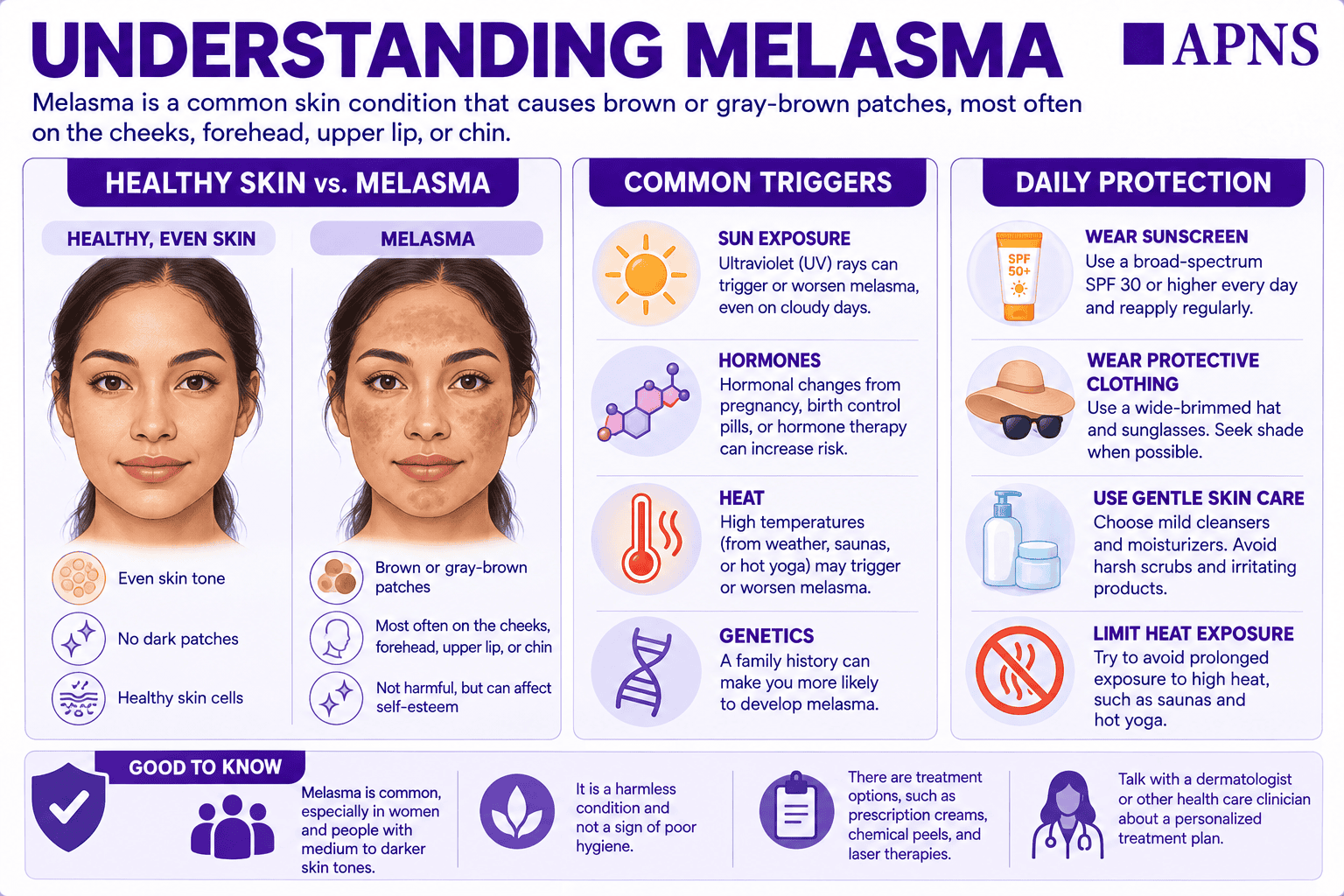
The exact cause of melasma is not fully understood. It develops when pigment-producing cells called melanocytes become more active and produce excess melanin.
Factors that may contribute include:
Sunlight is one of the most important triggers because ultraviolet and visible light can stimulate pigment production. Hormonal changes may explain why melasma commonly begins during pregnancy or while using hormone-containing medications.
Melasma: Causes – American Academy of Dermatology
https://www.aad.org/public/diseases/a-z/melasma-causes
Explains how sunlight, hormones, medications, and other factors may contribute to melasma.
Several exposures and skin-care habits can darken melasma or cause it to return after treatment.
Common factors include:
Any product or procedure that irritates the skin may worsen pigmentation. Gentle skin care and consistent protection from sunlight and visible light are essential parts of treatment.
Melasma: Self-Care – American Academy of Dermatology
https://www.aad.org/public/diseases/a-z/melasma-self-care
Provides practical guidance for protecting the skin and making melasma less noticeable.
Melasma cannot always be prevented, especially when pregnancy, hormones, or genetics contribute. However, careful light protection may prevent it from developing or becoming darker.
Helpful prevention tips include:
Melasma: Self-Care – American Academy of Dermatology
https://www.aad.org/public/diseases/a-z/melasma-self-care
Provides recommendations for preventing darkening and reducing recurrence.
The following video content is provided to help you better understand this condition. These resources are intended for educational purposes and should not replace personalized medical advice from your healthcare provider.
Most people with melasma do not need laboratory testing.
Laboratory tests may be recommended when a healthcare provider suspects an underlying condition or needs to rule out another cause of skin discoloration.
Possible laboratory tests may include:
Laboratory Tests – NIH MedlinePlus
https://medlineplus.gov/lab-tests/
Provides information about common laboratory tests that may be used to evaluate underlying medical conditions.
Most cases of melasma do not require imaging or invasive testing.
Possible diagnostic evaluations may include:
A Wood’s lamp may help with evaluation, but it does not always accurately predict how well treatment will work, particularly in darker skin tones.
Skin Biopsy – NIH MedlinePlus
https://medlineplus.gov/lab-tests/skin-biopsy/
Explains why a small skin sample may occasionally be needed to diagnose an unusual pigmentation problem.
Treatment aims to lighten the darkened areas, prevent additional pigment formation, and reduce recurrence. Results are gradual, and improvement may take several months.
Treatment options may include:
A dermatologist may combine treatments. Procedures must be chosen carefully because irritation can worsen pigmentation, especially in people with darker skin tones.
Melasma: Diagnosis and Treatment – American Academy of Dermatology
https://www.aad.org/public/diseases/a-z/melasma-treatment
Provides information about prescription creams, procedures, sun protection, and expected treatment results.
Daily skin protection is one of the most important parts of controlling melasma.
Helpful lifestyle changes include:
Sun protection should continue even after pigmentation improves because melasma commonly returns.
Melasma: Self-Care – American Academy of Dermatology
https://www.aad.org/public/diseases/a-z/melasma-self-care
Provides recommendations for sunscreen, gentle skin care, and reducing skin irritation.
Medication choices depend on the depth and severity of the pigmentation, skin type, pregnancy status, and previous treatments.
Common medications may include:
Hydroquinone and other lightening medications should be used as directed. Excessive or prolonged unsupervised use can cause irritation or, rarely, paradoxical darkening. Oral tranexamic acid is not appropriate for everyone because it may increase blood-clotting risk.
Pregnant or breastfeeding patients should consult their healthcare provider before using any melasma medication. Retinoids and hydroquinone are generally avoided during pregnancy unless a qualified clinician determines otherwise.
Melasma Treatment – American Academy of Dermatology
https://www.aad.org/public/diseases/a-z/melasma-treatment
Provides dermatologist-reviewed information about topical medications and treatment safety.
Some people may benefit from procedures when topical treatment and sun protection do not provide enough improvement. Procedures should be performed by a dermatologist experienced in treating pigmentation disorders.
Possible procedures may include:
Procedures may cause irritation, post-inflammatory hyperpigmentation, scarring, or worsening melasma. Laser and light treatments may produce temporary improvement but can also cause recurrence. Careful patient selection and continued sun protection are essential.
Melasma: Diagnosis and Treatment – American Academy of Dermatology
https://www.aad.org/public/diseases/a-z/melasma-treatment
Explains when chemical peels, microneedling, laser treatment, and other procedures may be considered.
Melasma is often a chronic or recurring condition. Some cases fade after pregnancy or after stopping a triggering hormone medication, but discoloration may continue for years in other people.
Treatment can make melasma less noticeable, but it does not always remove the pigment completely. Continued sun and visible-light protection are usually necessary to maintain improvement.
Pigmentation may return because of:
Regular follow-up with a dermatologist can help adjust treatment and reduce side effects.
A simple daily routine may support treatment and prevent additional darkening.
Morning routine:
Evening routine:
Additional tips include:
How to Make Melasma Less Noticeable – American Academy of Dermatology
https://www.aad.org/news/make-melasma-less-noticeable
Provides dermatologist-recommended strategies for protecting the skin and improving discoloration.
No. Melasma is benign and does not become skin cancer. However, a healthcare provider should evaluate unusual, raised, bleeding, painful, or rapidly changing skin areas.
No. It cannot spread from one person to another.
No. Melasma usually causes larger, symmetrical patches, while sunspots are often smaller individual spots caused by long-term sun exposure.
Yes. Pregnancy-related hormonal changes can trigger melasma, which is why it is sometimes called the mask of pregnancy.
It may fade after pregnancy, but some discoloration can remain or return during later pregnancies or with sun exposure.
Hormonal birth control may trigger or worsen melasma in some people. Do not stop prescribed contraception without discussing alternatives with your healthcare provider.
Sunscreen does not remove existing pigment by itself, but it prevents further darkening and helps other treatments work more effectively.
Improvement often takes several months. Some people require longer treatment and ongoing maintenance.
Laser treatment may improve pigmentation in selected patients, but melasma can return, and some procedures can worsen discoloration.
Products containing azelaic acid, kojic acid, vitamin C, or other brightening ingredients may help some people, but irritation can worsen melasma. A dermatologist can help select safer options.

Consider asking your healthcare provider:
Melasma is usually managed by a primary care provider or dermatologist.
You may be referred to:
Melasma Resource Center – American Academy of Dermatology
https://www.aad.org/public/diseases/a-z/melasma-overview
Provides information about melasma diagnosis, treatment, skin care, and specialist support.
There is no guaranteed permanent cure for melasma. Some cases fade after pregnancy or after a hormonal trigger ends, while others persist or repeatedly return.
Melasma can often be successfully managed through:
Even after the skin improves, continued prevention is important because small amounts of light exposure may cause pigment to return.
Melasma itself does not usually cause a medical emergency.
Call 911 or seek emergency medical care immediately if you experience:
Seek prompt medical evaluation if you notice:
Skin Conditions – NIH MedlinePlus
https://medlineplus.gov/skinconditions.html
Provides information about skin symptoms that may require medical evaluation.
CALL 911
APNS does not provide emergency medical services. If you believe you are experiencing a medical emergency, including (but not limited to) chest pain, difficulty breathing, stroke symptoms, severe allergic reactions, anaphylaxis, uncontrolled bleeding, seizures, loss of consciousness, or any other potentially life-threatening condition, you are instructed to call 911 immediately or go immediately to the nearest emergency department.
Melasma – NIH MedlinePlus
https://medlineplus.gov/ency/article/000836.htm
Easy-to-understand information about melasma symptoms, causes, treatment, and prevention.
Melasma: Overview – American Academy of Dermatology
https://www.aad.org/public/diseases/a-z/melasma-overview
Dermatologist-reviewed information about melasma and who commonly develops it.
Melasma: Diagnosis and Treatment – American Academy of Dermatology
https://www.aad.org/public/diseases/a-z/melasma-treatment
Provides detailed information about medications, procedures, and expected treatment results.
Melasma: Self-Care – American Academy of Dermatology
https://www.aad.org/public/diseases/a-z/melasma-self-care
Provides practical recommendations for sunscreen, gentle skin care, and preventing darkening.
Skin Pigmentation Disorders – NIH MedlinePlus
https://medlineplus.gov/skinpigmentationdisorders.html
Provides information about melanin, hyperpigmentation, and other disorders affecting skin color.
This guide is intended for educational purposes only and should not replace medical advice, diagnosis, or treatment from your healthcare provider or dermatologist. Melasma may resemble post-inflammatory hyperpigmentation, sun damage, medication-related pigmentation, autoimmune disease, or other skin conditions requiring different treatment. Some melasma medications and procedures are not appropriate during pregnancy or breastfeeding and may cause irritation, abnormal pigmentation, scarring, medication interactions, or other complications. Always follow your healthcare provider’s recommendations and stop using a product if it causes severe burning, swelling, blistering, or worsening discoloration. Seek immediate medical care for difficulty breathing, facial or throat swelling, loss of consciousness, chest pain, sudden shortness of breath, or another medical emergency.
At APNS, our providers take the time to understand your condition and your goals. We offer comprehensive telehealth visits at a fixed rate — no membership fees, no insurance required, and no unexpected charges. Whether you’re newly diagnosed or looking for a provider who actually listens, we’re here to help.