
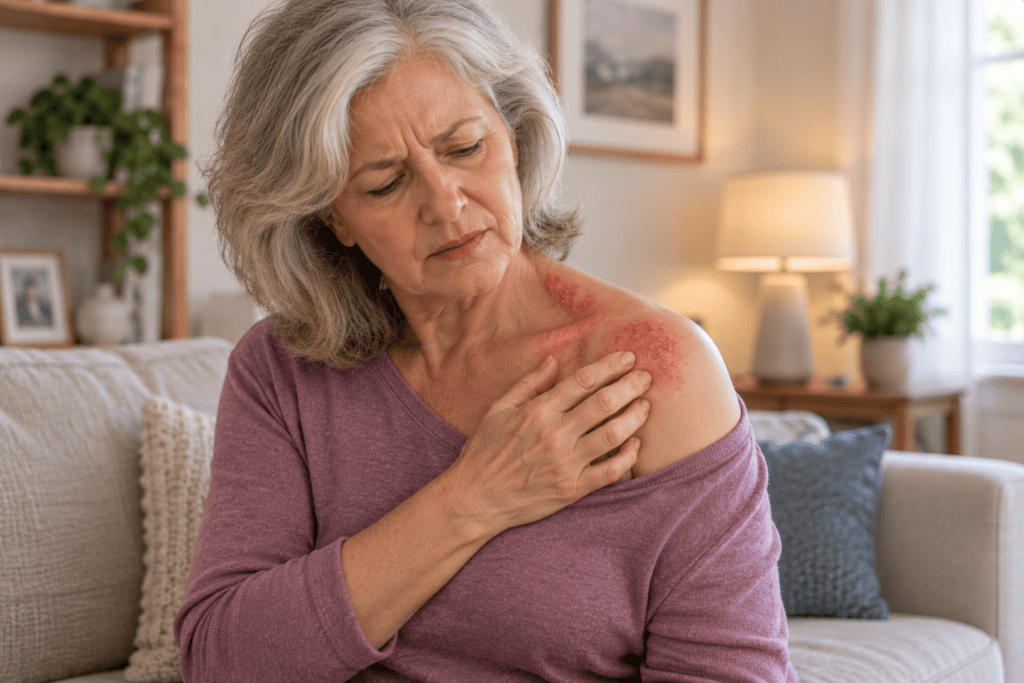
Shingles, also called herpes zoster, is a painful rash caused by the varicella-zoster virus—the same virus that causes chickenpox. After chickenpox, the virus stays inactive in nerve tissue and may reactivate years later as shingles.
Shingles usually causes pain, burning, tingling, itching, and a blistering rash on one side of the body or face. Most cases heal within two to four weeks, but serious eye, ear, brain, or widespread complications can occur. Early antiviral treatment can shorten illness and reduce complications.
About Shingles – CDC
https://www.cdc.gov/shingles/about/index.html
Explains causes, symptoms, complications, contagiousness, protection of others, and vaccination.
Shingles – NIH MedlinePlus
https://medlineplus.gov/shingles.html
Offers patient-friendly information about symptoms, antiviral treatment, pain, home care, and prevention.
About 1 in 3 people in the United States develops shingles during their lifetime. Risk rises with age and with conditions or medicines that weaken the immune system.
Anyone who has had chickenpox can develop shingles, including people who do not remember having it. Shingles can occur more than once.
About Shingles – CDC
https://www.cdc.gov/shingles/about/index.html
Explains causes, symptoms, complications, contagiousness, protection of others, and vaccination.
Symptoms may begin several days before the rash and can include:
Some people have nerve pain with little or no visible rash. A widespread rash, rash on both sides, or unusual lesions are more likely with immune suppression and require prompt care.
Clinical Overview of Shingles – CDC
https://www.cdc.gov/shingles/hcp/clinical-overview/index.html
Provides clinical information about rash patterns, complications, diagnosis, and early treatment.
Ramsay Hunt Syndrome – NIH MedlinePlus
https://medlineplus.gov/ency/article/001647.htm
Explains shingles involving the ear and facial nerve, including facial weakness, hearing changes, and vertigo.
A clinician usually diagnoses shingles from the pain pattern and the appearance and location of the rash. They ask when symptoms began, whether new blisters are appearing, vaccination history, immune conditions, medicines, pregnancy, and eye, ear, or neurologic symptoms.
Testing is useful when the rash is unusual, there are no visible blisters, the immune system is weakened, or another condition such as herpes simplex, contact dermatitis, impetigo, or an insect reaction is possible.
Clinical Overview of Shingles – CDC
https://www.cdc.gov/shingles/hcp/clinical-overview/index.html
Provides clinical information about rash patterns, complications, diagnosis, and early treatment.
Chickenpox and Shingles Tests – NIH MedlinePlus
https://medlineplus.gov/lab-tests/chickenpox-and-shingles-tests/
Explains when lesion or other testing may be used and what results can mean.
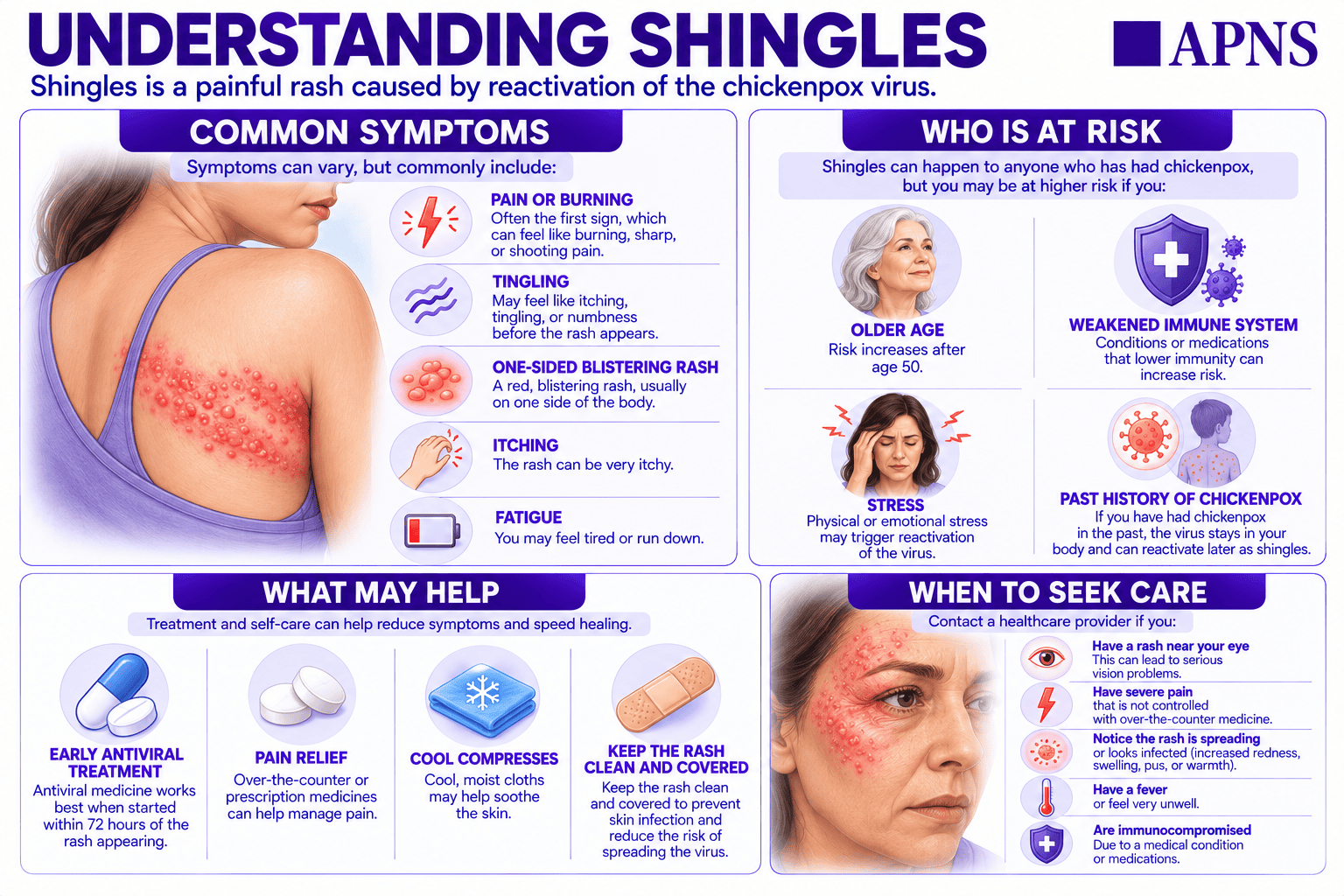
Shingles occurs when inactive varicella-zoster virus becomes active again in a sensory nerve. The exact trigger is not always known.
Shingles is not caused by poor hygiene or by catching shingles from someone else. Exposure to shingles can cause chickenpox—not shingles—in someone who has never had chickenpox or the chickenpox vaccine.
About Shingles – CDC
https://www.cdc.gov/shingles/about/index.html
Explains causes, symptoms, complications, contagiousness, protection of others, and vaccination.
Complications are more likely with:
Treatment works best when started within 72 hours of rash onset, but later treatment may still be appropriate if new blisters are appearing or complications are possible.
Clinical Overview of Shingles – CDC
https://www.cdc.gov/shingles/hcp/clinical-overview/index.html
Provides clinical information about rash patterns, complications, diagnosis, and early treatment.
CDC recommends two doses of recombinant zoster vaccine (Shingrix):
Shingrix commonly causes arm pain, fatigue, headache, muscle aches, fever, or chills for one to three days. These reactions are temporary and are not shingles.
Shingles Vaccine Recommendations – CDC
https://www.cdc.gov/shingles/hcp/vaccine-considerations/index.html
Explains who should receive the two-dose Shingrix series and recommended timing.
Shingrix for Immunocompromised Adults – CDC
https://www.cdc.gov/shingles/hcp/vaccine-considerations/immunocompromised-adults.html
Provides vaccination guidance for adults with weakened immune systems or immune-suppressing treatment.
Recombinant Zoster Vaccine Information Statement – CDC
https://www.cdc.gov/vaccines/hcp/current-vis/shingles.html
Reviews vaccine benefits, expected reactions, precautions, and when to seek help.
The following video content is provided to help you better understand this condition. These resources are intended for educational purposes and should not replace personalized medical advice from your healthcare provider.
Most typical cases do not require blood tests. Possible tests include:
A negative sample from an old, dry, or poorly collected lesion may not fully rule out shingles. Testing should not delay urgent antiviral treatment when eye or neurologic disease is suspected.
Chickenpox and Shingles Tests – NIH MedlinePlus
https://medlineplus.gov/lab-tests/chickenpox-and-shingles-tests/
Explains when lesion or other testing may be used and what results can mean.
Imaging is not needed for routine skin-limited shingles. Additional evaluation may include:
A rash on the tip or side of the nose can signal involvement of the same nerve that serves the eye and needs same-day eye evaluation.
Corneal Conditions and Urgent Eye Symptoms – National Eye Institute
https://www.nei.nih.gov/eye-health-information/eye-conditions-and-diseases/corneal-conditions
Explains eye symptoms that require immediate evaluation to protect vision.
Ramsay Hunt Syndrome – NIH MedlinePlus
https://medlineplus.gov/ency/article/001647.htm
Explains shingles involving the ear and facial nerve, including facial weakness, hearing changes, and vertigo.
Contact a clinician as soon as shingles is suspected. Treatment may include:
Antibiotics do not treat the shingles virus. They are used only if a bacterial skin infection develops.
Shingles – NIH MedlinePlus
https://medlineplus.gov/shingles.html
Offers patient-friendly information about symptoms, antiviral treatment, pain, home care, and prevention.
Shingles Aftercare – NIH MedlinePlus
https://medlineplus.gov/ency/patientinstructions/000560.htm
Provides practical instructions for skin care, pain relief, activity, and warning signs during recovery.
During recovery:
Do not return to close-contact work or activities when uncovered, draining lesions could expose high-risk people. Follow workplace and healthcare infection-control instructions.
Common medicines include:
Antiviral doses may need adjustment with kidney disease, older age, or dehydration. Steroids do not cure shingles and should never be used without antiviral and clinician-directed planning when considered.
Shingles – NIH MedlinePlus
https://medlineplus.gov/shingles.html
Offers patient-friendly information about symptoms, antiviral treatment, pain, home care, and prevention.
Postherpetic Neuralgia Aftercare – NIH MedlinePlus
https://medlineplus.gov/ency/patientinstructions/000555.htm
Reviews long-lasting nerve pain after shingles and available pain-management approaches.
Most cases do not need a procedure. Selected care may include:
Blisters should not be intentionally popped or drained. Opening them increases pain, infection risk, and exposure of others to blister fluid.
New blisters usually stop forming within several days, then crust and heal over two to four weeks. Skin color changes, itching, sensitivity, or numbness may last longer.
Postherpetic neuralgia is pain that continues after the rash heals and can last months or years. Risk increases with age and severe early pain or rash. Persistent pain is treatable and should not be dismissed.
About Shingles – CDC
https://www.cdc.gov/shingles/about/index.html
Explains causes, symptoms, complications, contagiousness, protection of others, and vaccination.
Postherpetic Neuralgia Aftercare – NIH MedlinePlus
https://medlineplus.gov/ency/patientinstructions/000555.htm
Reviews long-lasting nerve pain after shingles and available pain-management approaches.
To ease symptoms and protect others:
Avoid contact with pregnant people without chickenpox immunity, premature or low-birth-weight infants, and people with weakened immune systems until every blister has crusted.
About Shingles – CDC
https://www.cdc.gov/shingles/about/index.html
Explains causes, symptoms, complications, contagiousness, protection of others, and vaccination.
Shingles Aftercare – NIH MedlinePlus
https://medlineplus.gov/ency/patientinstructions/000560.htm
Provides practical instructions for skin care, pain relief, activity, and warning signs during recovery.
No. Shingles is caused by varicella-zoster virus. Oral and genital herpes are caused by herpes simplex viruses.
No. Someone without chickenpox immunity can develop chickenpox after direct contact with shingles blister fluid.
From the time blisters appear until all lesions have dried and crusted. Risk is lower when the rash is fully covered.
Typical shingles stays on one side. A widespread or two-sided rash needs prompt evaluation, especially with immune suppression.
Yes. Use gentle water and mild soap, avoid scrubbing, and pat dry with a clean towel.
Yes, if you meet age or immune-risk recommendations. Do not vaccinate during an active episode; ask when to schedule it after recovery.
No. Shingrix is not a live-virus vaccine and cannot cause shingles.
Get it as soon as possible. The series generally does not need to be restarted.

Consider asking:
Primary care can manage many cases. Referral may be made to:
Corneal Conditions and Urgent Eye Symptoms – National Eye Institute
https://www.nei.nih.gov/eye-health-information/eye-conditions-and-diseases/corneal-conditions
Explains eye symptoms that require immediate evaluation to protect vision.
Ramsay Hunt Syndrome – NIH MedlinePlus
https://medlineplus.gov/ency/article/001647.htm
Explains shingles involving the ear and facial nerve, including facial weakness, hearing changes, and vertigo.
There is no medicine that removes varicella-zoster virus from the body, but the active shingles episode usually resolves. Antivirals help the outbreak heal faster and reduce severity when started early.
Shingles can happen again. Shingrix lowers the risk of another episode and serious complications even after a person has already had shingles.
Shingles – NIH MedlinePlus
https://medlineplus.gov/shingles.html
Offers patient-friendly information about symptoms, antiviral treatment, pain, home care, and prevention.
Shingles Vaccine Recommendations – CDC
https://www.cdc.gov/shingles/hcp/vaccine-considerations/index.html
Explains who should receive the two-dose Shingrix series and recommended timing.
Seek urgent or emergency care for:
Eye, ear, brain, and widespread shingles can cause permanent disability or become life-threatening. Do not wait for a routine appointment.
Corneal Conditions and Urgent Eye Symptoms – National Eye Institute
https://www.nei.nih.gov/eye-health-information/eye-conditions-and-diseases/corneal-conditions
Explains eye symptoms that require immediate evaluation to protect vision.
Ramsay Hunt Syndrome – NIH MedlinePlus
https://medlineplus.gov/ency/article/001647.htm
Explains shingles involving the ear and facial nerve, including facial weakness, hearing changes, and vertigo.
Clinical Overview of Shingles – CDC
https://www.cdc.gov/shingles/hcp/clinical-overview/index.html
Provides clinical information about rash patterns, complications, diagnosis, and early treatment.
CALL 911
APNS does not provide emergency medical services. If you believe you are experiencing a medical emergency, including (but not limited to) chest pain, difficulty breathing, stroke symptoms, severe allergic reactions, anaphylaxis, uncontrolled bleeding, seizures, loss of consciousness, or any other potentially life-threatening condition, you are instructed to call 911 immediately or go immediately to the nearest emergency department.
About Shingles – CDC
https://www.cdc.gov/shingles/about/index.html
Explains causes, symptoms, complications, contagiousness, protection of others, and vaccination.
Clinical Overview of Shingles – CDC
https://www.cdc.gov/shingles/hcp/clinical-overview/index.html
Provides clinical information about rash patterns, complications, diagnosis, and early treatment.
Shingles Vaccine Recommendations – CDC
https://www.cdc.gov/shingles/hcp/vaccine-considerations/index.html
Explains who should receive the two-dose Shingrix series and recommended timing.
Shingrix for Immunocompromised Adults – CDC
https://www.cdc.gov/shingles/hcp/vaccine-considerations/immunocompromised-adults.html
Provides vaccination guidance for adults with weakened immune systems or immune-suppressing treatment.
Recombinant Zoster Vaccine Information Statement – CDC
https://www.cdc.gov/vaccines/hcp/current-vis/shingles.html
Reviews vaccine benefits, expected reactions, precautions, and when to seek help.
Shingles – NIH MedlinePlus
https://medlineplus.gov/shingles.html
Offers patient-friendly information about symptoms, antiviral treatment, pain, home care, and prevention.
Shingles Aftercare – NIH MedlinePlus
https://medlineplus.gov/ency/patientinstructions/000560.htm
Provides practical instructions for skin care, pain relief, activity, and warning signs during recovery.
Chickenpox and Shingles Tests – NIH MedlinePlus
https://medlineplus.gov/lab-tests/chickenpox-and-shingles-tests/
Explains when lesion or other testing may be used and what results can mean.
Postherpetic Neuralgia Aftercare – NIH MedlinePlus
https://medlineplus.gov/ency/patientinstructions/000555.htm
Reviews long-lasting nerve pain after shingles and available pain-management approaches.
Corneal Conditions and Urgent Eye Symptoms – National Eye Institute
https://www.nei.nih.gov/eye-health-information/eye-conditions-and-diseases/corneal-conditions
Explains eye symptoms that require immediate evaluation to protect vision.
Ramsay Hunt Syndrome – NIH MedlinePlus
https://medlineplus.gov/ency/article/001647.htm
Explains shingles involving the ear and facial nerve, including facial weakness, hearing changes, and vertigo.
This guide is for education only and does not replace professional medical advice, examination, diagnosis, or treatment. Antiviral treatment is most effective when started promptly. Seek urgent care for rash or pain near the eye or ear, vision or hearing changes, facial weakness, severe headache, confusion, weakness, seizure, widespread rash, serious infection, dehydration, or a severe medication reaction. People with weakened immune systems should contact a clinician promptly for any suspected shingles.
At APNS, our providers take the time to understand your condition and your goals. We offer comprehensive telehealth visits at a fixed rate — no membership fees, no insurance required, and no unexpected charges. Whether you’re newly diagnosed or looking for a provider who actually listens, we’re here to help.