
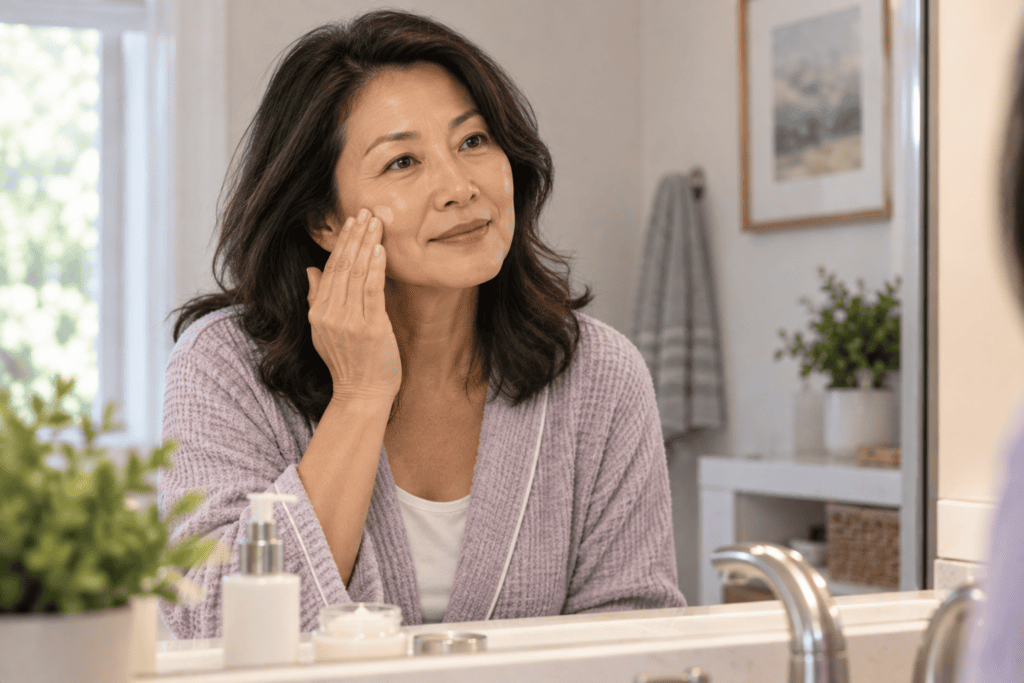
Skin care means protecting the skin barrier, keeping skin comfortable, and addressing concerns such as dryness, acne, uneven color, rough texture, or sun damage. Skin naturally changes with age: it becomes thinner, drier, less elastic, and slower to heal. Fine lines, wrinkles, spots, and changes in texture are normal and vary with genetics, hormones, health, and life experiences.
“Anti-aging” care cannot stop or reverse time, but it can reduce preventable damage and improve how skin looks and feels. Daily sun protection, gentle cleansing, regular moisturizing, avoiding tobacco, and using a small number of evidence-based products consistently are more useful than a complicated routine. New, changing, painful, bleeding, or nonhealing spots should be medically evaluated rather than treated as cosmetic aging.
Anti-Aging Skin Care – American Academy of Dermatology
https://www.aad.org/public/everyday-care/skin-care-secrets/anti-aging
Provides dermatologist-reviewed guidance for preventing premature skin aging and choosing a routine.
Basic Skin Care – American Academy of Dermatology
https://www.aad.org/public/everyday-care/skin-care-basics/care
Offers practical information about cleansing, moisturizing, product order, and age-specific skin care.
Everyone develops age-related skin changes, but the timing and amount differ. Ultraviolet exposure, tanning, smoking, repeated irritation, air pollution, certain medicines, menopause, and chronic health conditions can make changes appear earlier or become more noticeable.
Skin aging affects every skin tone. Dark spots and uneven color may be more noticeable or persistent in some skin tones, while skin cancer warning signs can be missed when people incorrectly assume darker skin cannot be harmed by ultraviolet radiation.
Skin Care in Your 60s and 70s – American Academy of Dermatology
https://www.aad.org/public/everyday-care/skin-care-basics/care/skin-care-in-your-60s-and-70s
Reviews gentle bathing, moisturizing, dryness, bruising, and skin checks as skin becomes thinner.
Common changes include:
A new or changing mole, a sore that does not heal, unexplained bleeding, or a rapidly growing spot is not simply a normal aging change and should be checked.
A healthcare provider or dermatologist will ask about your goals, skin type, current routine, allergies, medicines, pregnancy plans, sun exposure, tanning history, and personal or family history of skin cancer. They will examine the concern in good lighting and may check the rest of the skin when appropriate.
Bring product labels or photographs of your routine. A clinician can help separate normal aging, irritation, acne, rosacea, eczema, pigment conditions, actinic keratoses, and possible skin cancer so the treatment fits the actual problem.
Basic Skin Care – American Academy of Dermatology
https://www.aad.org/public/everyday-care/skin-care-basics/care
Offers practical information about cleansing, moisturizing, product order, and age-specific skin care.
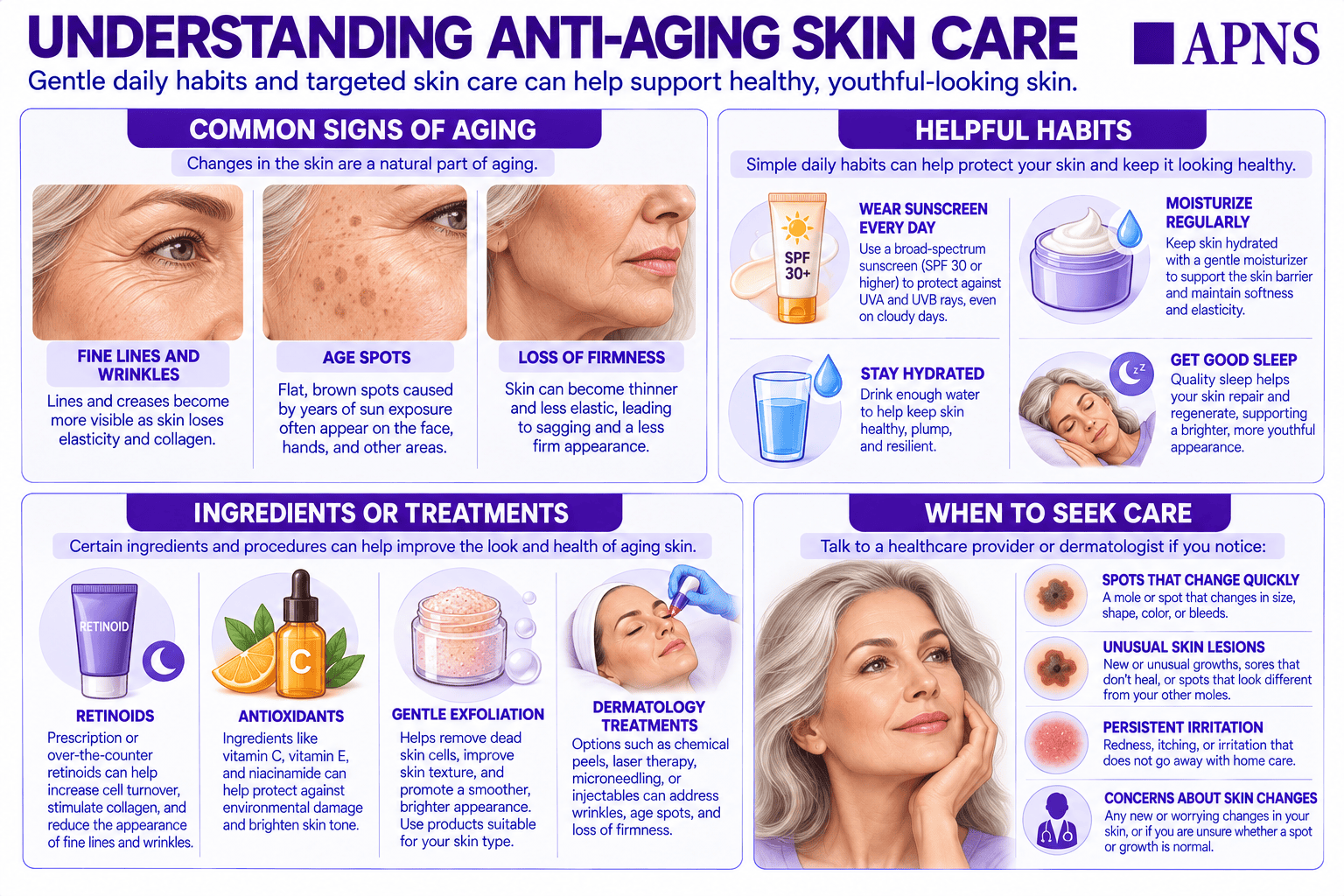
Natural aging is driven by genetics, hormones, and slower production of collagen, elastin, and skin oils. Premature aging is strongly influenced by repeated ultraviolet exposure from sunlight and tanning devices.
Other contributing factors include:
Sunlight and Cancer Risk – National Cancer Institute
https://www.cancer.gov/about-cancer/causes-prevention/risk/sunlight
Explains how ultraviolet exposure contributes to premature aging and skin cancer and how to reduce exposure.
Using too many active ingredients at once can damage the skin barrier and cause redness, burning, peeling, or dark marks after inflammation.
Common worsening factors include:
Natural aging cannot be prevented, but premature damage can be reduced.
Anti-Aging Skin Care – American Academy of Dermatology
https://www.aad.org/public/everyday-care/skin-care-secrets/anti-aging
Provides dermatologist-reviewed guidance for preventing premature skin aging and choosing a routine.
Warning About Skin-Lightening Products – U.S. Food and Drug Administration
Warns about illegal or unsafe skin-lightening products containing mercury or unapproved hydroquinone.
The following video content is provided to help you better understand this condition. These resources are intended for educational purposes and should not replace personalized medical advice from your healthcare provider.
Routine anti-aging skin care does not require blood tests. Laboratory testing is considered only when symptoms suggest an underlying condition.
Possible tests may include:
Direct-to-consumer “anti-aging panels” are not needed for most people and may lead to unnecessary treatment.
Most cosmetic skin concerns are diagnosed by examination. A dermatologist may use a dermatoscope, a magnifying light, to closely inspect a mole or other spot.
A skin biopsy may be performed when a growth, rash, or changing lesion needs microscopic testing. Standardized photographs may document changes over time, but commercial skin scanners do not replace a medical examination.
A simple routine is usually the best starting point. Introduce one new product at a time and allow several weeks to judge tolerance and benefit.
Options may include:
Healthier-Looking Skin – American Academy of Dermatology
https://www.aad.org/public/everyday-care/skin-care-secrets/routine/healthier-looking-skin
Explains daily habits that support healthy-looking skin, including sunscreen and gentle care.
Daily habits have a larger long-term effect than constantly changing products.
Sunlight and Cancer Risk – National Cancer Institute
https://www.cancer.gov/about-cancer/causes-prevention/risk/sunlight
Explains how ultraviolet exposure contributes to premature aging and skin cancer and how to reduce exposure.
Products can improve specific concerns, but stronger is not always better. Patch-test when possible and stop a product that causes severe burning, swelling, blistering, or a spreading rash.
Retinoid or Retinol? – American Academy of Dermatology
https://www.aad.org/public/everyday-care/skin-care-secrets/anti-aging/retinoid-retinol
Explains the benefits, irritation risks, and gradual introduction of retinoid products.
Alpha Hydroxy Acids in Cosmetics – U.S. Food and Drug Administration
https://www.fda.gov/cosmetics/cosmetic-ingredients/alpha-hydroxy-acids
Reviews potential irritation and increased sun sensitivity from alpha hydroxy acid products.
Cosmetic procedures can improve selected concerns but cannot stop aging. Results, cost, downtime, and risk vary by procedure, device, skin tone, operator training, and aftercare.
Choose a properly licensed, experienced clinician. Avoid home injections, nonmedical settings, and products purchased for self-injection.
Skin continues to age even with excellent care. Sunscreen and moisturizers require ongoing use, and results from topical products usually develop gradually over weeks to months.
Many procedures are temporary or require a series of treatments. A realistic plan focuses on healthier skin and specific concerns rather than promising poreless, wrinkle-free, or permanently “young” skin.
Maximizing Results from Anti-Aging Products – American Academy of Dermatology
https://www.aad.org/public/everyday-care/skin-care-secrets/anti-aging/maximize-anti-aging-products
Provides tips for using products safely, consistently, and with realistic expectations.
A basic routine can be effective and affordable.
If skin becomes irritated, pause active ingredients, use a gentle cleanser and plain moisturizer, and restart slowly after recovery.
Healthier-Looking Skin – American Academy of Dermatology
https://www.aad.org/public/everyday-care/skin-care-secrets/routine/healthier-looking-skin
Explains daily habits that support healthy-looking skin, including sunscreen and gentle care.
Daily broad-spectrum SPF 30 or higher sunscreen, combined with shade and protective clothing, provides the strongest foundation for preventing premature sun-related aging.
Not necessarily. Price, luxury packaging, and the word “medical-grade” do not guarantee better results.
There is no required age. Consider it when you have a concern it can treat and can use it consistently without significant irritation.
Some people can, but starting both at once may irritate skin. Introduce one product at a time and separate them if needed.
Evidence for visible benefit is limited and products vary. Supplements do not replace sun protection, nutrition, or medical treatment.
Most cosmetics and ingredients do not require FDA approval before sale, except color additives. Marketing claims do not prove effectiveness.
FDA Authority Over Cosmetics
Explains that most cosmetics and ingredients do not receive FDA approval before marketing.

Consider asking:
You may be referred to:
Skin aging is a normal biological process and is not curable. No cream, supplement, injection, or device can permanently stop aging or restore skin to an earlier age.
Healthy habits can prevent some premature damage, and evidence-based products or procedures can improve dryness, fine lines, discoloration, texture, and volume. Results vary and should be balanced with cost, side effects, and personal goals.
Most skin-care irritation is not an emergency. Stop the suspected product and contact a clinician for severe pain, blistering, spreading redness, pus, fever, or a burn that is worsening.
Call 911 or seek emergency care immediately for:
After a cosmetic procedure, follow the clinician’s emergency instructions. Sudden severe pain, pale or dusky skin, or vision symptoms after filler injection requires immediate treatment.
CALL 911
APNS does not provide emergency medical services. If you believe you are experiencing a medical emergency, including (but not limited to) chest pain, difficulty breathing, stroke symptoms, severe allergic reactions, anaphylaxis, uncontrolled bleeding, seizures, loss of consciousness, or any other potentially life-threatening condition, you are instructed to call 911 immediately or go immediately to the nearest emergency department.
Natural aging cannot be prevented, but premature damage can be reduced.
Learn More
Anti-Aging Skin Care – American Academy of Dermatology
https://www.aad.org/public/everyday-care/skin-care-secrets/anti-aging
Provides dermatologist-reviewed guidance for preventing premature skin aging and choosing a routine.
Warning About Skin-Lightening Products – U.S. Food and Drug Administration
Warns about illegal or unsafe skin-lightening products containing mercury or unapproved hydroquinone.
This guide is intended for educational purposes only and should not replace medical advice, diagnosis, or treatment from your healthcare provider or dermatologist. Skin changes may reflect normal aging, irritation, allergy, infection, medication effects, inflammatory disease, precancerous change, or skin cancer. Product safety and effectiveness vary, and most cosmetics are not FDA-approved before sale. Ask a qualified clinician before using prescription products, combining strong active ingredients, or undergoing a procedure. Seek emergency care for breathing difficulty, facial or throat swelling, widespread blistering or peeling, severe infection symptoms, or sudden pain, skin-color change, neurologic symptoms, or vision changes after a cosmetic injection.
At APNS, our providers take the time to understand your condition and your goals. We offer comprehensive telehealth visits at a fixed rate — no membership fees, no insurance required, and no unexpected charges. Whether you’re newly diagnosed or looking for a provider who actually listens, we’re here to help.