

Syphilis is a sexually transmitted infection (STI) caused by the bacterium Treponema pallidum. It usually spreads through direct contact with a syphilis sore during vaginal, anal, or oral sex. It can also pass from a pregnant person to a fetus and cause serious illness or death in the baby.
Syphilis develops in stages and is sometimes called the “great imitator” because its symptoms can look like many other conditions. A person may have no symptoms for years while the infection remains in the body. Antibiotics can cure syphilis, but treatment may not reverse damage that has already occurred.
About Syphilis – CDC
https://www.cdc.gov/syphilis/about/index.html
Explains symptoms, spread, testing, treatment, pregnancy risks, and prevention in patient-friendly language.
Syphilis – NIH MedlinePlus
https://medlineplus.gov/syphilis.html
Offers reliable patient education about symptoms, testing, treatment, and prevention.
Syphilis remains an important public-health problem in the United States. Anyone who has sexual contact can acquire it, and many people do not know they are infected because sores may be painless or hidden.
Rates are higher in some groups, including men who have sex with men and people living with HIV. Congenital syphilis has also increased, making early and repeated pregnancy testing especially important for people at risk.
About Syphilis – CDC
https://www.cdc.gov/syphilis/about/index.html
Explains symptoms, spread, testing, treatment, pregnancy risks, and prevention in patient-friendly language.
Symptoms vary by stage and may disappear without treatment even though the infection remains:
A sore or rash may heal on its own, but that does not mean the infection is gone. Testing is the only reliable way to know.
About Syphilis – CDC
https://www.cdc.gov/syphilis/about/index.html
Explains symptoms, spread, testing, treatment, pregnancy risks, and prevention in patient-friendly language.
Neurosyphilis, Ocular Syphilis, and Otosyphilis – CDC
https://www.cdc.gov/std/treatment-guidelines/neurosyphilis.htm
Describes urgent evaluation and treatment when syphilis affects the brain, eyes, or hearing.
A healthcare provider asks about symptoms, sexual exposures, prior tests or treatment, pregnancy, medicines, and neurologic, eye, or hearing changes. They may examine the mouth, skin, genitals, anus, lymph nodes, nervous system, eyes, and ears.
Diagnosis usually requires a blood screening test plus a different confirmatory test. The result is interpreted with symptoms, examination, past treatment, and possible exposure because no single blood test can answer every question.
Syphilis – CDC STI Treatment Guidelines
https://www.cdc.gov/std/treatment-guidelines/syphilis.htm
Provides clinical guidance about diagnosis, staging, treatment, follow-up, HIV testing, and partner care.
Syphilis Tests – NIH MedlinePlus
https://medlineplus.gov/lab-tests/syphilis-tests/
Explains blood testing, sore testing, preparation, and what results may mean.
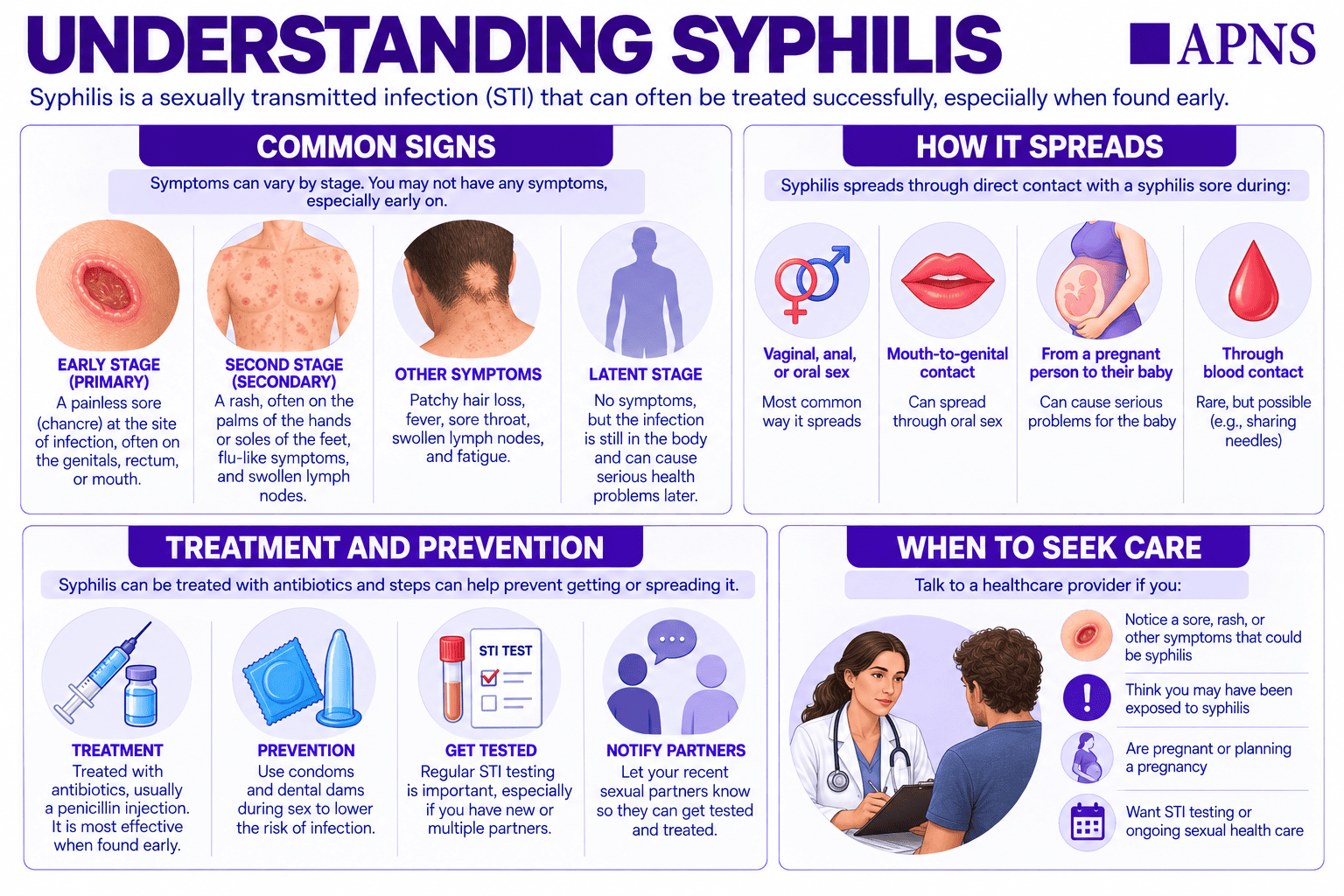
Syphilis is caused by bacteria passed through direct contact with an infectious sore or rash. Common routes include:
Syphilis is not spread by toilet seats, door handles, swimming pools, bathtubs, shared clothing, or casual contact. Sores may be inside the vagina, rectum, mouth, or under the foreskin and may not be noticed.
About Syphilis – CDC
https://www.cdc.gov/syphilis/about/index.html
Explains symptoms, spread, testing, treatment, pregnancy risks, and prevention in patient-friendly language.
Untreated infection can remain in the body and eventually damage major organs. These factors increase the chance of complications or reinfection:
Alcohol or recreational drug use may increase sexual risk or make follow-up harder, but neither causes syphilis. Symptoms disappearing without antibiotics does not mean the infection has cleared.
There is no vaccine for syphilis. Risk can be lowered by:
Condoms do not cover every possible sore. Testing and prompt treatment are central to preventing transmission and congenital syphilis.
About Syphilis – CDC
https://www.cdc.gov/syphilis/about/index.html
Explains symptoms, spread, testing, treatment, pregnancy risks, and prevention in patient-friendly language.
Condom Use – CDC
https://www.cdc.gov/condom-use/
Shows how to use condoms correctly and explains how they reduce STI risk.
Getting Tested for HIV – CDC
https://www.cdc.gov/hiv/testing/index.html
Explains HIV testing options, timing, and where to get tested.
The following video content is provided to help you better understand this condition. These resources are intended for educational purposes and should not replace personalized medical advice from your healthcare provider.
Syphilis testing may include:
Very early infection can produce a negative blood test. Repeat testing may be needed after a recent exposure. Follow-up usually uses the same type of nontreponemal test so titers can be compared accurately.
Syphilis Tests – NIH MedlinePlus
https://medlineplus.gov/lab-tests/syphilis-tests/
Explains blood testing, sore testing, preparation, and what results may mean.
Getting Tested for HIV – CDC
https://www.cdc.gov/hiv/testing/index.html
Explains HIV testing options, timing, and where to get tested.
Most people do not need imaging. Additional evaluation depends on symptoms:
Routine spinal-fluid testing is not needed simply because a blood test is positive. Examination findings and symptoms guide the decision.
Neurosyphilis, Ocular Syphilis, and Otosyphilis – CDC
https://www.cdc.gov/std/treatment-guidelines/neurosyphilis.htm
Describes urgent evaluation and treatment when syphilis affects the brain, eyes, or hearing.
Syphilis During Pregnancy – CDC STI Treatment Guidelines
https://www.cdc.gov/std/treatment-guidelines/syphilis-pregnancy.htm
Provides guidance about testing, penicillin treatment, fetal evaluation, and follow-up during pregnancy.
Penicillin G is the preferred treatment for every stage. The specific form, dose, route, and number of doses depend on the stage, duration, symptoms, pregnancy status, and whether the brain, eyes, or ears may be involved.
Treatment regimens must be prescribed by a clinician. Do not use leftover antibiotics or substitute oral penicillin products, which do not provide reliable treatment for syphilis.
Syphilis – CDC STI Treatment Guidelines
https://www.cdc.gov/std/treatment-guidelines/syphilis.htm
Provides clinical guidance about diagnosis, staging, treatment, follow-up, HIV testing, and partner care.
Primary and Secondary Syphilis – CDC STI Treatment Guidelines
https://www.cdc.gov/std/treatment-guidelines/p-and-s-syphilis.htm
Explains recommended treatment and follow-up for early symptomatic syphilis.
Latent Syphilis – CDC STI Treatment Guidelines
https://www.cdc.gov/std/treatment-guidelines/latent-syphilis.htm
Explains treatment and monitoring when syphilis is present without symptoms.
Treatment works best when paired with steps that prevent reinfection:
Condoms lower risk but may not cover a sore outside the protected area. Regular testing remains important when exposure risk continues.
Condom Use – CDC
https://www.cdc.gov/condom-use/
Shows how to use condoms correctly and explains how they reduce STI risk.
Getting Tested for HIV – CDC
https://www.cdc.gov/hiv/testing/index.html
Explains HIV testing options, timing, and where to get tested.
Common treatment medicines include:
Within 24 hours after treatment, some people develop a Jarisch-Herxheimer reaction: fever, chills, headache, muscle aches, or worsening rash. This is a response to dying bacteria, not usually a penicillin allergy. Contact your clinician for guidance; pregnancy symptoms such as contractions or reduced fetal movement need urgent obstetric care.
Penicillin Allergy – CDC STI Treatment Guidelines
https://www.cdc.gov/std/treatment-guidelines/penicillin-allergy.htm
Explains allergy evaluation and why penicillin is essential for syphilis during pregnancy and certain serious forms.
Syphilis During Pregnancy – CDC STI Treatment Guidelines
https://www.cdc.gov/std/treatment-guidelines/syphilis-pregnancy.htm
Provides guidance about testing, penicillin treatment, fetal evaluation, and follow-up during pregnancy.
Most syphilis care involves examination, blood testing, and antibiotic treatment rather than surgery. Procedures may include:
Ask why a procedure is needed, what discomfort or risks to expect, and how the result will change treatment.
Neurosyphilis, Ocular Syphilis, and Otosyphilis – CDC
https://www.cdc.gov/std/treatment-guidelines/neurosyphilis.htm
Describes urgent evaluation and treatment when syphilis affects the brain, eyes, or hearing.
Penicillin Allergy – CDC STI Treatment Guidelines
https://www.cdc.gov/std/treatment-guidelines/penicillin-allergy.htm
Explains allergy evaluation and why penicillin is essential for syphilis during pregnancy and certain serious forms.
Correct antibiotics cure the infection and prevent future damage, but they may not repair injury already caused to the brain, eyes, hearing, heart, or other organs. Blood titers usually fall after successful treatment, but a treponemal test often remains positive for life.
Follow-up blood tests are essential. Timing depends on the stage, pregnancy, HIV status, and clinical situation. A rising titer, new symptoms, or a new exposure may mean reinfection or treatment failure and requires reevaluation.
Syphilis – CDC STI Treatment Guidelines
https://www.cdc.gov/std/treatment-guidelines/syphilis.htm
Provides clinical guidance about diagnosis, staging, treatment, follow-up, HIV testing, and partner care.
Primary and Secondary Syphilis – CDC STI Treatment Guidelines
https://www.cdc.gov/std/treatment-guidelines/p-and-s-syphilis.htm
Explains recommended treatment and follow-up for early symptomatic syphilis.
Latent Syphilis – CDC STI Treatment Guidelines
https://www.cdc.gov/std/treatment-guidelines/latent-syphilis.htm
Explains treatment and monitoring when syphilis is present without symptoms.
After diagnosis and treatment:
Do not attempt to treat syphilis with herbs, supplements, topical products, or leftover antibiotics. Only the correct antibiotic regimen can cure it.
Symptoms can disappear, but the bacteria remain in the body. Only appropriate antibiotics cure the infection.
No. It is not spread through toilet seats, pools, bathtubs, clothing, or casual contact.
Not always. Providers interpret two types of blood tests with your history, symptoms, and prior treatment.
Treponemal tests often remain positive for life. RPR or VDRL titers are used to follow treatment response and may become negative or remain low-positive.
Sexual spread is most common during early stages when sores or rashes may be unnoticed. Pregnancy transmission can occur during latent infection.
No. Treatment cures the current infection but does not create immunity. Reinfection is possible.
Yes. It can cause miscarriage, stillbirth, premature birth, newborn death, or congenital syphilis. Prompt penicillin treatment is essential.
The short-term Jarisch-Herxheimer reaction is caused by the body’s response to treatment and is usually not a penicillin allergy, though severe allergic symptoms still require emergency care.

Consider asking:
Many cases can be managed in primary care or an STI clinic. Referral may be made to:
Neurosyphilis, Ocular Syphilis, and Otosyphilis – CDC
https://www.cdc.gov/std/treatment-guidelines/neurosyphilis.htm
Describes urgent evaluation and treatment when syphilis affects the brain, eyes, or hearing.
Syphilis During Pregnancy – CDC STI Treatment Guidelines
https://www.cdc.gov/std/treatment-guidelines/syphilis-pregnancy.htm
Provides guidance about testing, penicillin treatment, fetal evaluation, and follow-up during pregnancy.
Yes. Syphilis is curable with the correct antibiotics. Treatment stops the infection and prevents additional injury, but it may not reverse damage that already occurred before treatment.
A person can get syphilis again after being cured. Partners must be evaluated, and ongoing prevention and repeat testing may be needed.
About Syphilis – CDC
https://www.cdc.gov/syphilis/about/index.html
Explains symptoms, spread, testing, treatment, pregnancy risks, and prevention in patient-friendly language.
Seek urgent or emergency care for:
Brain, eye, ear, heart, and pregnancy complications can cause permanent injury or death. Do not wait for a routine appointment when these symptoms occur.
Neurosyphilis, Ocular Syphilis, and Otosyphilis – CDC
https://www.cdc.gov/std/treatment-guidelines/neurosyphilis.htm
Describes urgent evaluation and treatment when syphilis affects the brain, eyes, or hearing.
Syphilis During Pregnancy – CDC STI Treatment Guidelines
https://www.cdc.gov/std/treatment-guidelines/syphilis-pregnancy.htm
Provides guidance about testing, penicillin treatment, fetal evaluation, and follow-up during pregnancy.
CALL 911
APNS does not provide emergency medical services. If you believe you are experiencing a medical emergency, including (but not limited to) chest pain, difficulty breathing, stroke symptoms, severe allergic reactions, anaphylaxis, uncontrolled bleeding, seizures, loss of consciousness, or any other potentially life-threatening condition, you are instructed to call 911 immediately or go immediately to the nearest emergency department.
About Syphilis – CDC
https://www.cdc.gov/syphilis/about/index.html
Explains symptoms, spread, testing, treatment, pregnancy risks, and prevention in patient-friendly language.
Syphilis – CDC STI Treatment Guidelines
https://www.cdc.gov/std/treatment-guidelines/syphilis.htm
Provides clinical guidance about diagnosis, staging, treatment, follow-up, HIV testing, and partner care.
Primary and Secondary Syphilis – CDC STI Treatment Guidelines
https://www.cdc.gov/std/treatment-guidelines/p-and-s-syphilis.htm
Explains recommended treatment and follow-up for early symptomatic syphilis.
Latent Syphilis – CDC STI Treatment Guidelines
https://www.cdc.gov/std/treatment-guidelines/latent-syphilis.htm
Explains treatment and monitoring when syphilis is present without symptoms.
Neurosyphilis, Ocular Syphilis, and Otosyphilis – CDC
https://www.cdc.gov/std/treatment-guidelines/neurosyphilis.htm
Describes urgent evaluation and treatment when syphilis affects the brain, eyes, or hearing.
Syphilis During Pregnancy – CDC STI Treatment Guidelines
https://www.cdc.gov/std/treatment-guidelines/syphilis-pregnancy.htm
Provides guidance about testing, penicillin treatment, fetal evaluation, and follow-up during pregnancy.
Penicillin Allergy – CDC STI Treatment Guidelines
https://www.cdc.gov/std/treatment-guidelines/penicillin-allergy.htm
Explains allergy evaluation and why penicillin is essential for syphilis during pregnancy and certain serious forms.
Syphilis Tests – NIH MedlinePlus
https://medlineplus.gov/lab-tests/syphilis-tests/
Explains blood testing, sore testing, preparation, and what results may mean.
Syphilis – NIH MedlinePlus
https://medlineplus.gov/syphilis.html
Offers reliable patient education about symptoms, testing, treatment, and prevention.
Getting Tested for HIV – CDC
https://www.cdc.gov/hiv/testing/index.html
Explains HIV testing options, timing, and where to get tested.
Condom Use – CDC
https://www.cdc.gov/condom-use/
Shows how to use condoms correctly and explains how they reduce STI risk.
This guide is for education only and does not replace medical advice, examination, testing, diagnosis, or treatment from a healthcare professional. Syphilis symptoms may be absent or resemble other conditions, so testing and clinician-directed treatment are essential. Seek urgent care for vision or hearing changes, severe headache, confusion, weakness, seizure, serious allergic symptoms, pregnancy warning signs after treatment, or possible newborn exposure.
At APNS, our providers take the time to understand your condition and your goals. We offer comprehensive telehealth visits at a fixed rate — no membership fees, no insurance required, and no unexpected charges. Whether you’re newly diagnosed or looking for a provider who actually listens, we’re here to help.