

Urinary retention means the bladder cannot empty all of its urine. Acute urinary retention happens suddenly and may cause a complete inability to urinate, severe lower-abdominal pain, and bladder swelling. It is a medical emergency because pressure can injure the bladder and kidneys.
Chronic urinary retention develops gradually and may cause mild symptoms—or no obvious symptoms—even when a large amount of urine remains in the bladder. It may result from a blockage, weak bladder muscle, nerve-signal problems, medicines, surgery, or several factors together. Treatment focuses on safely emptying the bladder and correcting the cause when possible.
Urinary Retention – National Institute of Diabetes and Digestive and Kidney Diseases (NIDDK)
https://www.niddk.nih.gov/health-information/urologic-diseases/urinary-retention
Provides an overview of acute and chronic urinary retention, diagnosis, treatment, and prevention.
Definition and Facts of Urinary Retention – NIDDK
https://www.niddk.nih.gov/health-information/urologic-diseases/urinary-retention/definition-facts
Explains the difference between acute and chronic urinary retention and possible complications.
Urinary retention can affect adults of any sex, but risk rises with age and is especially common in people with an enlarged prostate. It can also occur after surgery, childbirth, pelvic injury, severe constipation, infection, or with neurologic and metabolic conditions.
Chronic retention is difficult to count because some people have few symptoms. Anyone with a persistently weak stream, incomplete emptying, repeated infections, or overflow leakage should be evaluated.
Urinary Retention and How to Care for It – Urology Care Foundation
Offers patient-friendly information about urinary retention, catheter use, and follow-up care.
Symptoms depend on whether retention is acute or chronic.
Acute retention may cause:
Chronic retention may cause:
Symptoms and Causes of Urinary Retention – NIDDK
https://www.niddk.nih.gov/health-information/urologic-diseases/urinary-retention/symptoms-causes
Reviews warning signs, urinary blockage, weak bladder contraction, nerve disorders, medicines, and surgical causes.
A provider will ask about urinary symptoms, bowel habits, operations, childbirth, nerve conditions, prostate or pelvic problems, catheter history, and all prescription and over-the-counter medicines. The examination may include the abdomen, genital and pelvic areas, prostate when appropriate, pelvic-floor muscles, and nerve function.
The key test is a post-void residual measurement, which determines how much urine remains after you urinate. In acute retention, treatment to drain the bladder should not be delayed for a lengthy evaluation.
Diagnosis of Urinary Retention – NIDDK
https://www.niddk.nih.gov/health-information/urologic-diseases/urinary-retention/diagnosis
Describes post-void residual measurement, laboratory testing, imaging, urodynamics, and cystoscopy.
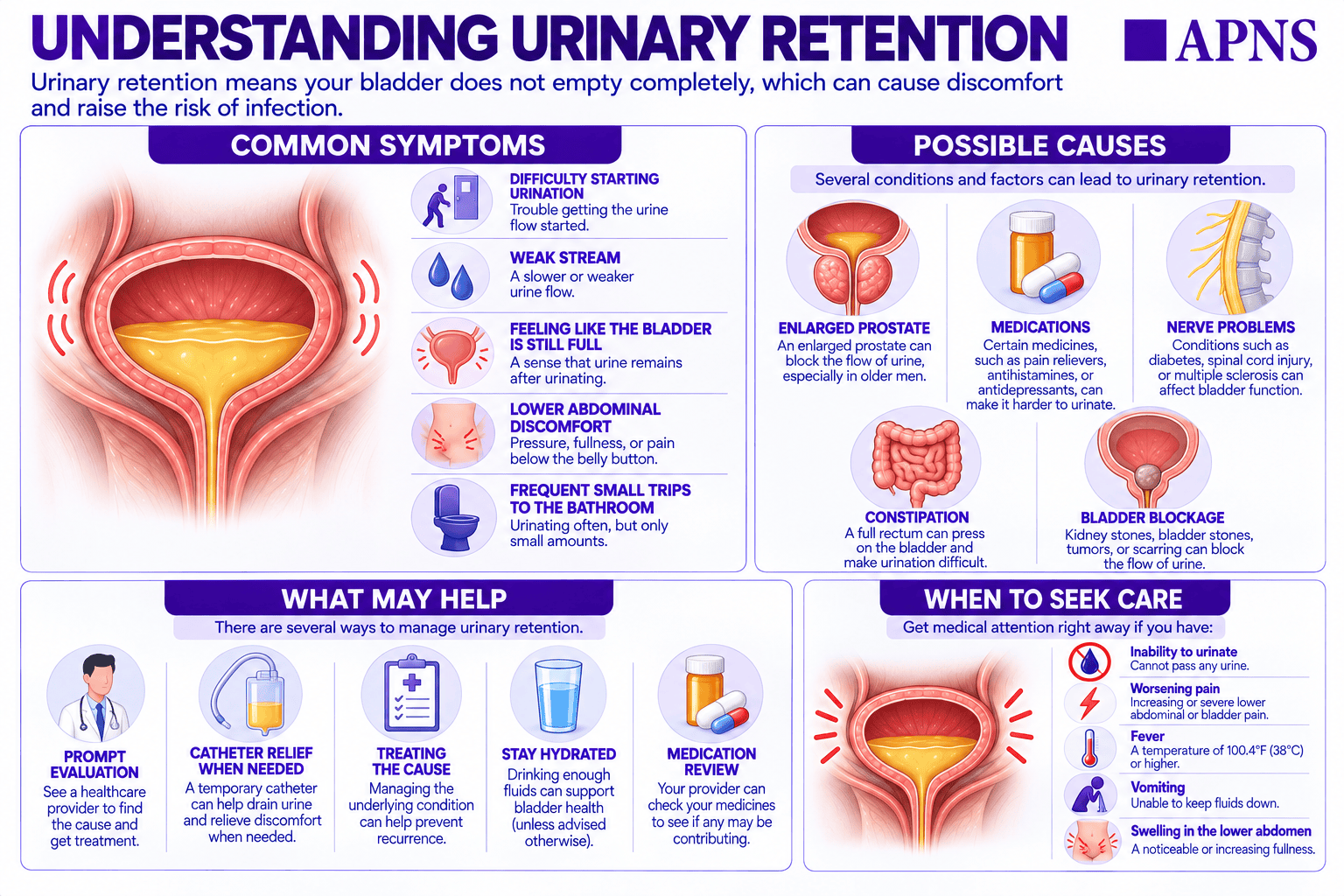
Retention occurs when urine flow is blocked or the bladder cannot squeeze strongly or long enough to empty.
Possible causes include:
Symptoms and Causes of Urinary Retention – NIDDK
https://www.niddk.nih.gov/health-information/urologic-diseases/urinary-retention/symptoms-causes
Reviews warning signs, urinary blockage, weak bladder contraction, nerve disorders, medicines, and surgical causes.
Retention may worsen when swelling or blockage increases, the bladder becomes overfilled, constipation is untreated, or a medicine interferes with bladder contraction.
Worsening factors may include:
Not every case can be prevented. Recognizing early symptoms and managing contributing conditions can reduce risk and complications.
Prevention of Urinary Retention – NIDDK
https://www.niddk.nih.gov/health-information/urologic-diseases/urinary-retention/prevention
Provides practical steps that may reduce urinary-retention risk and protect bladder health.
The following video content is provided to help you better understand this condition. These resources are intended for educational purposes and should not replace personalized medical advice from your healthcare provider.
Laboratory testing helps identify infection, kidney stress, diabetes, and other contributing conditions.
Urinalysis – NIH MedlinePlus
https://medlineplus.gov/lab-tests/urinalysis/
Explains urine testing for infection, blood, glucose, and other urinary abnormalities.
Testing is tailored to the likely cause and whether retention is acute, chronic, recurrent, or complicated.
Diagnosis of Urinary Retention – NIDDK
https://www.niddk.nih.gov/health-information/urologic-diseases/urinary-retention/diagnosis
Describes post-void residual measurement, laboratory testing, imaging, urodynamics, and cystoscopy.
Acute urinary retention is treated by promptly draining the bladder with a catheter. Chronic retention treatment depends on symptoms, the amount left in the bladder, infection history, kidney effects, and the underlying cause.
Treatment options may include:
Treatment of Urinary Retention – NIDDK
https://www.niddk.nih.gov/health-information/urologic-diseases/urinary-retention/treatment
Explains bladder drainage, medicines, procedures, surgery, and self-care treatments.
Lifestyle changes cannot safely treat acute retention, but they may support long-term bladder health and reduce contributing problems.
Medication choice depends on the cause. Medicines do not replace urgent catheter drainage when the bladder cannot empty.
Some bladder medicines used for urgency can worsen emptying in susceptible people. Tell every prescriber if you have urinary retention or use a catheter.
Treatment of Urinary Retention – NIDDK
https://www.niddk.nih.gov/health-information/urologic-diseases/urinary-retention/treatment
Explains bladder drainage, medicines, procedures, surgery, and self-care treatments.
Procedures are selected according to the blockage, bladder function, overall health, and treatment goals.
Urinary Catheters – NIH MedlinePlus
https://medlineplus.gov/ency/article/003981.htm
Explains catheter types, drainage, and basic catheter-care considerations.
Some retention resolves after anesthesia wears off, infection or constipation is treated, or a contributing medicine is changed. Retention caused by long-term blockage, bladder-muscle damage, or nerve disease may require ongoing care.
Follow-up may include residual measurements, kidney tests, infection monitoring, and catheter review. Early treatment can reduce the risk of repeated infections, bladder damage, kidney swelling, and kidney disease.
Follow your individualized voiding and catheter plan. Seek urgent care rather than trying home remedies if you suddenly cannot urinate.
Do not repeatedly strain, press hard on the abdomen, insert an unprescribed device, or force excessive fluids to make yourself urinate.
Urinary Retention and How to Care for It – Urology Care Foundation
Offers patient-friendly information about urinary retention, catheter use, and follow-up care.
A sudden inability to urinate—especially with pain or lower-abdominal swelling—is an emergency. Chronic incomplete emptying also needs evaluation but may not require emergency treatment unless symptoms worsen.
Yes. You may pass some urine while a significant amount remains in the bladder.
Yes. An overfilled bladder may cause overflow dribbling or leakage without a strong urge.
No. Forcing fluids may dangerously overfill the bladder when urine cannot leave normally.
A catheter drains and protects the bladder but does not necessarily correct the underlying cause.
Some antihistamines and decongestants can worsen retention, especially with prostate enlargement or weak bladder emptying. Ask a pharmacist or provider before use.

Consider asking:
You may be referred to:
Neurogenic Bladder – Urology Care Foundation
https://www.urologyhealth.org/urology-a-z/n/neurogenic-bladder
Explains how brain, spinal cord, and nerve conditions may affect bladder storage and emptying.
Urinary retention may be curable when a temporary or reversible cause—such as postoperative swelling, infection, constipation, a medication effect, a stone, or a treatable blockage—is corrected. Recovery depends on how long the bladder was overfilled and whether the nerves and bladder muscle remain healthy.
Chronic retention from lasting nerve or muscle damage may not be fully curable, but regular bladder emptying and appropriate treatment can protect the kidneys and improve comfort and daily life.
Go to an emergency department or seek immediate medical care if you suddenly cannot urinate, especially with a painful or swollen lower abdomen. Acute retention can be life-threatening and usually requires prompt catheter drainage.
Seek urgent care for:
Symptoms and Causes of Urinary Retention – NIDDK
https://www.niddk.nih.gov/health-information/urologic-diseases/urinary-retention/symptoms-causes
Reviews warning signs, urinary blockage, weak bladder contraction, nerve disorders, medicines, and surgical causes.
CALL 911
APNS does not provide emergency medical services. If you believe you are experiencing a medical emergency, including (but not limited to) chest pain, difficulty breathing, stroke symptoms, severe allergic reactions, anaphylaxis, uncontrolled bleeding, seizures, loss of consciousness, or any other potentially life-threatening condition, you are instructed to call 911 immediately or go immediately to the nearest emergency department.
Urinary Retention – National Institute of Diabetes and Digestive and Kidney Diseases (NIDDK)
https://www.niddk.nih.gov/health-information/urologic-diseases/urinary-retention
Provides an overview of acute and chronic urinary retention, diagnosis, treatment, and prevention.
Definition and Facts of Urinary Retention – NIDDK
https://www.niddk.nih.gov/health-information/urologic-diseases/urinary-retention/definition-facts
Explains the difference between acute and chronic urinary retention and possible complications.
Symptoms and Causes of Urinary Retention – NIDDK
https://www.niddk.nih.gov/health-information/urologic-diseases/urinary-retention/symptoms-causes
Reviews warning signs, urinary blockage, weak bladder contraction, nerve disorders, medicines, and surgical causes.
Diagnosis of Urinary Retention – NIDDK
https://www.niddk.nih.gov/health-information/urologic-diseases/urinary-retention/diagnosis
Describes post-void residual measurement, laboratory testing, imaging, urodynamics, and cystoscopy.
Treatment of Urinary Retention – NIDDK
https://www.niddk.nih.gov/health-information/urologic-diseases/urinary-retention/treatment
Explains bladder drainage, medicines, procedures, surgery, and self-care treatments.
Prevention of Urinary Retention – NIDDK
https://www.niddk.nih.gov/health-information/urologic-diseases/urinary-retention/prevention
Provides practical steps that may reduce urinary-retention risk and protect bladder health.
Urinary Retention and How to Care for It – Urology Care Foundation
Offers patient-friendly information about urinary retention, catheter use, and follow-up care.
Neurogenic Bladder – Urology Care Foundation
https://www.urologyhealth.org/urology-a-z/n/neurogenic-bladder
Explains how brain, spinal cord, and nerve conditions may affect bladder storage and emptying.
Urinary Catheters – NIH MedlinePlus
https://medlineplus.gov/ency/article/003981.htm
Explains catheter types, drainage, and basic catheter-care considerations.
Enlarged Prostate (BPH) – NIH MedlinePlus
https://medlineplus.gov/enlargedprostatebph.html
Reviews prostate enlargement, urinary symptoms, diagnosis, and treatment.
This guide is intended for educational purposes only and should not replace medical advice, diagnosis, or treatment from your healthcare provider or urologist. Urinary retention can result from blockage, weak bladder muscle, nerve disorders, medicines, infection, surgery, constipation, or other causes that require different treatment. Do not force fluids, insert an unprescribed device, stop prescribed medicines, or delay care if you cannot urinate. Seek emergency medical care for sudden inability to urinate, severe lower-abdominal pain or swelling, a blocked catheter with increasing pain, fever with flank pain or confusion, heavy bleeding or clots, or new bladder loss with leg weakness, groin numbness, or severe back pain.
At APNS, our providers take the time to understand your condition and your goals. We offer comprehensive telehealth visits at a fixed rate — no membership fees, no insurance required, and no unexpected charges. Whether you’re newly diagnosed or looking for a provider who actually listens, we’re here to help.