

Vaccinations, also called immunizations, are one of the safest and most effective ways to protect you from serious infectious diseases. Vaccines work by helping your immune system recognize and fight viruses or bacteria before they can cause severe illness.
When you receive a vaccine, your immune system learns how to recognize a specific germ without you having to become seriously ill. If you are exposed to that germ in the future, your body can respond more quickly to help prevent infection or reduce the severity of illness.
Vaccinations protect not only you but also your family, friends, and community by reducing the spread of infectious diseases. Keeping your vaccinations up to date is an important part of preventive healthcare throughout your life.
Vaccines – NIH MedlinePlus
https://medlineplus.gov/vaccines.html
Provides easy-to-understand information about vaccines, how they work, safety, and common questions.
Vaccines & Immunizations – Centers for Disease Control and Prevention (CDC)
https://www.cdc.gov/vaccines/
Provides comprehensive information about recommended vaccines for children, adolescents, and adults.
Vaccinations are routinely recommended throughout childhood and adulthood. Millions of vaccine doses are safely administered each year in the United States and around the world.
Vaccines have dramatically reduced or eliminated many serious diseases, including:
Recommended Adult Immunization Schedule – CDC
https://www.cdc.gov/vaccines/hcp/imz-schedules/adult-age.html
Provides the current recommended vaccine schedule for adults.
Vaccinations help prevent serious illnesses that can lead to hospitalization, disability, or death. Some vaccines also reduce the risk of certain cancers, such as cervical cancer caused by human papillomavirus (HPV).
Benefits of vaccination include:
Your healthcare provider reviews your:
Based on these factors, they recommend vaccines that are appropriate for you.
Adult Immunization Schedule – CDC
https://www.cdc.gov/vaccines/hcp/imz-schedules/adult-age.html
Explains which vaccines are recommended for adults based on age and health conditions.
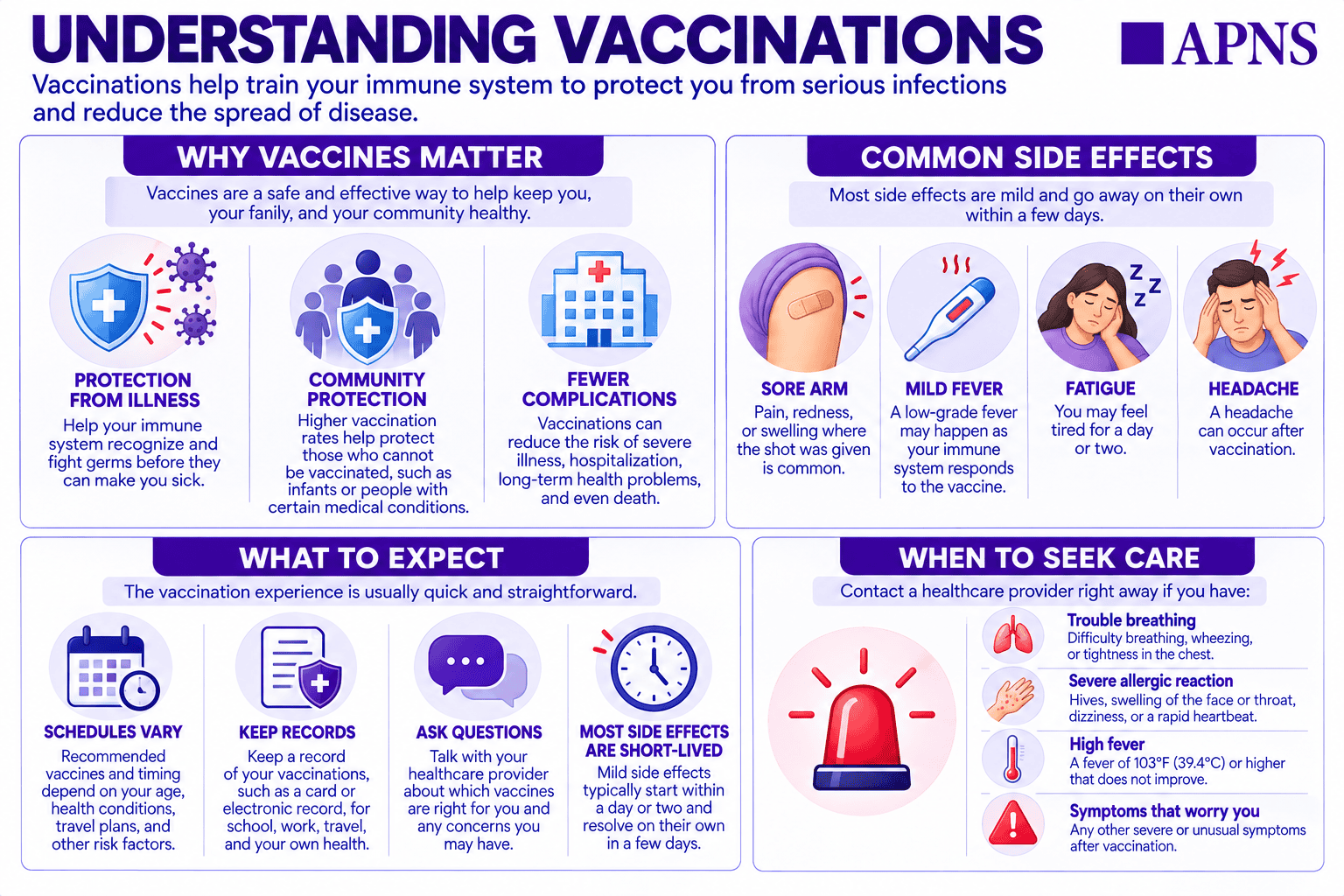
Vaccination recommendations depend on your:
Most people benefit from staying up to date with routine vaccinations throughout their lives.
Adult Vaccine Assessment Tool – CDC
https://www.cdc.gov/vaccines/schedules/
Helps determine which vaccines may be recommended based on your age and health conditions.
Several factors increase the risk of developing serious infections.
Risk factors include:
Vaccines & Immunizations – CDC
https://www.cdc.gov/vaccines/
Provides information about vaccine recommendations for different health conditions and risk groups.
Vaccination is one of the most effective ways to prevent serious infectious diseases.
Helpful prevention tips include:
Adult Immunization Schedule – CDC
https://www.cdc.gov/vaccines/hcp/imz-schedules/adult-age.html
Provides the most current recommendations for adult vaccinations based on age and health conditions.
The following video content is provided to help you better understand this condition. These resources are intended for educational purposes and should not replace personalized medical advice from your healthcare provider.
Most vaccinations do not require laboratory testing.
However, certain blood tests may occasionally be recommended, including:
Vaccines & Immunizations – CDC
Provides information about vaccine recommendations and immunity testing.
Routine diagnostic testing is not required before most vaccinations.
Additional testing may be recommended if:
Vaccines – NIH MedlinePlus
https://medlineplus.gov/vaccines.html
Provides information about vaccinations and special situations requiring additional evaluation.
Vaccinations are a preventive treatment designed to reduce your risk of serious infectious diseases.
Treatment options include:
CDC Adult Vaccine Schedule
https://www.cdc.gov/vaccines/hcp/imz-schedules/adult-age.html
Provides current vaccine recommendations for adults.
Healthy habits work together with vaccinations to reduce your risk of infectious diseases.
Helpful lifestyle habits include:
Vaccines & Immunizations – CDC
Provides information about preventing infectious diseases and maintaining overall health.
Vaccines are biologic medications that help your immune system develop protection against infectious diseases.
Common vaccines for adults may include:
Your healthcare provider will recommend vaccines based on your age, health conditions, occupation, pregnancy status, and other risk factors.
Recommended Adult Vaccines – CDC
https://www.cdc.gov/vaccines/adults/index.html
Provides detailed information about recommended adult vaccines and booster schedules
Receiving a vaccine is a simple medical procedure that is usually performed in a healthcare provider’s office, pharmacy, clinic, workplace, or public health department. Most vaccines are given as an injection (shot), while some are given by mouth or as a nasal spray.
Common vaccination procedures include:
Vaccines & Immunizations – Centers for Disease Control and Prevention (CDC)
https://www.cdc.gov/vaccines/
Learn about vaccine administration, safety, and what to expect before and after vaccination.
Vaccinations provide protection against many serious infectious diseases. Some vaccines provide lifelong immunity, while others require booster doses to maintain protection.
Your healthcare provider will recommend when future vaccines or boosters are needed based on your age, medical conditions, occupation, travel plans, and vaccination history.
Keeping your immunizations up to date is one of the best ways to protect your long-term health.
Most people experience few or no side effects after vaccination. Mild reactions are common and usually resolve within a few days.
Helpful tips after vaccination include:
Vaccine Safety – CDC
https://www.cdc.gov/vaccine-safety/
Provides information about common vaccine side effects, vaccine safety monitoring, and what to expect after vaccination.
Some vaccines require booster doses because protection decreases over time. Boosters help your immune system maintain strong protection.
Most vaccines cannot cause the disease they are designed to prevent. Some people experience mild side effects that are a normal sign the immune system is responding.
Yes. Many vaccines can safely be given during the same appointment. Your healthcare provider will determine the best schedule for you.
Yes. Adults need routine vaccinations throughout life because immunity can decrease over time, new vaccines become available, and certain medical conditions increase infection risk.
Your healthcare provider may review available immunization records, perform certain blood tests when appropriate, or recommend repeating vaccinations if records cannot be located.

Consider asking your healthcare provider:
Most vaccinations are provided by primary care providers, pharmacies, or public health clinics. Depending on your health needs, your provider may recommend seeing a specialist.
You may be referred to:
Vaccines & Immunizations – CDC
https://www.cdc.gov/vaccines/
Provides information about recommended vaccines, special populations, and preventive care.
Yes. Vaccines used in the United States undergo extensive testing before approval and continue to be carefully monitored for safety after they become available.
Most side effects are mild and temporary, such as:
Serious allergic reactions are very rare, but healthcare providers are trained to recognize and treat them immediately if they occur.
Most vaccine side effects are mild and resolve on their own.
Call 911 or seek emergency medical care immediately if you experience:
Contact your healthcare provider promptly if you develop:
Vaccine Safety – CDC
https://www.cdc.gov/vaccine-safety/
Learn about vaccine safety, possible side effects, and when to seek medical attention.
CALL 911
APNS does not provide emergency medical services. If you believe you are experiencing a medical emergency, including (but not limited to) chest pain, difficulty breathing, stroke symptoms, severe allergic reactions, anaphylaxis, uncontrolled bleeding, seizures, loss of consciousness, or any other potentially life-threatening condition, you are instructed to call 911 immediately or go immediately to the nearest emergency department.
Vaccines – NIH MedlinePlus
https://medlineplus.gov/vaccines.html
Easy-to-understand information about vaccines, vaccine safety, and immunization schedules.
Vaccines & Immunizations – Centers for Disease Control and Prevention (CDC)
https://www.cdc.gov/vaccines/
Comprehensive information about vaccine recommendations, schedules, safety, and vaccine-preventable diseases.
Adult Immunization Schedule – CDC
https://www.cdc.gov/vaccines/hcp/imz-schedules/adult-age.html
Current recommendations for adult vaccines based on age, health conditions, pregnancy, and other risk factors.
Immunize.org
https://www.immunize.org/
Trusted patient education about vaccines, frequently asked questions, and vaccine information statements.
This guide is intended for educational purposes only and should not replace medical advice, diagnosis, or treatment from your healthcare provider. Always discuss your vaccination needs with your healthcare provider, especially if you are pregnant, have a weakened immune system, have a history of severe allergic reactions, or have questions about vaccine safety. Call 911 immediately if you experience difficulty breathing, swelling of the face or throat, loss of consciousness, or symptoms of a severe allergic reaction after receiving a vaccine.
At APNS, our providers take the time to understand your condition and your goals. We offer comprehensive telehealth visits at a fixed rate — no membership fees, no insurance required, and no unexpected charges. Whether you’re newly diagnosed or looking for a provider who actually listens, we’re here to help.