
Vaginal dryness occurs when the vagina and nearby vulvar tissues do not have enough natural moisture. The tissue may become thin, less stretchy, irritated, or fragile. Dryness can cause burning, itching, urinary discomfort, and pain with penetration or sexual activity.
A common cause is lower estrogen during menopause, called genitourinary syndrome of menopause (GSM). Dryness can also occur during breastfeeding, after childbirth, with cancer treatment or certain medicines, or from irritation and other medical conditions. It is common and treatable, but new bleeding, discharge, sores, or severe pain needs evaluation.
Vaginal Dryness – NIH MedlinePlus
https://medlineplus.gov/ency/article/000892.htm
Explains low-estrogen vaginal changes, symptoms, evaluation, and treatment options.
Sex and Menopause: Treatment for Symptoms – National Institute on Aging
https://www.nia.nih.gov/health/menopause/sex-and-menopause-treatment-symptoms
Provides practical guidance about moisturizers, lubricants, vaginal estrogen, pain, and sexual health.
Vaginal dryness is common during and after menopause, but it can occur at any adult age. Many people do not mention it because of embarrassment or assume it is a normal problem they must tolerate.
Unlike hot flashes, low-estrogen vaginal and urinary symptoms often do not improve on their own and may slowly worsen without treatment. Effective hormone and nonhormone options are available.
What Is Menopause? – National Institute on Aging
https://www.nia.nih.gov/health/menopause/what-menopause
Explains menopause-related body changes, including vaginal dryness and painful sex.
Aging Changes in the Reproductive System – NIH MedlinePlus
https://medlineplus.gov/ency/article/004016.htm
Describes how lower estrogen can make vaginal and vulvar tissues thinner, drier, and more easily irritated.
Symptoms may include:
Dryness can affect the vagina, vaginal opening, vulva, clitoris, and urinary opening. Symptoms overlap with yeast infection, bacterial vaginosis, STIs, skin disorders, pelvic-floor pain, and cancer, so persistent symptoms should be examined.
Vaginal Dryness – NIH MedlinePlus
https://medlineplus.gov/ency/article/000892.htm
Explains low-estrogen vaginal changes, symptoms, evaluation, and treatment options.
Vaginal Diseases – NIH MedlinePlus
https://medlineplus.gov/vaginaldiseases.html
Provides reliable information about vaginal pain, itching, discharge, bleeding, infection, and other conditions.
A clinician asks about timing, menopause, periods, pregnancy, childbirth, breastfeeding, sexual pain, urinary symptoms, discharge, bleeding, medicines, products, cancer history, and treatment goals. A respectful pelvic examination may check the vulva, vaginal opening, vaginal walls, cervix, skin, and pelvic-floor muscles.
Low-estrogen tissue may look thin, pale, dry, less elastic, or easily irritated. Examination also helps identify infection, sores, skin disease, pelvic-floor pain, or a growth. You may ask to pause the exam at any time.
Vaginal Dryness – NIH MedlinePlus
https://medlineplus.gov/ency/article/000892.htm
Explains low-estrogen vaginal changes, symptoms, evaluation, and treatment options.
Vaginal Diseases – NIH MedlinePlus
https://medlineplus.gov/vaginaldiseases.html
Provides reliable information about vaginal pain, itching, discharge, bleeding, infection, and other conditions.
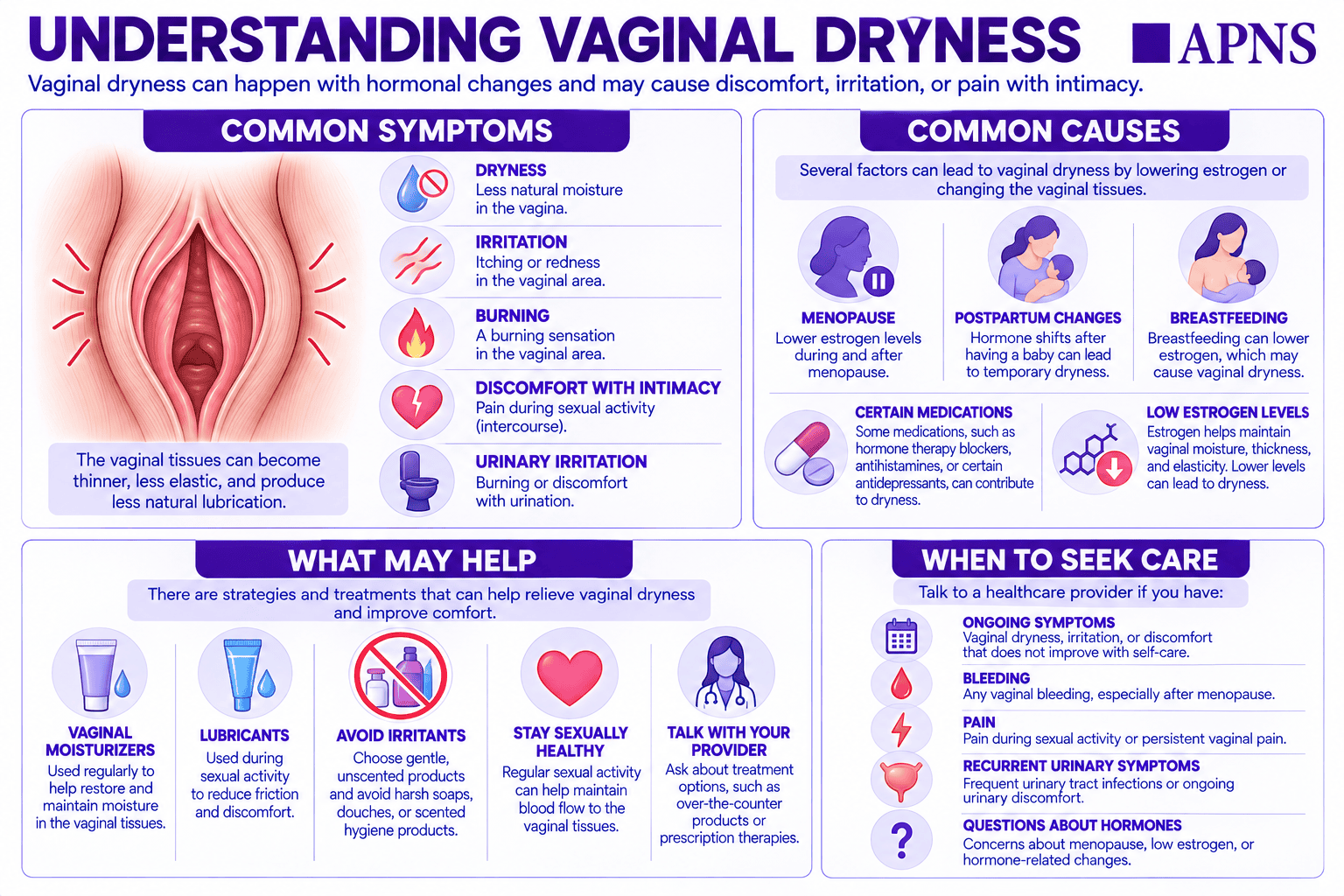
Possible causes include:
More than one cause may be present. Vaginal dryness is not a sign of poor hygiene and does not mean someone lacks interest in their partner.
Sexual Health Issues and Cancer Treatment – National Cancer Institute
https://www.cancer.gov/about-cancer/treatment/side-effects/sexuality-women
Explains how cancer and its treatments can affect vaginal tissue, comfort, sexual health, and treatment choices.
Drug-Free Treatments for Vaginal Dryness – NIH MedlinePlus
https://medlineplus.gov/ency/article/002142.htm
Reviews nonhormonal approaches and why the cause should be identified before self-treatment.
Symptoms may worsen with:
Repeated painful penetration can create more irritation and muscle guarding. It is reasonable to pause the painful activity while the cause is treated.
Not every cause can be prevented, but irritation and complications can be reduced by:
There is no required hygiene product or sexual activity that prevents dryness. Gentle care and early treatment are usually best.
Vaginal Dryness – NIH MedlinePlus
https://medlineplus.gov/ency/article/000892.htm
Explains low-estrogen vaginal changes, symptoms, evaluation, and treatment options.
Sex and Menopause: Treatment for Symptoms – National Institute on Aging
https://www.nia.nih.gov/health/menopause/sex-and-menopause-treatment-symptoms
Provides practical guidance about moisturizers, lubricants, vaginal estrogen, pain, and sexual health.
The following video content is provided to help you better understand this condition. These resources are intended for educational purposes and should not replace personalized medical advice from your healthcare provider.
No blood test is required for typical menopause-related dryness. Depending on symptoms, testing may include:
Do not repeatedly treat presumed yeast infection without testing when symptoms continue. Dryness and skin conditions can feel similar but require different treatment.
Most people do not need imaging. Additional testing may include:
Routine Pap or HPV screening does not diagnose vaginal dryness, but cervical screening should remain up to date according to age and history.
Vaginal Diseases – NIH MedlinePlus
https://medlineplus.gov/vaginaldiseases.html
Provides reliable information about vaginal pain, itching, discharge, bleeding, infection, and other conditions.
Treatment depends on the cause and whether symptoms are mainly vaginal, sexual, urinary, or part of broader menopause symptoms.
Start with the least invasive option that fits your symptoms and health history. Local therapy is often preferred when dryness is the only menopause symptom.
Sex and Menopause: Treatment for Symptoms – National Institute on Aging
https://www.nia.nih.gov/health/menopause/sex-and-menopause-treatment-symptoms
Provides practical guidance about moisturizers, lubricants, vaginal estrogen, pain, and sexual health.
Menopause – FDA
https://www.fda.gov/consumers/womens-health-topics/menopause
Reviews hormone and nonhormone treatments, FDA-approved products, safety, and when to seek care.
Daily steps can reduce irritation and improve comfort:
Sexual activity is optional; the vagina does not need penetration to stay healthy. Treatment should support comfort and personal goals, not pressure someone to have sex.
Sex and Menopause: Treatment for Symptoms – National Institute on Aging
https://www.nia.nih.gov/health/menopause/sex-and-menopause-treatment-symptoms
Provides practical guidance about moisturizers, lubricants, vaginal estrogen, pain, and sexual health.
Prescription options include:
People with breast, endometrial, or other hormone-sensitive cancer should begin with nonhormonal options and discuss persistent symptoms with their oncology and gynecology teams. Do not use another person’s hormone cream or compounded products without medical guidance.
Vaginal Estrogen – NIH MedlinePlus Drug Information
https://medlineplus.gov/druginfo/meds/a606005.html
Explains uses, dosing, precautions, interactions, side effects, and warning signs for vaginal estrogen.
Sexual Health Issues and Cancer Treatment – National Cancer Institute
https://www.cancer.gov/about-cancer/treatment/side-effects/sexuality-women
Explains how cancer and its treatments can affect vaginal tissue, comfort, sexual health, and treatment choices.
Hormone Replacement Therapy – NIH MedlinePlus
https://medlineplus.gov/hormonereplacementtherapy.html
Links to patient information about menopausal hormone therapy, benefits, risks, and vaginal symptoms.
Vaginal dryness usually does not require a procedure. Related procedures may include:
Ask what evidence supports a proposed procedure, whether it is FDA cleared for the claimed purpose, expected cost, risks, and what standard treatments have been tried.
Sexual Health Issues and Cancer Treatment – National Cancer Institute
https://www.cancer.gov/about-cancer/treatment/side-effects/sexuality-women
Explains how cancer and its treatments can affect vaginal tissue, comfort, sexual health, and treatment choices.
Moisturizers and lubricants help while they are used. Prescription local therapy often improves symptoms over several weeks, and continued treatment may be needed because low-estrogen changes can return when therapy stops.
Follow-up is based on symptoms, product, health history, and bleeding. Report new bleeding, breast changes, pelvic pain, discharge, sores, or treatment failure rather than increasing the dose independently.
Vaginal Dryness – NIH MedlinePlus
https://medlineplus.gov/ency/article/000892.htm
Explains low-estrogen vaginal changes, symptoms, evaluation, and treatment options.
Vaginal Estrogen – NIH MedlinePlus Drug Information
https://medlineplus.gov/druginfo/meds/a606005.html
Explains uses, dosing, precautions, interactions, side effects, and warning signs for vaginal estrogen.
For safer self-care:
Products labeled only for external use should not be inserted. “Natural” does not automatically mean safe for vaginal tissue.
Drug-Free Treatments for Vaginal Dryness – NIH MedlinePlus
https://medlineplus.gov/ency/article/002142.htm
Reviews nonhormonal approaches and why the cause should be identified before self-treatment.
Sex and Menopause: Treatment for Symptoms – National Institute on Aging
https://www.nia.nih.gov/health/menopause/sex-and-menopause-treatment-symptoms
Provides practical guidance about moisturizers, lubricants, vaginal estrogen, pain, and sexual health.
It is common, but you do not have to tolerate pain or urinary symptoms. Effective treatments are available.
No. Lubricant reduces friction during an activity; moisturizer is used regularly to improve day-to-day moisture.
Not necessarily. Hormones, medicines, health conditions, stress, pain, and relationship factors can affect lubrication independently of desire.
Usually not with standard low-dose local products, but the product, dose, uterus status, and bleeding history should be reviewed with a clinician.
Low-dose vaginal estrogen has much lower body-wide exposure than systemic therapy. Individual risks still need review, especially after hormone-sensitive cancer.
Low-estrogen vaginal and urinary changes can increase repeated urinary infection risk. Testing is needed because burning can also occur without infection.
No. Douching can irritate tissue and disrupt normal vaginal bacteria.
No. Comfortable sexual activity may support blood flow, but painful penetration can worsen irritation. No one should feel pressured to have sex as treatment.

Consider asking:
Primary care or gynecology can manage most cases. Referral may be made to:
Sexual Health Issues and Cancer Treatment – National Cancer Institute
https://www.cancer.gov/about-cancer/treatment/side-effects/sexuality-women
Explains how cancer and its treatments can affect vaginal tissue, comfort, sexual health, and treatment choices.
Vaginal Diseases – NIH MedlinePlus
https://medlineplus.gov/vaginaldiseases.html
Provides reliable information about vaginal pain, itching, discharge, bleeding, infection, and other conditions.
Vaginal dryness is often very treatable. When caused by a temporary factor such as breastfeeding, a medicine, or irritation, it may improve after the factor changes.
Menopause-related GSM is usually managed rather than permanently cured. Symptoms often return if treatment stops, but long-term local treatment may be appropriate after individualized review.
Vaginal Dryness – NIH MedlinePlus
https://medlineplus.gov/ency/article/000892.htm
Explains low-estrogen vaginal changes, symptoms, evaluation, and treatment options.
Sex and Menopause: Treatment for Symptoms – National Institute on Aging
https://www.nia.nih.gov/health/menopause/sex-and-menopause-treatment-symptoms
Provides practical guidance about moisturizers, lubricants, vaginal estrogen, pain, and sexual health.
Seek urgent or emergency care for:
Bleeding after menopause is not always an emergency, but it always needs prompt medical evaluation—even if it happens only once or seems related to dryness.
Menopause – FDA
https://www.fda.gov/consumers/womens-health-topics/menopause
Reviews hormone and nonhormone treatments, FDA-approved products, safety, and when to seek care.
Vaginal Diseases – NIH MedlinePlus
https://medlineplus.gov/vaginaldiseases.html
Provides reliable information about vaginal pain, itching, discharge, bleeding, infection, and other conditions.
CALL 911
APNS does not provide emergency medical services. If you believe you are experiencing a medical emergency, including (but not limited to) chest pain, difficulty breathing, stroke symptoms, severe allergic reactions, anaphylaxis, uncontrolled bleeding, seizures, loss of consciousness, or any other potentially life-threatening condition, you are instructed to call 911 immediately or go immediately to the nearest emergency department.
Vaginal Dryness – NIH MedlinePlus
https://medlineplus.gov/ency/article/000892.htm
Explains low-estrogen vaginal changes, symptoms, evaluation, and treatment options.
Drug-Free Treatments for Vaginal Dryness – NIH MedlinePlus
https://medlineplus.gov/ency/article/002142.htm
Reviews nonhormonal approaches and why the cause should be identified before self-treatment.
Sex and Menopause: Treatment for Symptoms – National Institute on Aging
https://www.nia.nih.gov/health/menopause/sex-and-menopause-treatment-symptoms
Provides practical guidance about moisturizers, lubricants, vaginal estrogen, pain, and sexual health.
What Is Menopause? – National Institute on Aging
https://www.nia.nih.gov/health/menopause/what-menopause
Explains menopause-related body changes, including vaginal dryness and painful sex.
Menopause – FDA
https://www.fda.gov/consumers/womens-health-topics/menopause
Reviews hormone and nonhormone treatments, FDA-approved products, safety, and when to seek care.
Vaginal Estrogen – NIH MedlinePlus Drug Information
https://medlineplus.gov/druginfo/meds/a606005.html
Explains uses, dosing, precautions, interactions, side effects, and warning signs for vaginal estrogen.
Vaginal Diseases – NIH MedlinePlus
https://medlineplus.gov/vaginaldiseases.html
Provides reliable information about vaginal pain, itching, discharge, bleeding, infection, and other conditions.
Sexual Health Issues and Cancer Treatment – National Cancer Institute
https://www.cancer.gov/about-cancer/treatment/side-effects/sexuality-women
Explains how cancer and its treatments can affect vaginal tissue, comfort, sexual health, and treatment choices.
Hormone Replacement Therapy – NIH MedlinePlus
https://medlineplus.gov/hormonereplacementtherapy.html
Links to patient information about menopausal hormone therapy, benefits, risks, and vaginal symptoms.
Aging Changes in the Reproductive System – NIH MedlinePlus
https://medlineplus.gov/ency/article/004016.htm
Describes how lower estrogen can make vaginal and vulvar tissues thinner, drier, and more easily irritated.
This guide is for education only and does not replace professional medical advice, examination, diagnosis, or treatment. Vaginal dryness can resemble infection, skin disease, urinary problems, or cancer. Seek urgent care for severe bleeding, pregnancy with one-sided pain or fainting, sudden severe pelvic pain, high fever, inability to urinate, serious injury, blood-clot or stroke symptoms, or a severe allergic reaction. Any bleeding after menopause needs prompt medical evaluation.
At APNS, our providers take the time to understand your condition and your goals. We offer comprehensive telehealth visits at a fixed rate — no membership fees, no insurance required, and no unexpected charges. Whether you’re newly diagnosed or looking for a provider who actually listens, we’re here to help.