

A vitamin deficiency occurs when your body does not get enough of one or more essential vitamins needed to function properly. Vitamins are nutrients that help your body produce energy, maintain healthy bones, support your immune system, form red blood cells, keep your nerves functioning properly, and perform many other important tasks.
Vitamin deficiencies can develop because of poor dietary intake, certain medical conditions that affect nutrient absorption, medications, increased nutritional needs, or other health conditions. The specific symptoms and treatment depend on which vitamin is deficient. Most vitamin deficiencies improve with dietary changes, vitamin supplements, or treatment of the underlying cause.
Common vitamin deficiencies include:
Vitamin Deficiency – NIH MedlinePlus
https://medlineplus.gov/vitamindeficiency.html
Provides easy-to-understand information about vitamin deficiencies, causes, symptoms, diagnosis, treatment, and prevention.
Office of Dietary Supplements (ODS) – National Institutes of Health
https://ods.od.nih.gov/
Provides evidence-based information about vitamins, minerals, dietary supplements, and recommended daily intake.
Vitamin deficiencies are common worldwide and can affect people of all ages. Some deficiencies, such as vitamin D deficiency, vitamin B12 deficiency, and iron deficiency, are among the most frequently diagnosed nutritional deficiencies in the United States.
Certain groups are at higher risk, including:
Office of Dietary Supplements (NIH)
https://ods.od.nih.gov/
Provides information about vitamin requirements, deficiency risks, and nutritional recommendations.
Symptoms depend on which vitamin is deficient and how severe the deficiency is.
Common symptoms may include:
Some deficiencies cause unique symptoms. For example:
Your healthcare provider will review your symptoms, medical history, dietary habits, medications, and perform a physical examination. Blood tests are commonly used to identify vitamin deficiencies and determine their severity.
Additional testing may be recommended to identify the underlying cause of the deficiency.
Vitamin Deficiency – NIH MedlinePlus
https://medlineplus.gov/vitamindeficiency.html
Explains how vitamin deficiencies are diagnosed and monitored.
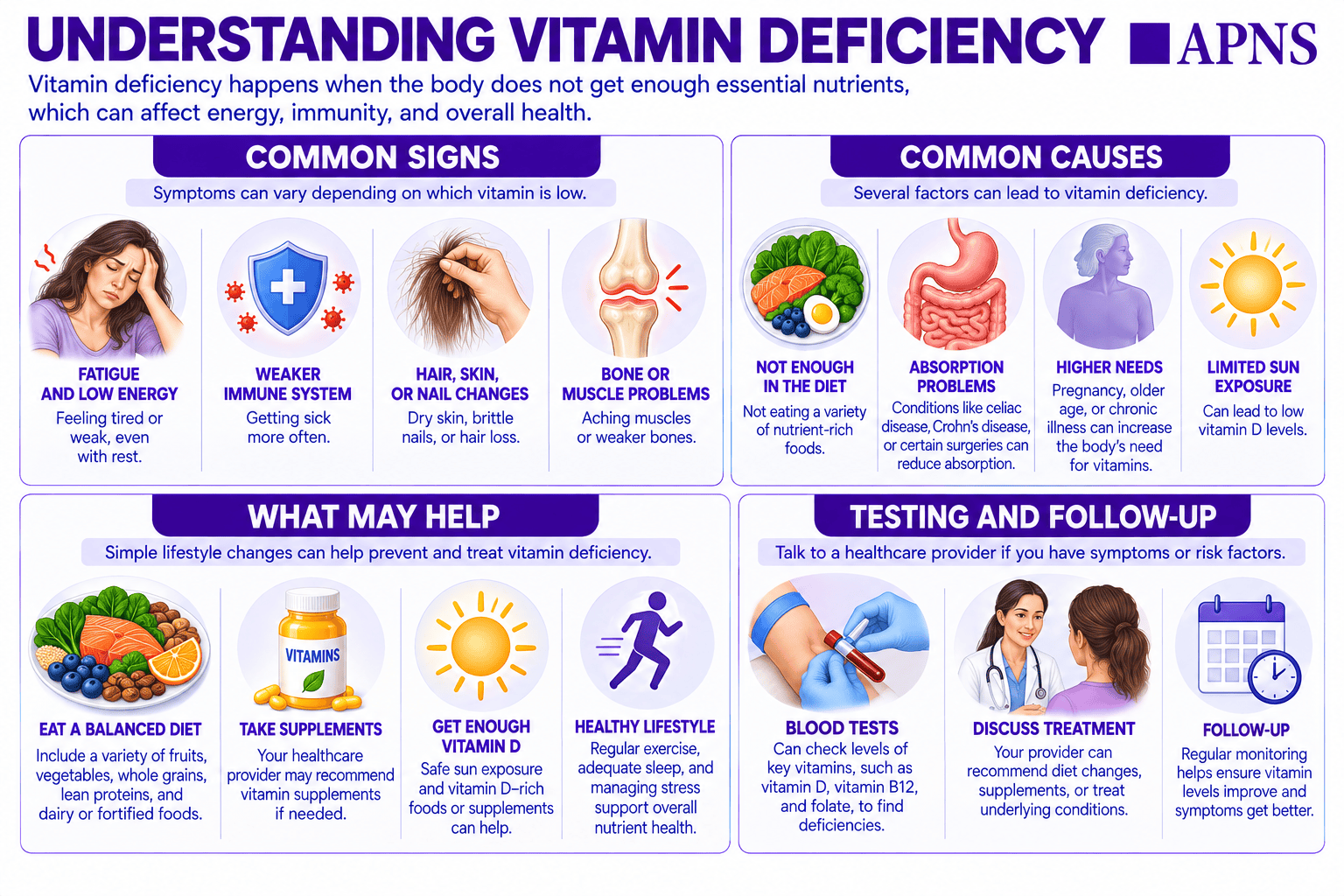
Vitamin deficiencies develop when the body does not receive enough vitamins or cannot absorb them properly.
Common causes include:
Office of Dietary Supplements (NIH)
https://ods.od.nih.gov/
Learn about the causes, risk factors, and prevention of vitamin deficiencies.
Several factors can worsen vitamin deficiencies or delay recovery.
Common factors include:
Vitamin Deficiency – NIH MedlinePlus
https://medlineplus.gov/vitamindeficiency.html
Provides practical information about managing vitamin deficiencies and reducing risk factors.
Many vitamin deficiencies can be prevented through healthy eating habits, regular healthcare visits, and early treatment of conditions that interfere with nutrient absorption.
Helpful prevention tips include:
Office of Dietary Supplements (National Institutes of Health)
https://ods.od.nih.gov/
Provides practical recommendations for preventing vitamin deficiencies and maintaining optimal nutrition.
The following video content is provided to help you better understand this condition. These resources are intended for educational purposes and should not replace personalized medical advice from your healthcare provider.
Laboratory testing depends on which vitamin deficiency is suspected.
Common laboratory tests may include:
Laboratory Tests – NIH MedlinePlus
https://medlineplus.gov/lab-tests/
Provides information about laboratory testing used to diagnose vitamin deficiencies.
Additional testing may be recommended if your healthcare provider suspects an underlying condition causing the deficiency.
Common diagnostic tests may include:
Office of Dietary Supplements (NIH)
https://ods.od.nih.gov/
Provides information about nutritional deficiencies and evaluation for underlying causes.
Treatment depends on which vitamin is deficient, the severity of the deficiency, and the underlying cause.
Treatment options may include:
Office of Dietary Supplements (NIH)
https://ods.od.nih.gov/
Provides evidence-based information about vitamin supplementation and treatment recommendations.
Healthy lifestyle habits can help prevent and treat vitamin deficiencies.
Helpful lifestyle changes include:
MyPlate – U.S. Department of Agriculture (USDA)
https://www.myplate.gov/
Provides practical guidance for building a healthy, nutrient-rich diet.
Treatment depends on the specific vitamin deficiency and its severity.
Common treatments may include:
Office of Dietary Supplements (NIH)
https://ods.od.nih.gov/
Provides information about vitamin supplements, recommended doses, and safe use.
Most vitamin deficiencies do not require surgery or invasive procedures. Treatment usually focuses on replacing the missing vitamin, improving nutrition, and treating the underlying cause. However, certain procedures or additional testing may be recommended if your healthcare provider suspects a condition affecting vitamin absorption or another medical problem.
Common procedures may include:
Office of Dietary Supplements (National Institutes of Health)
https://ods.od.nih.gov/
Learn about vitamin deficiencies, treatment options, and nutritional health.
Most vitamin deficiencies improve with appropriate treatment. Symptoms often begin to improve within weeks, although complete recovery may take several months depending on the severity of the deficiency and which vitamin is affected.
Some people require lifelong vitamin supplementation, particularly if they have conditions that affect nutrient absorption, have undergone bariatric surgery, or have chronic medical conditions.
Regular follow-up appointments and laboratory testing help ensure vitamin levels remain within a healthy range.
Daily healthy habits can help correct vitamin deficiencies and prevent them from returning.
Helpful tips include:
MyPlate – U.S. Department of Agriculture (USDA)
https://www.myplate.gov/
Provides practical nutrition guidance for maintaining a healthy, balanced diet.
Yes. Fatigue is one of the most common symptoms of several vitamin deficiencies, including vitamin D, vitamin B12, folate, and iron deficiency.
Many people can meet their vitamin needs by eating a balanced diet. Others may require supplements because of medical conditions, dietary restrictions, medications, or problems absorbing nutrients.
Recovery depends on the vitamin involved and how severe the deficiency is. Some symptoms improve within a few weeks, while others may take several months to fully resolve.
Continue taking supplements exactly as directed by your healthcare provider until they tell you it is safe to stop. Stopping treatment too early may cause the deficiency to return.
Yes. Some vitamins, especially fat-soluble vitamins such as vitamins A, D, E, and K, can become harmful if taken in excessive amounts. Always follow your healthcare provider’s recommendations.

Consider asking your healthcare provider:
Many vitamin deficiencies are managed by a primary care provider. Depending on the cause or severity of your deficiency, your provider may recommend seeing a specialist.
You may be referred to:
Office of Dietary Supplements (National Institutes of Health)
https://ods.od.nih.gov/
Provides evidence-based information about vitamins, nutrition, and dietary supplements.
Most vitamin deficiencies are treatable and often reversible, especially when identified early. Many people fully recover after replacing the missing vitamin and treating the underlying cause.
Some people require lifelong supplementation if they have chronic digestive diseases, certain autoimmune conditions, previous bariatric surgery, or other conditions that permanently affect vitamin absorption.
Most vitamin deficiencies do not cause medical emergencies. However, severe deficiencies or complications may require urgent evaluation.
Call 911 or seek emergency medical care immediately if you experience:
Seek prompt medical evaluation if you notice:
Vitamin Deficiency – NIH MedlinePlus
https://medlineplus.gov/vitamindeficiency.html
Learn about vitamin deficiencies, possible complications, and when medical evaluation is needed.
CALL 911
APNS does not provide emergency medical services. If you believe you are experiencing a medical emergency, including (but not limited to) chest pain, difficulty breathing, stroke symptoms, severe allergic reactions, anaphylaxis, uncontrolled bleeding, seizures, loss of consciousness, or any other potentially life-threatening condition, you are instructed to call 911 immediately or go immediately to the nearest emergency department.
Vitamin Deficiency – NIH MedlinePlus
https://medlineplus.gov/vitamindeficiency.html
Easy-to-understand information about vitamin deficiencies, including symptoms, diagnosis, treatment, and prevention.
Office of Dietary Supplements (National Institutes of Health)
https://ods.od.nih.gov/
Comprehensive evidence-based information about vitamins, minerals, dietary supplements, recommended intake, and nutritional health.
MyPlate – U.S. Department of Agriculture (USDA)
https://www.myplate.gov/
Provides nutrition guidance, healthy eating recommendations, and meal planning resources.
Academy of Nutrition and Dietetics
https://www.eatright.org/
Reliable patient education about healthy eating, nutrition, vitamins, and working with a registered dietitian.
This guide is intended for educational purposes only and should not replace medical advice, diagnosis, or treatment from your healthcare provider. Always follow the recommendations of your healthcare team regarding your individual health needs. Contact your healthcare provider if your symptoms worsen, new symptoms develop, or your vitamin levels do not improve with treatment. Call 911 immediately if you experience chest pain, difficulty breathing, severe confusion, seizures, loss of consciousness, or another medical emergency.
At APNS, our providers take the time to understand your condition and your goals. We offer comprehensive telehealth visits at a fixed rate — no membership fees, no insurance required, and no unexpected charges. Whether you’re newly diagnosed or looking for a provider who actually listens, we’re here to help.